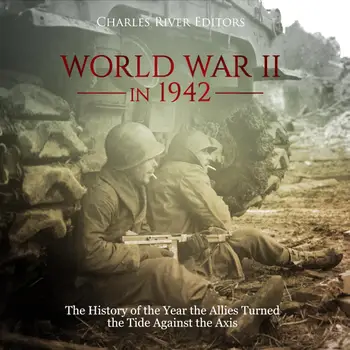
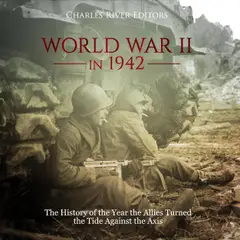
World War II in 1942: The History of the Year the Allies Turned the Tide Against the Axis

The United States began 1942 determined to avenge Pearl Harbor, but the Allies, now including the Soviet Union by necessity, did not agree on the war strategy. In 1941, both the Germans and British moved armies into North Africa, where Italy had already tried and failed to reach the Suez Canal. The British sought American help in North Africa, where British General Bernard Montgomery was fighting the legendary “Desert Fox,” General Erwin Rommel. At the same time, Stalin was desperate for Allied action on the European continent that could free up the pressure on the besieged Soviets.

President Roosevelt had a consequential decision to make, and he eventually decided to land American forces on North Africa to assist the British against Rommel, much to Stalin’s chagrin. While the Americans and British could merely harass the Germans with air power and naval forces in the Atlantic, Stalin’s Red Army had to take Hitler’s best shots in Russia throughout 1942. But the Red Army’s tenuous hold continued to cripple the Nazi war machine while buying the other Allies precious time.

Despite fighting in North Africa and the Atlantic, the United States still had the resources and manpower to fight the Japanese in the Pacific. Though the Japanese had crippled the American fleet at Pearl Harbor, its distance from Japan made an invasion of Pearl Harbor impossible, and Japan had not severely damaged important infrastructure. Thus, the United States was able to quickly rebuild a fleet, still stationed at Pearl Harbor right in the heart of the Pacific. This forward location allowed the United States to immediately push deeply into the Pacific theater. In fact, the turning point in the Pacific theater took place in 1942 near Midway Island. The Japanese had moved a sizable fleet intending to occupy Midway Island and draw the American navy near.

Starten Sie noch heute mit diesem Buch für 0 €

  • Hole dir während der Testphase vollen Zugriff auf alle Bücher in der App
  • Keine Verpflichtungen, jederzeit kündbar
Jetzt kostenlos testen
Mehr als 52 000 Menschen haben Nextory im App Store und auf Google Play 5 Sterne gegeben.

  1. Neu

    The Assassinated Presidents: The Lives and Deaths of Abraham Lincoln, James Garfield, William McKinley, and John F. Kennedy

    Charles River Editors

  2. Neu

    Göbekli Tepe and Derinkuyu: The History of Ancient Anatolia’s Most Unique Sites

    Charles River Editors

  3. Neu
    4.0

    The Ancient Indus Valley Civilization’s Biggest Cities: The History and Legacy of Mohenjo-daro, Harappa, and Kalibangan

    Charles River Editors

  4. Neu

    The Battle of Crécy: The History and Legacy of England’s Most Important Victory in the Hundred Years’ War

    Charles River Editors

  5. Neu

    The Colonies of British South Africa: The History and Legacy of British Imperialism in Modern South Africa and Zimbabwe

    Charles River Editors

  6. Neu

    Kalibangan: The History of the Indus Valley Civilization’s Provincial Capital in Ancient India

    Charles River Editors

  7. Neu

    Crécy and Agincourt: The History of the Hundred Years’ War’s Most Famous Battles

    Charles River Editors

  8. Neu

    The Race for Nuclear Weapons during World War II: The History and Legacy of Both Sides’ Efforts to Build an Atomic Bomb

    Charles River Editors

  9. Neu

    America’s Most Famous Disappearances

    Charles River Editors

  10. Neu
    3.0

    The Triassic Period: The History and Legacy of the Geologic Era that Witnessed the Rise of Dinosaurs

    Charles River Editors

  11. Neu

    South Africa and the British Empire: The History and Legacy of the Region Under Great Britain’s Control

    Charles River Editors

  12. Neu

    Joan Crawford and Bette Davis: The Lives and Careers of the Actresses Who Became Hollywood’s Most Famous Rivals

    Charles River Editors