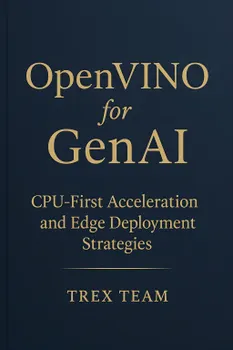
OpenVINO for GenAI : CPU‑First Acceleration and Edge Deployment Strategies

"OpenVINO for GenAI: CPU‑First Acceleration and Edge Deployment Strategies"

Generative AI at the edge is constrained less by hype than by latency budgets, memory ceilings, packaging friction, and hardware variability. This book is written for experienced ML engineers, systems practitioners, and platform architects who need GenAI systems that actually run outside idealized benchmark environments. Centering OpenVINO’s CPU-first execution model, it offers a pragmatic path to building local and edge deployments that are portable, debuggable, and operationally reliable.

Readers will learn how OpenVINO GenAI layers over OpenVINO Runtime, how to prepare and export models correctly, and how to engineer reproducible CPU baselines before tuning. The book then moves into the techniques that matter most in practice: compression and quantization, KV-cache management, speculative decoding, prefill optimization, continuous batching, prefix caching, and API design for streaming and concurrency. It also covers OpenVINO Model Server, graph-based pipeline composition, deployment packaging, target-system validation, and the disciplined use of GPUs and NPUs without sacrificing CPU portability.

Rather than treating acceleration as a collection of isolated tricks, the book presents it as a system design problem shaped by workload type, serving pattern, and platform constraints. A working knowledge of modern inference stacks, transformers, and deployment workflows is assumed. The result is a technically rigorous guide for turning OpenVINO into a production-grade foundation for GenAI on CPUs and


Sobre este libro

"OpenVINO for GenAI: CPU‑First Acceleration and Edge Deployment Strategies"

Generative AI at the edge is constrained less by hype than by latency budgets, memory ceilings, packaging friction, and hardware variability. This book is written for experienced ML engineers, systems practitioners, and platform architects who need GenAI systems that actually run outside idealized benchmark environments. Centering OpenVINO’s CPU-first execution model, it offers a pragmatic path to building local and edge deployments that are portable, debuggable, and operationally reliable.

Readers will learn how OpenVINO GenAI layers over OpenVINO Runtime, how to prepare and export models correctly, and how to engineer reproducible CPU baselines before tuning. The book then moves into the techniques that matter most in practice: compression and quantization, KV-cache management, speculative decoding, prefill optimization, continuous batching, prefix caching, and API design for streaming and concurrency. It also covers OpenVINO Model Server, graph-based pipeline composition, deployment packaging, target-system validation, and the disciplined use of GPUs and NPUs without sacrificing CPU portability.

Rather than treating acceleration as a collection of isolated tricks, the book presents it as a system design problem shaped by workload type, serving pattern, and platform constraints. A working knowledge of modern inference stacks, transformers, and deployment workflows is assumed. The result is a technically rigorous guide for turning OpenVINO into a production-grade foundation for GenAI on CPUs and

Empieza este libro hoy por 0 €

  • Disfruta de acceso completo a todos los libros de la app durante el periodo de prueba
  • Sin compromiso, cancela cuando quieras
Pruébalo gratis ahora
Más de 52 000 clientes han dado a Nextory 5 estrellas en la App Store y Google Play.