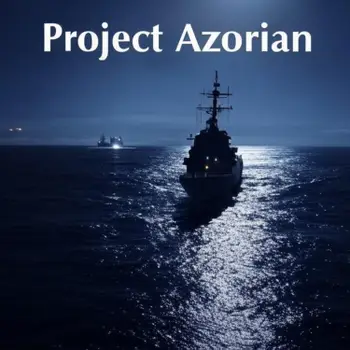
Project Azorian: The History of the CIA Operation to Recover a Sunken Soviet Submarine

Given that there’s such little margin for error in a submersible, many submarine losses remain sources of intrigue and mystery, and few rival the disappearance of the Soviet submarine K-129 in 1968. The Cold War was in high gear, and under the waters of the world’s oceans, Soviet and American submarines were in intense competition, pushing the boundaries of new technologies. Some of these submarines carried nuclear missiles that carried more destructive power than all the bombs dropped by the U.S. Army Air Force throughout World War II, including the nuclear bombs dropped on Hiroshima and Nagasaki. Other submarines, the hunter-killers, were designed to find and destroy these missile-carrying submarines. All of these submarines engaged in their activities while aiming to avoid detection by the other side, establishing a clandestine conflict that was carried out far from the gaze of the public but still strategically vital. If either side could gain a notable advantage, it could abruptly change the fragile balance of power.

Both sides lost submarines in the 1960s, but when the Soviets lost K-129 in 1968, it triggered one of the most interesting episodes of the Cold War, and something that reads like the plot of a techno-thriller. A race developed between the Americans and Soviets to locate the wreck, and when the Americans found it, they realized the submarine sunk in one of the deepest parts of the ocean, far beyond the depths at which conventional divers or submarines could operate. As a result, the CIA, aided by eccentric billionaire Howard Hughes, clandestinely began a lengthy and incredibly expensive project to build equipment that might allow them to recover and examine parts of the sunken submarine.

That operation, Project Azarian, is still controversial over 50 years later.
Sobre este libro

Given that there’s such little margin for error in a submersible, many submarine losses remain sources of intrigue and mystery, and few rival the disappearance of the Soviet submarine K-129 in 1968. The Cold War was in high gear, and under the waters of the world’s oceans, Soviet and American submarines were in intense competition, pushing the boundaries of new technologies. Some of these submarines carried nuclear missiles that carried more destructive power than all the bombs dropped by the U.S. Army Air Force throughout World War II, including the nuclear bombs dropped on Hiroshima and Nagasaki. Other submarines, the hunter-killers, were designed to find and destroy these missile-carrying submarines. All of these submarines engaged in their activities while aiming to avoid detection by the other side, establishing a clandestine conflict that was carried out far from the gaze of the public but still strategically vital. If either side could gain a notable advantage, it could abruptly change the fragile balance of power.

Both sides lost submarines in the 1960s, but when the Soviets lost K-129 in 1968, it triggered one of the most interesting episodes of the Cold War, and something that reads like the plot of a techno-thriller. A race developed between the Americans and Soviets to locate the wreck, and when the Americans found it, they realized the submarine sunk in one of the deepest parts of the ocean, far beyond the depths at which conventional divers or submarines could operate. As a result, the CIA, aided by eccentric billionaire Howard Hughes, clandestinely began a lengthy and incredibly expensive project to build equipment that might allow them to recover and examine parts of the sunken submarine.

That operation, Project Azarian, is still controversial over 50 years later.
Empieza este libro hoy por 0 €

  • Disfruta de acceso completo a todos los libros de la app durante el periodo de prueba
  • Sin compromiso, cancela cuando quieras
Pruébalo gratis ahora
Más de 52 000 clientes han dado a Nextory 5 estrellas en la App Store y Google Play.

  1. The Library of Alexandria and the Library of Pergamon: The History of the Most Important Libraries in Antiquity

    Charles River Editors

  2. Los vándalos: la historia y legado de los bárbaros más famosos de la Antigüedad

    Charles River Editors

  3. The Making of Modern China: The History of the World’s Most Populous Country from the Qing Dynasty to Today

    Charles River Editors

  4. El robo nazi de arte: La historia de la confiscación y destrucción de obras de arte europeas por parte de Alemania durante la Segunda Guerra Mundial

    Charles River Editors

  5. La República de Venecia: La historia del imperio veneciano y su influencia a lo largo del Mediterráneo

    Charles River Editors

  6. Tupac Amaru II: The Life and Legacy of the Peruvian Leader Who Rebelled against the Spanish Empire

    Charles River Editors

  7. 4.0

    The Delhi Sultanate: The History and Legacy of the Medieval Islamic Dynasty in India

    Charles River Editors

  8. Operation Mockingbird: The Controversial History of the CIA’s Efforts to Manipulate American Media Outlets

    Charles River Editors

  9. La Guerra Civil española: La historia y el legado del controversial conflicto que estableció la dictadura de Francisco Franco en España

    Charles River Editors

  10. Las pirámides de Egipto: los orígenes y la historia de los monumentos más famosos del mundo

    Charles River Editors

  11. Hispania romana: La historia de la conquista de España y la península ibérica por la antigua Roma

    Charles River Editors

  12. Eleanor of Aquitaine and Richard the Lionheart: The History of the Mother and Son Who Shaped Medieval Europe

    Charles River Editors