Over dit boek

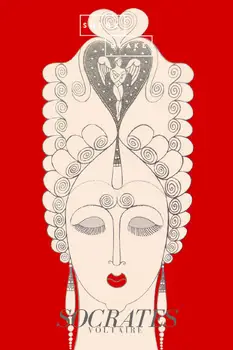
Socrates is a 1759 French play in three acts written by Voltaire. It is set in Ancient Greece during the events just before the trial and death of Greek philosopher Socrates. It is heavy with satire specifically at government authority and organized religion. The main characters besides the titular role is that of the priest Anitus, his entourage, Socrates' wife Xantippe, several judges, and some children Socrates has adopted as his own. Like more historical accounts by Herodotus, Plato, and Xenophon, the playwright shows Socrates as a moral individual charged with baseless accusations by a conspiracy of corrupt Athenians or Athenian officials although Voltaire implies that the wrongdoers are a select few. Unlike the historical account, Socrates deals with several judges, whereas his real life counterpart receives his punishment of death by hemlock by a jury of 500 Athenians. The presence or mention of Socrates' best-known students such as Plato, Antisthenes, Zeno of Citium, and others are replaced by unnamed disciples, delivering only a few token lines at the end of the play. Socrates is also portrayed as a monotheist and a victim of religious persecution, an interpretation that is not generally shared by modern scholars and historians. Generally, this is not the most well-known of his works in comparison with Letters on the English which Voltaire published in 1778 or the Dictionnaire philosophique published earlier in 1764. However, hints of his contempt for government and religion are apparent here which later influenced the leaders of the American Revolution and the French Revolution.
Begin vandaag nog met dit boek voor € 0

  • Krijg volledige toegang tot alle boeken in de app tijdens de proefperiode
  • Geen verplichtingen, op elk moment annuleren
Probeer nu gratis
Meer dan 52.000 mensen hebben Nextory 5 sterren gegeven in de App store en op Google Play.

Meer van Voltaire

  1. Nieuw
    3.5

    Candide : Of het optimisme

    Voltaire

  2. 4.3

    Candide

    Voltaire

  3. 4.0

    3500 Final Quotes

    Marcus Aurelius, Jane Austen, Beaumarchais, Napoleon Bonaparte, Buddha, Winston Churchill, Cicero, Confucius, Nicolas de Chamfort, Charles de Gaulle, Antoine de Saint-Exupéry, Denis Diderot, Fyodor Dostoevsky, Albert Einstein, Ralph Waldo Emerson, Anne Frank, Mahatma Gandhi, Immanuel Kant, Søren Kierkegaard, Martin Luther King, Georg Christoph Lichtenberg, Abraham Lincoln, Montesquieu, Friedrich Nietzsche, Plato, Marcel Proust, Arthur Schopenhauer, William Shakespeare, Socrates, Baruch Spinoza, Henry David Thoreau, Leonardo da Vinci, Voltaire, Oscar Wilde, Laozi

  4. 33 Human Science Masterpieces You Must Read Before You Die. Illustrated : The Art of Public Speaking, The Meditations, The Kama Sutra and other masterpieces

    Edwin A. Abbott, Aristotle, Dale Carnegie, Gilbert Chesterton, René Descartes, Epictetus, Marcus Aurelius Antoninus, Sigmund Freud, Hermann Hesse, David Hume, Lao Tzu, Confucius, Swami Abhedananda, Anonimous, David Herbert Lawrence, Niccolò Machiavelli, Benedictus de Spinoza, John Mill, Prentice Mulford, Thomas More, Friedrich Nietzsche, J. Allanson Picton, Plato, Sun Tzu, Vatsyayana, Voltaire, H.G. Wells, Frances Bacon

  5. Nieuw
    4.1

    Candide

    Voltaire

  6. Candide and Zadig : Two Philosophical Tales

    Voltaire

  7. Candide and Zadig : Two Philosophical Tales

    Voltaire

  8. A Voltaire Triptych : Plato's Dream, Micromegas, and Candide

    Voltaire

  9. Political Philosophy Collection: Common Sense, Candide, Anthem, and The Communist Manifesto

    Thomas Paine, Voltaire, Ayn Rand, Friedrich Engels, Karl Marx

  10. 4.1

    Candide

    Voltaire

  11. 4.1

    Candide

    Voltaire

  12. Zadig

    Voltaire