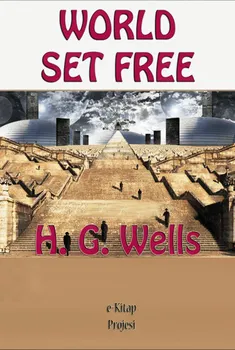
The World Set Free

THE WORLD SET FREE was written in 1913 and published early in 1914, and it is the latest of a series of three fantasias of possibility, stories which all turn on the possible developments in the future of some contemporary force or group of forces. The World Set Free was written under the immediate shadow of the Great War. Every intelligent person in the world felt that disaster was impending and knew no way of averting it, but few of us realised in the earlier half of 1914 how near the crash was to us. The reader will be amused to find that here it is put off until the year 1956. He may naturally want to know the reason for what will seem now a quite extraordinary delay. As a prophet, the author must confess he has always been inclined to be rather a slow prophet.

The war aeroplane in the world of reality, for example, beat the forecast in Anticipations by about twenty years or so. I suppose a desire not to shock the sceptical reader's sense of use and wont and perhaps a less creditable disposition to hedge, have something to do with this dating forward of one's main events, but in the particular case of The World Set Free there was, I think, another motive in holding the Great War back, and that was to allow the chemist to get well forward with his discovery of the release of atomic energy. 1956—or for that matter 2056—may be none too late for that crowning revolution in human potentialities. And apart from this procrastination of over forty years, the guess at the opening phase of the war was fairly lucky; the forecast of an alliance of the Central Empires, the opening campaign through the Netherlands, and the despatch of the British Expeditionary Force were all justified before the book had been published six months. And the opening section of Chapter the Second remains now, after the reality has happened, a fairly adequate diagnosis of the essentials of the matter. One happy hit (in Chapter the Second, Section 2), on which the writer may congratulate himself, is the forecast that under modern conditions it would be quite impossible for any great general to emerge to supremacy and concentrate the enthusiasm of the armies of either side.

There could be no Alexanders or Napoleons. And we soon heard the scientific corps muttering, 'These old fools,' exactly as it is here foretold.

These, however, are small details, and the misses in the story far outnumber the hits. It is the main thesis which is still of interest now; the thesis that because of the development of scientific knowledge, separate sovereign states and separate sovereign empires are no longer possible in the world, that to attempt to keep on with the old system is to heap disaster upon disaster for mankind and perhaps to destroy our race altogether. The remaining interest of this book now is the sustained validity of this thesis and the discussion of the possible ending of war on the earth.
Over dit boek

THE WORLD SET FREE was written in 1913 and published early in 1914, and it is the latest of a series of three fantasias of possibility, stories which all turn on the possible developments in the future of some contemporary force or group of forces. The World Set Free was written under the immediate shadow of the Great War. Every intelligent person in the world felt that disaster was impending and knew no way of averting it, but few of us realised in the earlier half of 1914 how near the crash was to us. The reader will be amused to find that here it is put off until the year 1956. He may naturally want to know the reason for what will seem now a quite extraordinary delay. As a prophet, the author must confess he has always been inclined to be rather a slow prophet.

The war aeroplane in the world of reality, for example, beat the forecast in Anticipations by about twenty years or so. I suppose a desire not to shock the sceptical reader's sense of use and wont and perhaps a less creditable disposition to hedge, have something to do with this dating forward of one's main events, but in the particular case of The World Set Free there was, I think, another motive in holding the Great War back, and that was to allow the chemist to get well forward with his discovery of the release of atomic energy. 1956—or for that matter 2056—may be none too late for that crowning revolution in human potentialities. And apart from this procrastination of over forty years, the guess at the opening phase of the war was fairly lucky; the forecast of an alliance of the Central Empires, the opening campaign through the Netherlands, and the despatch of the British Expeditionary Force were all justified before the book had been published six months. And the opening section of Chapter the Second remains now, after the reality has happened, a fairly adequate diagnosis of the essentials of the matter. One happy hit (in Chapter the Second, Section 2), on which the writer may congratulate himself, is the forecast that under modern conditions it would be quite impossible for any great general to emerge to supremacy and concentrate the enthusiasm of the armies of either side.

There could be no Alexanders or Napoleons. And we soon heard the scientific corps muttering, 'These old fools,' exactly as it is here foretold.

These, however, are small details, and the misses in the story far outnumber the hits. It is the main thesis which is still of interest now; the thesis that because of the development of scientific knowledge, separate sovereign states and separate sovereign empires are no longer possible in the world, that to attempt to keep on with the old system is to heap disaster upon disaster for mankind and perhaps to destroy our race altogether. The remaining interest of this book now is the sustained validity of this thesis and the discussion of the possible ending of war on the earth.

Begin vandaag nog met dit boek voor € 0

  • Krijg volledige toegang tot alle boeken in de app tijdens de proefperiode
  • Geen verplichtingen, op elk moment annuleren
Probeer nu gratis
Meer dan 52.000 mensen hebben Nextory 5 sterren gegeven in de App store en op Google Play.

  1. The Essential Classics Collection : 1984; Great Expectations; The Brothers Karamazov; Pride and Prejudice; & The War of the Worlds

    George Orwell, Fyodor Dostoyevsky, Charles Dickens, Jane Austen, H.G. Wells

  2. 11 Tales of the Unknown Before Lovecraft : Early Science Fiction, Weird Tales & Speculative Fiction

    Algernon Blackwood, William Hope Hodgson, E. M. Forster, Ambrose Bierce, Jack London, H.G. Wells, Arthur Machen, Nathaniel Hawthorne

  3. Classic Golden Age Science Fiction Short Stories

    Kurt Vonnegut, Ray Bradbury, Philip K Dick, Robert Sheckley, Murray Leinster, H.G. Wells

  4. 4.0

    The Pioneers of Science Fiction

    Kurt Vonnegut, Ray Bradbury, Philip K Dick, Robert Sheckley, Murray Leinster, H.G. Wells

  5. 50 Vintage Sci-Fi Short Stories 8

    Edgar Allan Poe, Robert Silverberg, Jack London, Arthur C. Clarke, Katherine MacLean, Clyde Beck, Clifford D. Simak, Mack Reynolds, Donald E. Westlake, Harlan Ellison, H.P. Lovecraft, H.G. Wells, Nelson S. Bond, Alfred Coppel, William Tenn, Lyn Venable, Robert Moore Williams, Francis Stevens, Miriam Allen deFord, Robert Sheckley, Harry Harrison, Fritz Leiber, Noel Loomis, Charles Dye, Alfred Bester, Henry Kuttner, Michael Shaara, Zenna Henderson, Isaac Asimov, Clark Ashton Smith, Donald A. Wollheim, Randall Garrett, Philip K Dick, Winston Marks, Frank Belknap Long, G. Peyton Wertenbaker, James Rosenquest, Raymond Z. Gallun, Harl Vincent, Edward Page Mitchell

  6. 50 Vintage Sci-Fi Short Stories 4 - More than 29 hours of Vintage Science Fiction : From Mary Shelley to Philip K. Dick — 29 Hours of Sci-Fi That Shaped the Future

    William F. Nolan, Robert Zacks, Isaac Asimov, Ray Bradbury, Mary Shelley, Mack Reynolds, Edward Halibut, Leigh Brackett, Robert F. Young, Fredric Brown, Robert Silverberg, Jack Williamson, William Hope Hodgson, Evelyn E. Smith, Gordon R. Dickson, Theodore Sturgeon, Clifford D. Simak, Arthur C. Clarke, Robert A. Heinlein, August Derleth, Lawrence M. Jannifer, Ambrose Bierce, Henry Kuttner, Allen K. Lang, Carl W. Ganzlin, H.G. Wells, Margaret St. Clair, Carl Jacobi, Philip K Dick, Andre Norton, Murray Leinster, Ross Rocklynne, Harry Harrison, Frank M. Robinson, Alfred Coppel, Lynn Venable

  7. The Complete Novels of H. G. Wells

    H.G. Wells

  8. The Invisible Man

    H.G. Wells

  9. The Book of Shadows Vol II : Supernatural Horror & Occult Fiction – A Chilling Anthology of Witchcraft, Curses, and Dark Forces

    Bram Stoker, Robert W. Chambers, H.G. Wells, W. W. Jacobs, Mary Eleanor Wilkins Freeman, Arthur Machen, Mary Webb, John Buchan, W. F. Harvey, Hugh Walpole

  10. The Book of Shadows Vol 2 : A Supernatural Horror Anthology of Curses, Hauntings, Folk Horror, and Occult Dread

    Bram Stoker, H.G. Wells, Robert W. Chambers, William Wymark Jacobs, Mary Eleanor Wilkins Freeman, Arthur Machen, Mary Webb

  11. In the Days of the Comet : H.G. Wells' Sci-Fi Classic of Cosmic Change & Human Transformation

    H.G. Wells

  12. World's Greatest Short Stories

    Daniel Defoe, Benjamin Franklin, Washington Irving, Mateo Falcone, Charlotte Bronte, Mary Shelley, Nathaniel Hawthorne, Nikolai Gogol, Edgar Allan Poe, Fyodor Dostoyevsky, Charles Dickens, Herman Melville, Mark Twain, Guy De Maupassant, Oscar Wilde, Leo Tolstoy, H.G. Wells, Ambrose Bierce, Stephen Crane, Kate Chopin, Jack London, E. M. Forster


Gerelateerde categorieën