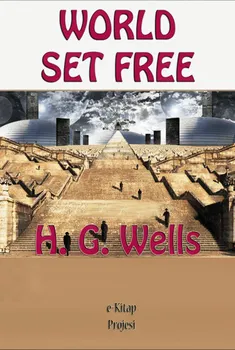
The World Set Free

THE WORLD SET FREE was written in 1913 and published early in 1914, and it is the latest of a series of three fantasias of possibility, stories which all turn on the possible developments in the future of some contemporary force or group of forces. The World Set Free was written under the immediate shadow of the Great War. Every intelligent person in the world felt that disaster was impending and knew no way of averting it, but few of us realised in the earlier half of 1914 how near the crash was to us. The reader will be amused to find that here it is put off until the year 1956. He may naturally want to know the reason for what will seem now a quite extraordinary delay. As a prophet, the author must confess he has always been inclined to be rather a slow prophet.

The war aeroplane in the world of reality, for example, beat the forecast in Anticipations by about twenty years or so. I suppose a desire not to shock the sceptical reader's sense of use and wont and perhaps a less creditable disposition to hedge, have something to do with this dating forward of one's main events, but in the particular case of The World Set Free there was, I think, another motive in holding the Great War back, and that was to allow the chemist to get well forward with his discovery of the release of atomic energy. 1956—or for that matter 2056—may be none too late for that crowning revolution in human potentialities. And apart from this procrastination of over forty years, the guess at the opening phase of the war was fairly lucky; the forecast of an alliance of the Central Empires, the opening campaign through the Netherlands, and the despatch of the British Expeditionary Force were all justified before the book had been published six months. And the opening section of Chapter the Second remains now, after the reality has happened, a fairly adequate diagnosis of the essentials of the matter. One happy hit (in Chapter the Second, Section 2), on which the writer may congratulate himself, is the forecast that under modern conditions it would be quite impossible for any great general to emerge to supremacy and concentrate the enthusiasm of the armies of either side.

There could be no Alexanders or Napoleons. And we soon heard the scientific corps muttering, 'These old fools,' exactly as it is here foretold.

These, however, are small details, and the misses in the story far outnumber the hits. It is the main thesis which is still of interest now; the thesis that because of the development of scientific knowledge, separate sovereign states and separate sovereign empires are no longer possible in the world, that to attempt to keep on with the old system is to heap disaster upon disaster for mankind and perhaps to destroy our race altogether. The remaining interest of this book now is the sustained validity of this thesis and the discussion of the possible ending of war on the earth.

Om denne boken

THE WORLD SET FREE was written in 1913 and published early in 1914, and it is the latest of a series of three fantasias of possibility, stories which all turn on the possible developments in the future of some contemporary force or group of forces. The World Set Free was written under the immediate shadow of the Great War. Every intelligent person in the world felt that disaster was impending and knew no way of averting it, but few of us realised in the earlier half of 1914 how near the crash was to us. The reader will be amused to find that here it is put off until the year 1956. He may naturally want to know the reason for what will seem now a quite extraordinary delay. As a prophet, the author must confess he has always been inclined to be rather a slow prophet.

The war aeroplane in the world of reality, for example, beat the forecast in Anticipations by about twenty years or so. I suppose a desire not to shock the sceptical reader's sense of use and wont and perhaps a less creditable disposition to hedge, have something to do with this dating forward of one's main events, but in the particular case of The World Set Free there was, I think, another motive in holding the Great War back, and that was to allow the chemist to get well forward with his discovery of the release of atomic energy. 1956—or for that matter 2056—may be none too late for that crowning revolution in human potentialities. And apart from this procrastination of over forty years, the guess at the opening phase of the war was fairly lucky; the forecast of an alliance of the Central Empires, the opening campaign through the Netherlands, and the despatch of the British Expeditionary Force were all justified before the book had been published six months. And the opening section of Chapter the Second remains now, after the reality has happened, a fairly adequate diagnosis of the essentials of the matter. One happy hit (in Chapter the Second, Section 2), on which the writer may congratulate himself, is the forecast that under modern conditions it would be quite impossible for any great general to emerge to supremacy and concentrate the enthusiasm of the armies of either side.

There could be no Alexanders or Napoleons. And we soon heard the scientific corps muttering, 'These old fools,' exactly as it is here foretold.

These, however, are small details, and the misses in the story far outnumber the hits. It is the main thesis which is still of interest now; the thesis that because of the development of scientific knowledge, separate sovereign states and separate sovereign empires are no longer possible in the world, that to attempt to keep on with the old system is to heap disaster upon disaster for mankind and perhaps to destroy our race altogether. The remaining interest of this book now is the sustained validity of this thesis and the discussion of the possible ending of war on the earth.
Kom i gang med denne boken i dag for 0 kr

  • Få full tilgang til alle bøkene i appen i prøveperioden
  • Ingen forpliktelser, si opp når du vil
Prøv gratis nå
Mer enn 52 000 personer har gitt Nextory 5 stjerner på App Store og Google Play.

  1. 3.7
    #55

    The War of the Worlds

    H.G. Wells

  2. 50 Masterpieces you have to read before you die

    Frances Hodgson Burnett, Homer, Charles Dickens, Lyman Frank Baum, Nathaniel Hawthorne, Thomas Hardy, Robert Louis Stevenson, Henry Haggard, Wilkie Collins, H.G. Wells, Sir Walter Scott, Lucy Maud Montgomery, Louisa May Alcott, Henry Fielding, Mary Shelley, Arthur Conan Doyle, Leo Tolstoy, Euripides, Fyodor Dostoevsky, Alexander Pushkin, James Fenimore Cooper, Daniel Defoe, Joseph Conrad, Jonathan Swift, William Shakespeare, Oscar Wilde, John Bunyan, Charles Darwin, Alfred Tennyson, Bram Stoker, James Joyce, Dante Alighieri, Howard Pyle, Jane Austen, Emily Bronte, Giovanni Boccaccio, Rudyard Kipling

  3. 3.9

    Klodenes kamp

    H.G. Wells

  4. #33

    Men Like Gods by H. G. Wells (Illustrated)

    H.G. Wells

  5. 3.8

    Tidsmaskinen

    H.G. Wells

  6. 4.0

    The Pioneers of Science Fiction

    Kurt Vonnegut, Ray Bradbury, Philip K Dick, Robert Sheckley, Murray Leinster, H.G. Wells

  7. 3.0

    50 Masterpieces you have to read before you die vol: 1 (2020 Edition) : Included: Little Women, The Richest Man in Babylon Emma, The Call Of The Wild ....

    Louisa May Alcott, Dante Alighieri, Marcus Aurelius, Jane Austen, L. Frank Baum, Charlotte Brontë, Emily Brontë, Anne Brontë, Miguel de Cervantes, Agatha Christie, George S. Clason, Arthur Conan Doyle, Joseph Conrad, Charles Dickens, Fyodor Dostoyevsky, Alexandre Dumas, George Eliot, G.K. Chesterton, G.K. Chesterton, Zane Grey, Nathaniel Hawthorne, Napoleon Hill, Homer, Victor Hugo, Frances Hodgson Burnett, Washington Irving, Henry James, Franz Kafka, Rudyard Kipling, Jack London, Leo Tolstoy, H.P. Lovecraft, Lucy Maud Montgomery, Joseph Murphy, Robert Louis Stevenson, Edgar Allan Poe, Marcel Proust, Publius, Mary Shelley, Bram Stoker, Mark Twain, Sun Tzu, Lew Wallace, Wallace D. Wattles, H.G. Wells

  8. Tellers of Tales 200 Years of Timeless Stories : Featuring Charlotte Bronte, Ambrose Bierce, W.B. Yates and Many Others. Narrated by Kennedy Center Award Winning Actor Dennis Edward Delaney.

    Charlotte Bronte, Ambrose Bierce, W.B. Yates, Saki, Evelyn Everett, Carl Stephensen, Mark Twain, Prosper Merimee, Anna Katherine Green, David Earl DeWitt, O.Henry, Agatha Christie, Harriet H. Jacobs, H.G. Wells, Arthur Conan Doyle, Richard Middleton, Hans Christian Anderson, Rudyard Kipling, Edgar Allan Poe, W. Jacobs, Mary Shelley, Bret Harte, G.K. Chesterton, George G. Toudouze, Dennis Edward Delaney

  9. Mars and Martians and Nothing But Mars and Martians 3 : Pioneers, Aliens, and Ancient Secrets on the Red Planet

    Ray Bradbury, H.G. Wells, Robert Silverberg, Fritz Leiber, Harry Harrison, Henry Kuttner, Frank Belknap Long, James Blish, Robert Sheckley, Raymond Z. Gallun, Basil Wells, Stephen Bartholomew, James R. Adams, Arthur Jean Cox, Lucius Daniel, Richard R. Smith, Alan J. Ramm, Joe Gibson

  10. The Masters of Science Fiction Short Stories

    Frank Herbert, H.G. Wells, Philip K Dick, Ray Bradbury, Jules Verne, Murray Leinster, Robert Sheckley

  11. 50 Vintage Sci-Fi Short Stories 10 : A Treasure Chest of Classic Science Fiction Short Stories

    Arthur C. Clarke, H.G. Wells, H.P. Lovecraft, Mary Shelley, Robert Silverberg, Robert Bloch, Harry Harrison, Fritz Leiber, Alfred Bester, A. E. van Vogt, Brian W. Aldiss, Robert E. Howard, Henry Kuttner, Clark Ashton Smith, Frank Belknap Long, Edward Page Mitchell, Jack Williamson, Tom Godwin, Robert Sheckley, Michael Shaara, Francis Stevens, A.H. Gibson, Gene L. Henderson, H. F. Arnold, Richard R. Smith, Frank M. Robinson, Manly Wade Wellman, William Bender, Thomas S. Gardiner, James Bell, Beta McGavin, Alfred Connable, Jack Sharkey, Ron Goulart, Victoria Lincoln, Nelson S. Bond, Ray Cummings, Morton Klass, Elisabeth R. Lewis, John W. Campbell, James Blish, Roger D. Aycock

  12. The Essential Classics Collection : 1984; Great Expectations; The Brothers Karamazov; Pride and Prejudice; & The War of the Worlds

    George Orwell, Fyodor Dostoyevsky, Charles Dickens, Jane Austen, H.G. Wells