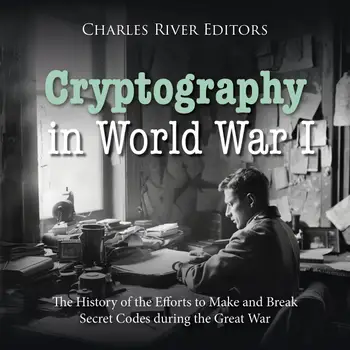
Cryptography in World War I: The History of the Efforts to Make and Break Secret Codes during the Great War

World War I was the first major conflict in which new electronic means of transmitting and receiving messages became a major factor in political and military operations. The electric telegraph was developed in the first half of the 19th century, and by 1850, there were several telegraph companies around the world providing a service that allowed virtually instantaneous communication over long distances. This was a major breakthrough, but the telegraph depended on the availability of wires to transmit messages between stations, meaning that if these wires were broken or damaged, communications were cut off.

Late in the 19th century, there was another new development, the telephone, though this too relied on wires to transmit and receive information. At the same time, there was a new invention that provided instant voice and Morse code communication over long distances that did not require wires. Initially called wireless, radio was quickly adopted by armies around the world as a way of providing rapid communication between military units. By the time World War I began in 1914, all the major nations involved had provided their forces with some form of radio equipment.

Of course, this came with a fundamental problem: radio, telephone, and telegraph messages could be intercepted by the enemy, potentially giving them notice of impending operations. To protect these electronic messages from being read by the enemy, armies began to use codes and ciphers to disguise the meaning of messages. Teams were created to devise effective codes and ciphers, and these were quickly followed by other teams whose role was to attempt to break the codes and ciphers used by the other side. As a result, a secret war began, almost completely hidden from public view, as the belligerents devised complex ways of hiding the real meaning of their own messages while simultaneously attempting to understand those of the enemy.

Starte noch heute mit diesem Buch für 0 €

  • Hole dir während der Testphase vollen Zugriff auf alle Bücher in der App
  • Keine Verpflichtungen, jederzeit kündbar
Jetzt kostenlos testen
Mehr als 52 000 Menschen haben Nextory im App Store und auf Google Play 5 Sterne gegeben.

  1. 1.0

    Die Panzer: Die Geschichte und das Vermächtnis von Nazideutschlands berühmtesten Panzern des Zweiten Weltkriegs

    Charles River Editors

  2. The Christianization of Rome: The History of the Roman Empire’s Religious Conversion

    Charles River Editors

  3. Kublai Khan and Marco Polo: The History of a Unique Partnership at the Court of the Mongol Empire

    Charles River Editors

  4. Dr. Mary Edwards Walker: The Life and Legacy of the Civil Rights Activist Who Became the Only Woman to Receive the Medal of Honor

    Charles River Editors

  5. The Making of Modern China: The History of the World’s Most Populous Country from the Qing Dynasty to Today

    Charles River Editors

  6. 2.0

    Göbekli Tepe: The History and Mystery of One of the World’s Oldest Neolithic Sites

    Charles River Editors

  7. Chiang Kai-Shek: The Life and Legacy of the Republic of China’s Revolutionary Leader

    Charles River Editors

  8. 5.0

    Cochise and Geronimo: The Lives and Legacies of the Most Famous Apache Warriors

    Charles River Editors

  9. J. Edgar Hoover and Allen Dulles: The History of 20th Century America’s Most Controversial FBI and CIA Directors

    Charles River Editors

  10. The Texas Revolution and Mexican-American War: The History and Legacy of the Conflicts that Led to Mexico’s Cession of the American Southwest

    Charles River Editors

  11. Das mittelalterliche Russland: Die Geschichte und das Erbe der Gruppen, die den russischen Staat im Mittelalter entwickelten

    Charles River Editors

  12. The Moors of Andalusia: The History of the Muslims in the Iberian Peninsula during the Middle Ages

    Charles River Editors