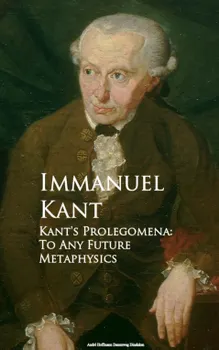
Kant's Prolegomena : To Any Future Metaphysics

KANT'S Prolegomena, although a small book, is indubitably the most important of his writings. It furnishes us with a key to his main work, The Critique of Pure Reason; in fact, it is an extract containing all the salient ideas of Kant's system. It approaches the subject in the simplest and most direct way, and is therefore best adapted as an introduction into his philosophy. For this reason, The Open Court Publishing Company has deemed it advisable to bring out a new edition of the work, keeping in view its broader use as a preliminary survey and explanation of Kant's philosophy in general. In order to make the book useful for this broader purpose, the editor has not only stated his own views concerning the problem underlying the Prolegomena, but has also collected the most important materials which have reference to Kant's philosophy, or to the reception which was accorded to it in various quarters. The selections have not been made from a partisan standpoint, but have been chosen with a view to characterising the attitude of different minds, and to directing the student to the best literature on the subject.

It is not without good reasons that the appearance of the Critique of Pure Reason is regarded as the beginning of a new era in the history of philosophy; and so it seems that a comprehension of Kant's position, whether we accept or reject it, is indispensable to the student of philosophy. It is not his solution which makes the sage of Königsberg the initiator of modern thought, but his formulation of the problem.

The present translation is practically new, but it goes without saying that the editor utilised the labors of his predecessors, among whom Prof. John P. Mahaffy and John H. Bernard deserve special credit. Richardson's translation of 1818 may be regarded as superseded and has not been consulted, but occasional reference has been made to that of Prof. Ernest Belfort Bax.
Über dieses Buch

KANT'S Prolegomena, although a small book, is indubitably the most important of his writings. It furnishes us with a key to his main work, The Critique of Pure Reason; in fact, it is an extract containing all the salient ideas of Kant's system. It approaches the subject in the simplest and most direct way, and is therefore best adapted as an introduction into his philosophy. For this reason, The Open Court Publishing Company has deemed it advisable to bring out a new edition of the work, keeping in view its broader use as a preliminary survey and explanation of Kant's philosophy in general. In order to make the book useful for this broader purpose, the editor has not only stated his own views concerning the problem underlying the Prolegomena, but has also collected the most important materials which have reference to Kant's philosophy, or to the reception which was accorded to it in various quarters. The selections have not been made from a partisan standpoint, but have been chosen with a view to characterising the attitude of different minds, and to directing the student to the best literature on the subject.

It is not without good reasons that the appearance of the Critique of Pure Reason is regarded as the beginning of a new era in the history of philosophy; and so it seems that a comprehension of Kant's position, whether we accept or reject it, is indispensable to the student of philosophy. It is not his solution which makes the sage of Königsberg the initiator of modern thought, but his formulation of the problem.

The present translation is practically new, but it goes without saying that the editor utilised the labors of his predecessors, among whom Prof. John P. Mahaffy and John H. Bernard deserve special credit. Richardson's translation of 1818 may be regarded as superseded and has not been consulted, but occasional reference has been made to that of Prof. Ernest Belfort Bax.
Starte noch heute mit diesem Buch für 0 €

  • Hole dir während der Testphase vollen Zugriff auf alle Bücher in der App
  • Keine Verpflichtungen, jederzeit kündbar
Jetzt kostenlos testen
Mehr als 52 000 Menschen haben Nextory im App Store und auf Google Play 5 Sterne gegeben.

  1. Grundlegung zur Metaphysik der Sitten

    Immanuel Kant

  2. Immanuel Kant zum Reinhören

    Immanuel Kant

  3. Die Kritik der reinen Vernunft : Die transzendentale Ästhetik

    Immanuel Kant

  4. 50 Meisterwerke der Philosophie : Metaphysik, Das Gastmahl, Bhagavadgita, Tractatus logico-philosophicus, Kritik der reinen Vernunft, Also sprach Zarathustra, Selbstbetrachtungen von Marcus Aurelius

    Ludwig Wittgenstein, Edmund Husserl, Karl Marx, Søren Kierkegaard, Friedrich Nietzsche, Ralph Waldo Emerson, John Stuart Mill, Georg Wilhelm Friedrich Hegel, Friedrich Schelling, Johann Gottlieb Fichte, Immanuel Kant, John Locke, Montesquieu, Jean-Jacques Rousseau, David Hume, Gottfried Wilhelm Leibniz, Baruch Spinoza, - Konfuzius, Lao Tse, Platon, Xenophon, - Aristoteles, Marcus Tullius Cicero, Seneca, Epiktet, Marc Aurel, Plotin, Thomas von Aquin, Nicolaus von Cues, - Erasmus von Rotterdam, Niccolò Machiavelli, Tommaso Campanella, Martin Luther, Giordano Bruno, Samuel von Pufendorf, Abbé Castel de Saint-Pierre, Michel de Montaigne, René Descartes, Francis Bacon, Blaise Pascal

  5. Essenzielle Klassiker der politischen Philosophie : Der Staat, Der Gesellschaftsvertrag, Der Fürst, Utopia, Manifest der Kommunistischen Partei, Geschichte der Socialdemokratie

    Niccolò Machiavelli, Montesquieu, Friedrich der Große, Platon, - Aristoteles, Marcus Tullius Cicero, Tommaso Campanella, Thomas Morus, Samuel von Pufendorf, Abbé Castel de Saint-Pierre, Jean-Jacques Rousseau, Immanuel Kant, Johann Gottlieb Fichte, Karl Marx, Friedrich Engels, Wilhelm von Humboldt, Friedrich Christoph Dahlmann, Franz Mehring, Johann Most, John Henry Mackay, Rosa Luxemburg, Erich Mühsam

  6. Kant's Three Critiques : The Critique of Pure Reason, The Critique of Practical Reason & The Critique of Judgment

    Immanuel Kant

  7. Kant's Three Critiques : The Critique of Pure Reason, The Critique of Practical Reason & The Critique of Judgment

    Immanuel Kant

  8. Erkenne Dich selbst: Die große Hörbuch Box der philosophischen Anregungen : Kant, Montaigne, Seneca, Nietzsche, Konfuzius

    - Konfuzius, Lucius Annaeus Seneca, Immanuel Kant, Michel de Montaigne, Friedrich Nietzsche

  9. 300 Quotes from Idealistic Philosophers

    Immanuel Kant, Plato, Arthur Schopenhauer

  10. Kritik der reinen Vernunft

    Immanuel Kant

  11. 1.0

    Immanuel Kant: Was ist Aufklärung? : Ein philosophischer Essay

    Immanuel Kant

  12. 50 Meisterwerke Musst Du Lesen, Bevor Du Stirbst: Vol. 2

    Jakob Christoph Heer, Immanuel Kant, Ernst Weiß, Stefan Zweig, Franz Kafka, Theodor Fontane, Fyodor Dostoyevsky, Emile Zola, Karl May, Antoine François Prévos, Hugo von Hofmannsthal, E. T. Hoffmann, Lev Tolstoy, Charles Baudelaire, Heinrich von Kleist, Edgar Allan Poe, Rainer Maria Rilke, Hermann Hesse, Jules Verne, Joseph Conrad, Gustave Flaubert, Jacques-Henri Bernardin, Joseph Roth, Anton Pavlovich Chekhov, Ludwig Ganghofer, Thomas Morus, Leopold von Sacher-Masoch, BookTime