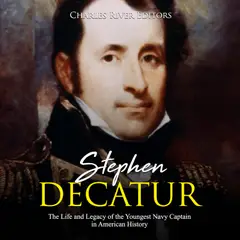
Stephen Decatur: The Life and Legacy of the Youngest Navy Captain in American History

"Our country, right or wrong.” – Stephen Decatur

Between the Revolutionary War and the Civil War, the United States engaged in several wars that have mostly been overlooked. The War of 1812 is one of America’s forgotten conflicts, and the stalemated nature of the war (which resolved virtually none of either side’s war aims) has also ensured that it is often given merely a cursory overview. Great Britain, as the leader of several coalitions of conservative European countries trying to isolate and snuff out the revolutionary spirit and the ambitions of Napoleon, had been at war with France almost continuously since 1792. Under President Thomas Jefferson (1801-1809) and James Madison (1809-1817), the United States tried to steer a course that would keep it from being drawn into the European war and defend its neutrality on the high seas. However, both Britain and France wanted to hurt the other side economically by keeping goods out of their enemy’s hands. Thus, they did not faithfully respect the rights of neutral nations. The British government in 1807 had issued the “Orders in Council,” which enforced a naval blockade against France, and with a shortage of seamen to man the Royal Navy, Britain also felt justified in stopping and sometimes firing on ships flying the American flag in the name of apprehending escaped British sailors. In the same vein, American shipping was disrupted by piracy across the globe, especially in the Mediterranean, leading to multiple conflicts known as the Barbary Wars.

Americans had few things to celebrate during the Barbary Wars or the War of 1812, but one of them was the growing prestige of the U.S. Navy, and among those who were instrumental in its development, few were as influential as Stephen Decatur Jr. Decatur had an impact on nearly every war America fought in between the 1780s until his death in 1820, and his stardom ensured that he was a fixture among Washington, D.C.’s elite in his own lifetime.

Über dieses Buch

"Our country, right or wrong.” – Stephen Decatur

Between the Revolutionary War and the Civil War, the United States engaged in several wars that have mostly been overlooked. The War of 1812 is one of America’s forgotten conflicts, and the stalemated nature of the war (which resolved virtually none of either side’s war aims) has also ensured that it is often given merely a cursory overview. Great Britain, as the leader of several coalitions of conservative European countries trying to isolate and snuff out the revolutionary spirit and the ambitions of Napoleon, had been at war with France almost continuously since 1792. Under President Thomas Jefferson (1801-1809) and James Madison (1809-1817), the United States tried to steer a course that would keep it from being drawn into the European war and defend its neutrality on the high seas. However, both Britain and France wanted to hurt the other side economically by keeping goods out of their enemy’s hands. Thus, they did not faithfully respect the rights of neutral nations. The British government in 1807 had issued the “Orders in Council,” which enforced a naval blockade against France, and with a shortage of seamen to man the Royal Navy, Britain also felt justified in stopping and sometimes firing on ships flying the American flag in the name of apprehending escaped British sailors. In the same vein, American shipping was disrupted by piracy across the globe, especially in the Mediterranean, leading to multiple conflicts known as the Barbary Wars.

Americans had few things to celebrate during the Barbary Wars or the War of 1812, but one of them was the growing prestige of the U.S. Navy, and among those who were instrumental in its development, few were as influential as Stephen Decatur Jr. Decatur had an impact on nearly every war America fought in between the 1780s until his death in 1820, and his stardom ensured that he was a fixture among Washington, D.C.’s elite in his own lifetime.
Starte noch heute mit diesem Buch für 0 €

  • Hole dir während der Testphase vollen Zugriff auf alle Bücher in der App
  • Keine Verpflichtungen, jederzeit kündbar
Jetzt kostenlos testen
Mehr als 52 000 Menschen haben Nextory im App Store und auf Google Play 5 Sterne gegeben.

  1. The Iranian Revolution and Iran Hostage Crisis: The History of the Events that Broke American Relations with Iran

    Charles River Editors

  2. 4.0

    The Empires of India: The History of the Dynasties that Ruled India Before the British

    Charles River Editors

  3. Imperial Germany’s Colonization in Africa: The History of the German Efforts and Conflicts to Colonize Parts of Africa

    Charles River Editors

  4. 4.3

    The Sentinelese: The History of the Uncontacted People on North Sentinel Island

    Charles River Editors

  5. 3.4

    Mustafa Kemal Atatürk and the Republic of Turkey: The History of the Ottoman Empire’s Collapse and the Establishment of a New State

    Charles River Editors

  6. 2.0

    Die Panzer: Die Geschichte und das Vermächtnis von Nazideutschlands berühmtesten Panzern des Zweiten Weltkriegs

    Charles River Editors

  7. Japan in the World Wars: The History of the Imperial Japanese Empire during World War I and World War II

    Charles River Editors

  8. Ada Lovelace: The Life and Legacy of the Math Prodigy Who Pioneered Computer Science

    Charles River Editors

  9. Die Han-Dynastie: Geschichte und Erbe des einflussreichsten Reiches des alten China

    Charles River Editors

  10. The Ancient Kingdoms of Africa: The History and Legacy of the African Continent’s Most Prominent Kingdoms in Antiquity

    Charles River Editors

  11. The Spanish Empire in the Americas: The History of Spain’s Colonization across Central America and South America

    Charles River Editors

  12. Das mittelalterliche Russland: Die Geschichte und das Erbe der Gruppen, die den russischen Staat im Mittelalter entwickelten

    Charles River Editors