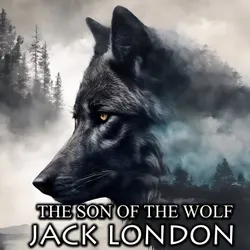
The Son of the Wolf

Jack London gained his first and most lasting fame as the author of tales of the Klondike gold rush. This, his first collection of stories, draws on his experience in the Yukon. The stories tell of gambles won and lost, of endurance and sacrifice, and often turn on the qualities of exceptional women and on the relations between the white adventurers and the native tribes.

The Son

of the Wolf (excerpt)

Man rarely places a proper valuation upon his womankind, at least not

until deprived of them. He has no conception of the subtle atmosphere

exhaled by the sex feminine, so long as he bathes in it; but let it

be withdrawn, and an ever-growing void begins to manifest itself in

his existence, and he becomes hungry, in a vague sort of way, for a

something so indefinite that he cannot characterize it. If his

comrades have no more experience than himself, they will shake their

heads dubiously and dose him with strong physic. But the hunger will

continue and become stronger; he will lose interest in the things of

his everyday life and wax morbid; and one day, when the emptiness has

become unbearable, a revelation will dawn upon him.

In the Yukon country, when this comes to pass, the

man usually provisions a poling boat, if it is summer, and if winter,

harnesses his dogs, and heads for the Southland. A few months later,

supposing him to be possessed of a faith in the country, he returns

with a wife to share with him in that faith, and incidentally in his

hardships. This but serves to show the innate selfishness of man. It

also brings us to the trouble of 'Scruff' Mackenzie, which occurred

in the old days, before the country was stampeded and staked by a

tidal-wave of the che-cha-quas, and when the Klondike's only claim to

notice was its salmon fisheries.

'Scruff' Mackenzie bore the earmarks of a frontier

birth and a frontier life.

His face was stamped with twenty-five years of

incessant struggle with Nature in her wildest moods,--the last two,

the wildest and hardest of all, having been spent in groping for the

gold which lies in the shadow of the Arctic Circle. When the yearning

sickness came upon him, he was not surprised, for he was a practical

man and had seen other men thus stricken. But he showed no sign of

his malady, save that he worked harder. All summer he fought

mosquitoes and washed the sure-thing bars of the Stuart River for a

double grubstake. Then he floated a raft of houselogs down the Yukon

to Forty Mile, and put together as comfortable a cabin as any the

camp could boast of. In fact, it showed such cozy promise that many

men elected to be his partner and to come and live with him. But he

crushed their aspirations with rough speech, peculiar for its

strength and brevity, and bought a double supply of grub from the

trading-post...

About Jack London:

Jack London (1876-1916), was an American author and a pioneer in the then-burgeoning world of commercial magazine fiction. He was one of the first Americans to make a lucrative career exclusively from writing. London was self-educated. He taught himself in the public library, mainly just by reading books. In 1898, he began struggling seriously to break into print, a struggle memorably described in his novel, Martin Eden (1909). Jack London was fortunate in the timing of his writing career. He started just as new printing technologies enabled lower-cost production of magazines. This resulted in a boom in popular magazines aimed at a wide public, and a strong market for short fiction. In 1900, he made $2,500 in writing, the equivalent of about $75,000 today. His career was well under way. Among his famous works are: Children of the Frost (1902), The Call of the Wild (1903), The Sea Wolf (1904), The Game (1905), White Fang (1906), The Road (1907), Before Adam (1907), Adventure (1911), and The Scarlet Plague (1912).

Über dieses Buch

Jack London gained his first and most lasting fame as the author of tales of the Klondike gold rush. This, his first collection of stories, draws on his experience in the Yukon. The stories tell of gambles won and lost, of endurance and sacrifice, and often turn on the qualities of exceptional women and on the relations between the white adventurers and the native tribes.

The Son

of the Wolf (excerpt)

Man rarely places a proper valuation upon his womankind, at least not

until deprived of them. He has no conception of the subtle atmosphere

exhaled by the sex feminine, so long as he bathes in it; but let it

be withdrawn, and an ever-growing void begins to manifest itself in

his existence, and he becomes hungry, in a vague sort of way, for a

something so indefinite that he cannot characterize it. If his

comrades have no more experience than himself, they will shake their

heads dubiously and dose him with strong physic. But the hunger will

continue and become stronger; he will lose interest in the things of

his everyday life and wax morbid; and one day, when the emptiness has

become unbearable, a revelation will dawn upon him.

In the Yukon country, when this comes to pass, the

man usually provisions a poling boat, if it is summer, and if winter,

harnesses his dogs, and heads for the Southland. A few months later,

supposing him to be possessed of a faith in the country, he returns

with a wife to share with him in that faith, and incidentally in his

hardships. This but serves to show the innate selfishness of man. It

also brings us to the trouble of 'Scruff' Mackenzie, which occurred

in the old days, before the country was stampeded and staked by a

tidal-wave of the che-cha-quas, and when the Klondike's only claim to

notice was its salmon fisheries.

'Scruff' Mackenzie bore the earmarks of a frontier

birth and a frontier life.

His face was stamped with twenty-five years of

incessant struggle with Nature in her wildest moods,--the last two,

the wildest and hardest of all, having been spent in groping for the

gold which lies in the shadow of the Arctic Circle. When the yearning

sickness came upon him, he was not surprised, for he was a practical

man and had seen other men thus stricken. But he showed no sign of

his malady, save that he worked harder. All summer he fought

mosquitoes and washed the sure-thing bars of the Stuart River for a

double grubstake. Then he floated a raft of houselogs down the Yukon

to Forty Mile, and put together as comfortable a cabin as any the

camp could boast of. In fact, it showed such cozy promise that many

men elected to be his partner and to come and live with him. But he

crushed their aspirations with rough speech, peculiar for its

strength and brevity, and bought a double supply of grub from the

trading-post...

About Jack London:

Jack London (1876-1916), was an American author and a pioneer in the then-burgeoning world of commercial magazine fiction. He was one of the first Americans to make a lucrative career exclusively from writing. London was self-educated. He taught himself in the public library, mainly just by reading books. In 1898, he began struggling seriously to break into print, a struggle memorably described in his novel, Martin Eden (1909). Jack London was fortunate in the timing of his writing career. He started just as new printing technologies enabled lower-cost production of magazines. This resulted in a boom in popular magazines aimed at a wide public, and a strong market for short fiction. In 1900, he made $2,500 in writing, the equivalent of about $75,000 today. His career was well under way. Among his famous works are: Children of the Frost (1902), The Call of the Wild (1903), The Sea Wolf (1904), The Game (1905), White Fang (1906), The Road (1907), Before Adam (1907), Adventure (1911), and The Scarlet Plague (1912).
Starte noch heute mit diesem Buch für 0 €

  • Hole dir während der Testphase vollen Zugriff auf alle Bücher in der App
  • Keine Verpflichtungen, jederzeit kündbar
Jetzt kostenlos testen
Mehr als 52 000 Menschen haben Nextory im App Store und auf Google Play 5 Sterne gegeben.

  1. 3.0

    200 Meisterwerke der Literaturgeschichte : Die größten Klassiker der Weltliteratur

    Franz Kafka, Victor Hugo, Fjodor Michailowitsch Dostojewski, Lord Byron, Giacomo Leopardi, Marcel Proust, Henrik Ibsen, Percy Bysshe Shelley, Charles Dickens, Jane Austen, Mary Shelley, Emily Brontë, Charlotte Brontë, Anne Brontë, William Makepeace Thackeray, Bram Stoker, Henry Fielding, George Eliot, William Shakespeare, D. H. Lawrence, Walt Whitman, Herman Melville, Thomas Wolfe, Virginia Woolf, Joseph Conrad, Sinclair Lewis, Lewis Carrol, Edgar Allan Poe, Edward Bulwer-Lytton, Oscar Wilde, H.G. Wells, Daniel Defoe, James Fenimore Cooper, Lew Wallace, Jonathan Swift, Robert Louis Stevenson, Mark Twain, Walter Scott, Nathaniel Hawthorne, Harriet Beecher Stowe, Laurence Sterne, Frances Hodgson Burnett, Arthur Conan Doyle, Wilkie Collins, Edgar Wallace, Jack London, Henry David Thoreau, John Galsworthy, F. Scott Fitzgerald, Rudyard Kipling, G.K. Chesterton, Washington Irvin, O.Henry, Ambrose Bierce, Alexander Sergejewitsch Puschkin, Michail Lermontow, Iwan Sergejewitsch Turgenew, Leo Tolstoi, Nikolai Gogol, Iwan Gontscharow, Nikolai Leskow, Anton Pawlowitsch Tschechow, Maxim Gorki, François Rabelais, Jean de la Fontaine, Blaise Pascal, Pierre Corneille, Moliere, Jean Baptiste Racine, Charles Perrault, Voltaire, Denis Diderot, Jean-Jacques Rousseau, Pierre-Ambroise Choderlos de Laclos, Antoine-François Prévost, Marquis De Sade, François René Chateaubriand, Stendhal, Honoré de Balzac, Alexandre Dumas, Alphonse de Lamartine, George Sand, Gustave Flaubert, Emile Zola, Guy De Maupassant, Alphonse Daudet, Jules Verne, Joris-Karl Huysmans, Prosper Mérimée, Charles Baudelaire, Stéphane Mallarmé, Arthur Rimbaud, André Gide, Arthur Schopenhauer, Heinrich Heine, Friedrich Schiller, Johann Wolfgang von Goethe, Jacob Grimm, Gottfried von Straßburg, Wolfram von Eschenbach, E T A Hoffmann, Annette von Droste-Hülshoff, Heinrich von Kleist, Friedrich Hölderlin, Theodor Fontane, Gustav Freytag, Gottfried Keller, Theodor Storm, Stefan Zweig, Joseph von Eichendorff, Klaus Mann, Rainer Maria Rilke, Johanna Spyri, Joseph Roth, Karl May, Robert Musil, Heinrich Mann, Sigmund Freud, Friedrich Nietzsche, Dante Alighieri, Giovanni Boccaccio, Giacomo Casanova, Luigi Pirandello, Giosuè Carducci, Gabriele D’Annunzio, Niccolo Machiavelli, Miguel Cervantes de Saavedra, Pedro Calderón de la Barca, Vicente Blasco Ibañez, Knut Hamsun, Homer, Äsop, Herodot, Thukydides, Xenophon, Platon, - Aristoteles, - Sophokles, Euripides, - Aristophanes, Lao Tse, - Konfuzius, Siddhartha Gautama Buddha, Titus Livius, Tacitus, Marcus Tullius Cicero, Vergil, Ovid, Lukian, Petronius, Apuleius, Longos von Lesbos, Mark Aurel, Aurelius Augustinus

  2. 1.0

    100 Meisterwerke der Weltliteratur - Klassiker die man kennen muss : Bereicherte Ausgabe. Ein literarisches Panorama: Meisterwerke, Klassiker und Autoren der Weltliteratur

    Johann Wolfgang von Goethe, Jules Verne, Gustave Flaubert, Franz Kafka, Lewis Carroll, Selma Lagerlöf, Sigmund Freud, Johanna Spyri, Theodor Storm, Rainer Maria Rilke, Charles Dickens, Stefan Zweig, Heinrich Heine, Honoré de Balzac, Theodor Fontane, Karl May, Gottfried Keller, Mark Twain, Heinrich Mann, Else Lasker-Schüler, Robert Musil, Walt Whitman, Oscar Wilde, Annette von Droste-Hülshoff, Arthur Schopenhauer, Robert Louis Stevenson, Gustav Freytag, James Fenimore Cooper, Edgar Allan Poe, Heinrich von Kleist, William Shakespeare, Dante Alighieri, Charlotte Brontë, Emily Brontë, Jack London, Arthur Conan Doyle, Joseph Conrad, Jane Austen, Herman Melville, Guy De Maupassant, Walter Scott, Jonathan Swift, Jacob Grimm, Wilhelm Grimm, Alexandre Dumas, Rudyard Kipling, Nathaniel Hawthorne, Homer, O.Henry, Voltaire, Lew Wallace, John Galsworthy, E T A Hoffmann, Marcus Aurelius, Hans Christian Andersen, Anton Pawlowitsch Tschechow, Platon, Friedrich Nietzsche, Iwan Sergejewitsch Turgenew, Tacitus, Nikolai Gogol, Miguel de Cervantes, Mary Shelley, Thomas Wolfe, Emile Zola, Fjodor Michailowitsch Dostojewski, Leo Tolstoi, Joseph Roth, Joseph von Eichendorff, Kurt Tucholsky, Iwan Alexandrowitsch Gontscharow, Oswald Spengler, Moliere, Alfred Adler, Sophie von La Roche, Klaus Mann, Rumi

  3. Die Abenteuer Box: 4 Hörbuch-Klassiker : Wolfsblut, Das Dschungelbuch, Tom Sawyer, Gullivers Reisen

    Jonathan Swift, Jack London, Rudyard Kipling, Mark Twain

  4. 100 Meisterwerke der englischen Literatur - Klassiker, die man kennen muss

    George Orwell, Charles Dickens, Jane Austen, Katherine Mansfield, H.P. Lovecraft, William Wordsworth, John Keats, Percy Bysshe Shelley, Robert Burns, John Milton, William Shakespeare, Christopher Marlowe, Geoffrey Chaucer, Laurence Sterne, Henry Fielding, Mary Shelley, Emily Brontë, Charlotte Brontë, Anne Brontë, William Makepeace Thackeray, George Eliot, D. H. Lawrence, Herman Melville, Thomas Wolfe, Virginia Woolf, Joseph Conrad, Sinclair Lewis, Walt Whitman, Edgar Allan Poe, Oscar Wilde, Jerome K Jerome, Washington Irving, Bram Stoker, H.G. Wells, Daniel Defoe, Lew Wallace, James Fenimore Cooper, Jonathan Swift, Robert Louis Stevenson, Mark Twain, Lewis Carrol, Edward Bulwer-Lytton, F. Scott Fitzgerald, Arthur Conan Doyle, Jack London, Henry David Thoreau, G.K. Chesterton, Edith Wharton, Henry James, Thomas Hardy, Margaret Mitchell, Kate Chopin, Willa Cather, Charlotte Perkins Gilman, James Joyce, John Galsworthy, Francis Hodgson Burnett, Lucy Maud Montgomery, Louisa May Alcott, Rudyard Kipling

  5. Wolfsblut - Hörbuch Klassiker

    Jack London, Hörbuch Klassiker

  6. 10 Masterpieces You Have to Read Before You Die, Vol. 3

    Edgar Allan Poe, William Shakespeare, H.P. Lovecraft, Mary W. Shelley, Osamu Dazai, Jack London, Fyodor Dostoyevsky, Nathaniel Hawthorne, Frances Hodgson Burnett, Robert Louis Stevenson

  7. Gekürzt

    Kurzgeschichten: Zehn Meisterwerke der Weltliteratur : Grüne Edition

    Kurt Tucholsky, Franz Kafka, Arthur Conan Doyle, Giovanni Boccaccio, Edgar Allan Poe, Guy De Maupassant, Mark Twain, Jack London, Friedrich Glauser, Bret Harte

  8. Die größten Liebesgeschichten des Vergoldeten Zeitalters : Gilded Age Romance Sammelband: Aus guter Familie, Die Herrin des Großen Hauses, Die Aßmanns, Der Maskenball, Die Kameliendame

    Gabriele Reuter, John Galsworthy, Wilhelmine Heimburg, D. H. Lawrence, Hermann Heiberg, Joseph Roth, Edward Bulwer-Lytton, Ernst Wichert, Jack London, Alexandre Dumas, Lew Tolstoi, Gabriele D’Annunzio, Fjodor Michailowitsch Dostojewski, Theodor Fontane, Guy De Maupassant, George Eliot, Rudyard Kipling, Arthur Schnitzler, Anatole France, Johanna Spyri, Gustave Flaubert, Ida Boy-Ed, Hedwig Courths-Mahler, Eugenie Marlitt, Eufemia von Adlersfeld-Ballestrem, Nataly von Eschstruth, Elisabeth Bürstenbinder, Franziska Gräfin zu Reventlow, Elisabeth von Heyking

  9. Die Meisterwerke der Weltliterature : Bereicherte Ausgabe. 100 Klassiker die man kennen muss

    Johann Wolfgang von Goethe, Jules Verne, Gustave Flaubert, Franz Kafka, Lewis Carroll, Selma Lagerlöf, Sigmund Freud, Johanna Spyri, Theodor Storm, Rainer Maria Rilke, Charles Dickens, Stefan Zweig, Heinrich Heine, Honoré de Balzac, Theodor Fontane, Karl May, Gottfried Keller, Mark Twain, Heinrich Mann, Else Lasker-Schüler, Robert Musil, Walt Whitman, Oscar Wilde, Annette von Droste-Hülshoff, Arthur Schopenhauer, Robert Louis Stevenson, Gustav Freytag, James Fenimore Cooper, Edgar Allan Poe, Heinrich von Kleist, William Shakespeare, Dante Alighieri, Charlotte Brontë, Emily Brontë, Jack London, Arthur Conan Doyle, Joseph Conrad, Jane Austen, Herman Melville, Guy De Maupassant, Walter Scott, Jonathan Swift, Jacob Grimm, Wilhelm Grimm, Alexandre Dumas, Rudyard Kipling, Nathaniel Hawthorne, Homer, O.Henry, Voltaire, Lew Wallace, John Galsworthy, E T A Hoffmann, Marcus Aurelius, Hans Christian Andersen, Anton Pawlowitsch Tschechow, Platon, Friedrich Nietzsche, Iwan Sergejewitsch Turgenew, Tacitus, Nikolai Gogol, Miguel de Cervantes, Mary Shelley, Thomas Wolfe, Emile Zola, Fjodor Michailowitsch Dostojewski, Leo Tolstoi, Joseph Roth, Joseph von Eichendorff, Kurt Tucholsky, Iwan Alexandrowitsch Gontscharow, Oswald Spengler, Moliere, Alfred Adler, Sophie von La Roche, Klaus Mann, Rumi

  10. Erste Kinderbücher für die Kleinsten : Peterchens Mondfahrt, Bambi, Die Biene Maja und ihre Abenteuer, ABC-Buch, Max und Moritz

    Selma Lagerlöf, Beatrix Potter, Waldemar Bonsels, Felix Salten, Gerdt von Bassewitz, Else Ury, Karl Philipp Moritz, Hans Christian Andersen, Ludwig Tieck, Hermann Löns, Johanna Spyri, Rudyard Kipling, Jack London, Wilhelm Busch, Walther Kabel, Franz Bonn, Joachim Ringelnatz, Jacob Grimm, Wilhelm Grimm, Joseph Jacobs, Ludwig Bechstein, Elsbeth Montzheimer, Heinrich Seidel, Lothar Meggendorfer, ETA Hoffman, Oscar Wilde, Rosalie Koch, Walter Scott

  11. Die größten Kinderklassiker der Weltliteratur : Pinocchio, Bambi, Peterchens Mondfahrt, Das Dschungelbuch, Nesthäkchen, Heidi, Die Schatzinsel

    Frances Hodgson Burnett, Selma Lagerlöf, Mark Twain, Johanna Spyri, Waldemar Bonsels, Lewis Carroll, Else Ury, Charles Dickens, Rudyard Kipling, Gerdt von Bassewitz, Robert Louis Stevenson, David Friedrich Weinland, Harriet Beecher Stowe, Emmy von Rhoden, Agnes Sapper, Jack London

  12. 200 Literarische Meisterwerke der Weltgeschichte : Die größten Klassiker aus Deutschland, England, den USA, Russland und Frankreich

    Lew Tolstoi, Virginia Woolf, Henrik Ibsen, Franz Kafka, Fjodor Michailowitsch Dostojewski, Lord Byron, Victor Hugo, Giacomo Leopardi, Marcel Proust, Percy Bysshe Shelley, Charles Dickens, Jane Austen, Mary Shelley, Emily Brontë, Charlotte Brontë, Anne Brontë, William Makepeace Thackeray, Bram Stoker, Henry Fielding, George Eliot, William Shakespeare, D. H. Lawrence, Walt Whitman, Herman Melville, Thomas Wolfe, Joseph Conrad, Sinclair Lewis, Lewis Carrol, Edgar Allan Poe, Edward Bulwer-Lytton, Oscar Wilde, H.G. Wells, Daniel Defoe, James Fenimore Cooper, Lew Wallace, Jonathan Swift, Robert Louis Stevenson, Mark Twain, Walter Scott, Nathaniel Hawthorne, Harriet Beecher Stowe, Laurence Sterne, Frances Hodgson Burnett, Arthur Conan Doyle, Wilkie Collins, Edgar Wallace, Jack London, Henry David Thoreau, John Galsworthy, F. Scott Fitzgerald, Rudyard Kipling, G.K. Chesterton, Alexander Sergejewitsch Puschkin, Leo Tolstoi, Nikolai Gogol, Charles Baudelaire, Arthur Rimbaud, Edmond Rostand, Jean Giraudoux, André Gide, Arthur Schopenhauer, Heinrich Heine, Friedrich Schiller, Johann Wolfgang von Goethe, Jacob Grimm, Wilhelm Grimm, Gottfried von Straßburg, Wolfram von Eschenbach, E T A Hoffmann, Annette von Droste-Hülshoff, Dante Alighieri, Giovanni Boccaccio, Luigi Pirandello, Niccolo Machiavelli, Miguel Cervantes de Saavedra, Pedro Calderón de la Barca, Vicente Blasco Ibañez, Knut Hamsun, Friedrich Nietzsche, Homer, Äsop, Herodot, Thukydides, Xenophon, Platon, - Aristoteles, Tacitus, - Konfuzius, Siddhartha Gautama Buddha, Marcus Tullius Cicero, Vergil, Ovid, Mark Aurel, Aurelius Augustinus