Time to Kill : Murder Echoes Through the Night

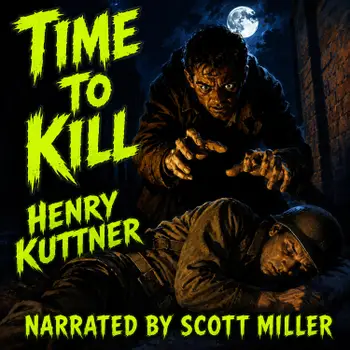
The war never truly sleeps in Henry Kuttner’s “Time to Kill.” Even when the guns fall silent for an hour, the city remains trapped beneath dread, hunger, exhaustion, and the steady expectation of sudden death. Refugees crowd into ruined buildings, nerves fray under constant bombardment, and every sound feels like the beginning of another disaster. In the middle of that living nightmare, a weary doctor named Stanley shares a room with Rudolph Harmon, a nervous mechanic who discovers something impossible. During strange trance-like episodes, Harmon begins receiving the thoughts of a murderer in real time.

What starts as a terrifying curiosity quickly becomes unbearable. The killer’s mind arrives in fragments of fear, pressure, and violent release, transmitted through a repaired dictaphone as Harmon helplessly records what he hears. Each episode grows darker. Each murder comes closer. And as the city collapses further into panic and isolation, Stanley begins to wonder whether the war itself has twisted human thought into something dangerous and contagious. “Time to Kill” combines psychological horror with science fiction dread, building toward a final moment that lands with shocking force.

Henry Kuttner published widely in Weird Tales, Thrilling Wonder Stories, Astounding Science Fiction, and Unknown during the 1930s and 1940s. He wrote horror, fantasy, and science fiction with equal skill, often blending genres in ways that felt unsettling and modern. Alongside his wife and collaborator C. L. Moore, Kuttner created stories under multiple pen names including Lewis Padgett and Lawrence O’Donnell. “Time to Kill” shows Kuttner at his darkest, using the emotional strain of war to explore fear, violence, and the terrifying possibility that human minds may not be as separate as we believe.
Über dieses Buch

The war never truly sleeps in Henry Kuttner’s “Time to Kill.” Even when the guns fall silent for an hour, the city remains trapped beneath dread, hunger, exhaustion, and the steady expectation of sudden death. Refugees crowd into ruined buildings, nerves fray under constant bombardment, and every sound feels like the beginning of another disaster. In the middle of that living nightmare, a weary doctor named Stanley shares a room with Rudolph Harmon, a nervous mechanic who discovers something impossible. During strange trance-like episodes, Harmon begins receiving the thoughts of a murderer in real time.

What starts as a terrifying curiosity quickly becomes unbearable. The killer’s mind arrives in fragments of fear, pressure, and violent release, transmitted through a repaired dictaphone as Harmon helplessly records what he hears. Each episode grows darker. Each murder comes closer. And as the city collapses further into panic and isolation, Stanley begins to wonder whether the war itself has twisted human thought into something dangerous and contagious. “Time to Kill” combines psychological horror with science fiction dread, building toward a final moment that lands with shocking force.

Henry Kuttner published widely in Weird Tales, Thrilling Wonder Stories, Astounding Science Fiction, and Unknown during the 1930s and 1940s. He wrote horror, fantasy, and science fiction with equal skill, often blending genres in ways that felt unsettling and modern. Alongside his wife and collaborator C. L. Moore, Kuttner created stories under multiple pen names including Lewis Padgett and Lawrence O’Donnell. “Time to Kill” shows Kuttner at his darkest, using the emotional strain of war to explore fear, violence, and the terrifying possibility that human minds may not be as separate as we believe.

Starte noch heute mit diesem Buch für 0 €

  • Hole dir während der Testphase vollen Zugriff auf alle Bücher in der App
  • Keine Verpflichtungen, jederzeit kündbar
Jetzt kostenlos testen
Mehr als 52 000 Menschen haben Nextory im App Store und auf Google Play 5 Sterne gegeben.

  1. 1900 to 1939 Science Fiction - 17 Classic Science Fiction Short Stories from 1900 to 1939

    H.G. Wells, Murray Leinster, H.P. Lovecraft, Robert E. Howard, Clark Ashton Smith, Jack Williamson, Henry Kuttner, Paul Ernst, Mack Reynolds, George T. Spillman, William Hope Hodgson, August Derleth, Carl W. Ganzlin, Ambrose Bierce, Carl Jacobi, William Brittain, Edmond Hamilton, Frank Belknap Long

  2. 4.0

    The Salem Horror

    Henry Kuttner

  3. The secret of Kralitz

    Henry Kuttner

  4. The Mad Virus

    Henry Kuttner

  5. Neu
    5.0

    Twenty-Five Sci-Fi Flashes : Classic Science Fiction at Light Speed

    Philip K Dick, Ray Bradbury, Isaac Asimov, August Derleth, Richard O. Lewis, Robert Zacks, Fredric Brown, Harry Fletcher, Robert Sheckley, I. M. Bukstein, Fritz Leiber, Arthur C. Clarke, Allen K. Lang, George T. Spillman, Carl W. Ganzlin, Edward Halibut, Henry Kuttner

  6. Neu

    Outlaws of Tomorrow 2 : Robbers, Rogues, Detectives & Future Crime

    Jack London, Isaac Asimov, Alfred Bester, Harry Harrison, Robert Sheckley, Fredric Brown, Clifford D. Simak, August Derleth, Donald E. Westlake, Miriam Allen deFord, Nelson S. Bond, Randall Garrett, Henry Kuttner, Winston Marks, Lawrence M. Jannifer, Bryce Walton

  7. Neu

    Lost Sci-Fi Books 481 thru 485 : Alien Encounters, Cosmic Mysteries, and Brilliant Ideas

    Ben Bova, Jack Williamson, Henry Kuttner, Fritz Leiber, William Bender Jr.

  8. Lost Sci-Fi Books 301 thru 320 : Robots, Time Travel, Alien Worlds and Visions of Tomorrow

    Poul Anderson, Mack Reynolds, John Victor Peterson, Mary Carlson, David Mason, John W. Campbell, Ray Bradbury, Henry Kuttner, Alfred Bester, Lester del Rey, Alan E. Nourse, Robert Silverberg, Arthur C. Clarke, Miriam Allen deFord, Donald A. Wollheim, R. J. Rice, Isaac Asimov, Roger D. Aycock

  9. Neu
    #562

    The Secret of Kralitz : The Curse Waiting Underground

    Henry Kuttner

  10. 1900 - 1939 Science Fiction 4 - 18 Classic Science Fiction Short Stories by H. P. Lovecraft, Robert E. Howard, Jack Williamson, John W. Campbell, Robert Bloch and more : Strange Signals, Alien Terrors, And Forgotten Masterpieces From Early Science Fiction

    H.P. Lovecraft, Robert E. Howard, Jack Williamson, Robert Bloch, Lester del Rey, John W. Campbell, Henry Kuttner, Clark Ashton Smith, Frank Belknap Long, Ray Cummings, Francis Stevens, Victor Rousseau, H. F. Arnold, Alfred Bester

  11. 1940s Science Fiction 6 : Space Explorers, Cosmic Mysteries, Time Paradoxes and Alien Worlds

    Nelson S. Bond, Arthur C. Clarke, Manly Wade Wellman, Thomas S. Gardiner, Henry Kuttner, H.P. Lovecraft, James Blish, E. M. Hull, Thorp McClusky, Bryce Walton, Theodore Sturgeon, A. Bertram Chandler, Robert Abernathy, James R. Adams, John Wyndham, Russ Winterbotham