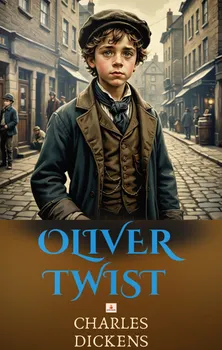
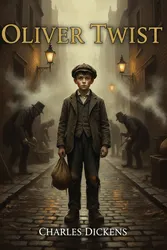
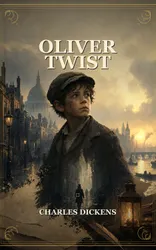
Oliver Twist; or, The Parish Boy's Progress, is the second novel by English author Charles Dickens. It was originally published as a serial from 1837 to 1839 and as a three-volume book in 1838. The story follows the titular orphan, who, after being raised in a workhouse, escapes to London, where he meets a gang of juvenile pickpockets led by the elderly criminal Fagin, discovers the secrets of his parentage, and reconnects with his remaining family.Oliver Twist unromantically portrays the sordid lives of criminals and exposes the cruel treatment of the many orphans in London in the mid-19th century. The alternative title, The Parish Boy's Progress, alludes to Bunyan's The Pilgrim's Progress as well as the 18th-century caricature series by painter William Hogarth, A Rake's Progress and A Harlot's Progress.
Oliver Twist; or, The Parish Boy's Progress, is the second novel by English author Charles Dickens. It was originally published as a serial from 1837 to 1839 and as a three-volume book in 1838. The story follows the titular orphan, who, after being raised in a workhouse, escapes to London, where he meets a gang of juvenile pickpockets led by the elderly criminal Fagin, discovers the secrets of his parentage, and reconnects with his remaining family.Oliver Twist unromantically portrays the sordid lives of criminals and exposes the cruel treatment of the many orphans in London in the mid-19th century. The alternative title, The Parish Boy's Progress, alludes to Bunyan's The Pilgrim's Progress as well as the 18th-century caricature series by painter William Hogarth, A Rake's Progress and A Harlot's Progress.
Empieza este libro hoy por 0 €
Disfruta de acceso completo a todos los libros de la app durante el periodo de prueba
Charles Dickens (Portsmuth, 1812 – Gadshill, 1870) ha llegado hasta nosotros como el autor más importante e influyente de la literatura victoriana. Sus obras y su peripecia personal, íntimamente relacionadas, plasmaron no sólo el pulso social de su época, también el terrible estado moral de una sociedad atrapada en la desigualdad y las convenciones. Dickens experimentó la miseria, el éxito popular, la cárcel, el hambre... sólo logró cumplir con el más íntimo de sus anhelos, la libertad, entregándose a la literatura. Aunque muchas de sus obras gozaron de un extraordinario favor popular, baste decir que muchas de ellas fueron publicadas por entregas, en formato folletín; serían las críticas entusiastas de George Gissing y G. K. Chesterton las que encumbrarían a Dickens como el autor más importante de la literatura inglesa del siglo XIX.