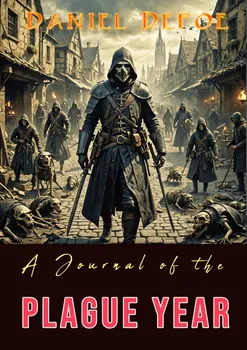
A Journal of the Plague Year : "Illustrated"

This is the Illustrated version of the "A Journal of the Plague Year", A work that is often read as if it were non-fiction is his account of the Great Plague of London in 1665: A Journal of the Plague Year, a complex historical novel published in 1722.

Bring out your dead! The ceaseless chant of doom echoed through a city of emptied streets and filled grave pits. For this was London in the year of 1665, the Year of the Great Plague....In 1721, when the Black Death again threatened the European Continent, Daniel Defoe wrote "A Journal of the Plague Year" to alert an indifferent populace to the horror that was almost upon them. Through the eyes of a saddler who had chosen to remain while multitudes fled, the master realist vividly depicted a plague-stricken city. He re-enacted the terror of a helpless people caught in a tragedy they could not comprehend: the weak preying on the dying, the strong administering to the sick, the sinful orgies of the cynical, the quiet faith of the pious. With dramatic insight he captured for all time the death throes of a great city.

In this Illustrated book, Noted all of Defoe's pamphlet writing was political. One pamphlet (originally published anonymously) entitled "A True Relation of the Apparition of One Mrs. Veal the Next Day after her Death to One Mrs. Bargrave at Canterbury the 8th of September, 1705," deals with interaction between the spiritual realm and the physical realm. It was most likely written in support of Charles Drelincourt's The Christian Defense against the Fears of Death (1651). It describes Mrs. Bargrave's encounter with an old friend Mrs. Veal, after she had died. It is clear from this piece and other writings, that while the political portion of

Defoe's life was fairly dominant, it was by no means the only aspect:

"Wherever God erects a house of prayer

the Devil always builds a chapel there;

And 't will be found, upon examination,

the latter has the largest congregation."

— Defoe's The True-Born Englishman, 1701

Copyright & Illustrated by e-Kitap Projesi

ABOUT AUTHOR:

Daniel Defoe ( 1660 – 1731), born Daniel Foe, was an English trader, writer, journalist, pamphleteer, and spy, now most famous for his novel Robinson Crusoe.
Über dieses Buch

This is the Illustrated version of the "A Journal of the Plague Year", A work that is often read as if it were non-fiction is his account of the Great Plague of London in 1665: A Journal of the Plague Year, a complex historical novel published in 1722.

Bring out your dead! The ceaseless chant of doom echoed through a city of emptied streets and filled grave pits. For this was London in the year of 1665, the Year of the Great Plague....In 1721, when the Black Death again threatened the European Continent, Daniel Defoe wrote "A Journal of the Plague Year" to alert an indifferent populace to the horror that was almost upon them. Through the eyes of a saddler who had chosen to remain while multitudes fled, the master realist vividly depicted a plague-stricken city. He re-enacted the terror of a helpless people caught in a tragedy they could not comprehend: the weak preying on the dying, the strong administering to the sick, the sinful orgies of the cynical, the quiet faith of the pious. With dramatic insight he captured for all time the death throes of a great city.

In this Illustrated book, Noted all of Defoe's pamphlet writing was political. One pamphlet (originally published anonymously) entitled "A True Relation of the Apparition of One Mrs. Veal the Next Day after her Death to One Mrs. Bargrave at Canterbury the 8th of September, 1705," deals with interaction between the spiritual realm and the physical realm. It was most likely written in support of Charles Drelincourt's The Christian Defense against the Fears of Death (1651). It describes Mrs. Bargrave's encounter with an old friend Mrs. Veal, after she had died. It is clear from this piece and other writings, that while the political portion of

Defoe's life was fairly dominant, it was by no means the only aspect:

"Wherever God erects a house of prayer

the Devil always builds a chapel there;

And 't will be found, upon examination,

the latter has the largest congregation."

— Defoe's The True-Born Englishman, 1701

Copyright & Illustrated by e-Kitap Projesi

ABOUT AUTHOR:

Daniel Defoe ( 1660 – 1731), born Daniel Foe, was an English trader, writer, journalist, pamphleteer, and spy, now most famous for his novel Robinson Crusoe.

Starte noch heute mit diesem Buch für € 0

  • Hole dir während der Testphase vollen Zugriff auf alle Bücher in der App
  • Keine Verpflichtungen, jederzeit kündbar
Jetzt kostenlos testen
Mehr als 52 000 Menschen haben Nextory im App Store und auf Google Play 5 Sterne gegeben.

  1. 100 Meisterwerke der englischen Literatur - Klassiker, die man kennen muss : Hamlet, 1984, Ulysses...

    George Orwell, Charles Dickens, Jane Austen, Katherine Mansfield, H.P. Lovecraft, William Wordsworth, John Keats, Percy Bysshe Shelley, Robert Burns, John Milton, William Shakespeare, Christopher Marlowe, Geoffrey Chaucer, Laurence Sterne, Henry Fielding, Mary Shelley, Emily Brontë, Charlotte Brontë, Anne Brontë, William Makepeace Thackeray, George Eliot, D. H. Lawrence, Herman Melville, Thomas Wolfe, Virginia Woolf, Joseph Conrad, Sinclair Lewis, Walt Whitman, Edgar Allan Poe, Oscar Wilde, Jerome K Jerome, Washington Irving, Bram Stoker, H.G. Wells, Daniel Defoe, Lew Wallace, James Fenimore Cooper, Jonathan Swift, Robert Louis Stevenson, Mark Twain, Lewis Carrol, Edward Bulwer-Lytton, F. Scott Fitzgerald, Arthur Conan Doyle, Jack London, Henry David Thoreau, G.K. Chesterton, Edith Wharton, Henry James, Thomas Hardy, Margaret Mitchell, Kate Chopin, Willa Cather, Charlotte Perkins Gilman, James Joyce, John Galsworthy, Francis Hodgson Burnett, Lucy Maud Montgomery, Louisa May Alcott, Rudyard Kipling

  2. 3.5

    Robinson Crusoe

    Daniel Defoe

  3. Neu

    Avventure di Robinson Crusoe

    Daniel Defoe

  4. 3.0
    #2

    The Further Adventures of Robinson Crusoe

    Daniel Defoe

  5. 4.4

    Robinson Crusoe

    Daniel Defoe

  6. Neu

    50 Masterpieces You Must Read Before You Die : Timeless Classics That Will Enrich Your Mind and Soul

    Louisa May Alcott, Jane Austen, Joseph Conrad, D. H. Lawrence, George Eliot, Leo Tolstoy, James Joyce, Charles Dickens, Bram Stoker, Oscar Wilde, Honoré de Balzac, Edgar Rice Burroughs, Anne Brontë, Charlotte Brontë, Emily Brontë, Lewis Carroll, Willa Cather, Miguel de Cervantes, E. E. Cummings, Fyodor Dostoyevsky, Daniel Defoe, Arthur Conan Doyle, Alexandre Dumas, Gustave Flaubert, Henry James, Victor Hugo

  7. Neu

    50 Masterpieces you have to read before you die vol 1

    Louisa May Alcott, Jane Austen, Joseph Conrad, Edwin Abbott Abbott, George Eliot, Leo Tolstoy, James Joyce, Charles Dickens, Bram Stoker, Oscar Wilde, Honoré de Balzac, Edgar Rice Burroughs, Anne Brontë, Charlotte Brontë, Emily Brontë, Lewis Carroll, Willa Cather, Miguel de Cervantes, E. E. Cummings, Fyodor Dostoyevsky, Daniel Defoe, Arthur Conan Doyle, Alexandre Dumas, Gustave Flaubert, Henry James, Victor Hugo

  8. Neu
    4.4

    Robinson Crusoe

    Daniel Defoe

  9. Avventure di Robinson Crusoe

    Daniel Defoe

  10. 100 Clásicos de la Literatura Universal

    Francis Scott Fitzgerald, Mary Shelley, Lyman Frank Baum, Louisa May Alcott, Dante Alighieri, Jane Austen, Ambrose Bierce, Emily Brontë, Edgar Rice Burroughs, Lewis Carroll, Wilkie Collins, René Descartes, Charles Dickens, Emily Dickinson, Alexandre Dumas, Gustave Flaubert, Benito Pérez Galdós, Johann Wolfgang von Goethe, Thomas Hardy, E T A Hoffmann, Washington Irving, Henry James, James Joyce, Franz Kafka, Gaston Leroux, Federico García Lorca, H.P. Lovecraft, Publio Virgilio Marón, Lucy Maud Montgomery, John William Polidori, Marco Polo, Antoine de Saint-Exupéry, Emilio Salgari, Walter Scott, Mark Twain, Jules Verne, Julio Verne, H.G. Wells, Edith Wharton, Mary Wollstonecraft, Stefan Zweig, Sun Tzu, Bram Stoker, - Aristoteles, George Bernard Shaw, Henryk Sienkiewicz, Concepción Arenal, Charlotte Brontë, Miguel de Cervantes, G.K. Chesterton, Daniel Defoe, Fyodor Mikhailovich Dostoyevsky, Arthur Conan Doyle, Sigmund Freud, H. Rider Haggard, Homero, Immanuel Kant, Rudyard Kipling, Molière, Friedrich Nietzsche, Fernando de Rojas, Sófocles, William Makepeace Thackeray, León Tolstói, Voltaire, Ramón María del Valle-Inclán, Oscar Wilde, Virginia Woolf

  11. 4.4

    Robinson Crusoe

    Daniel Defoe

  12. AVENTURAS : Pack obras selectas con introducción y notas

    Julio Verne, Mark Twain, Robert Stevenson, Daniel Defoe