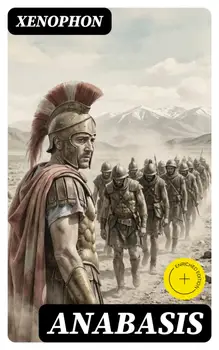
Anabasis : Enriched edition.

Xenophon's "Anabasis" is a profound narrative detailing the harrowing journey of Greek mercenaries known as the Ten Thousand, stranded deep within Persian territory after their employer's defeat. Written in a straightforward, yet eloquent prose that vividly captures the landscape and trials of the march, the text is both a military account and a philosophical meditation on leadership, loyalty, and the human condition in the face of adversity. It was composed in the 4th century BCE, reflecting the socio-political unrest of its time while serving as a pivotal historical document that illuminates not just the intricacies of Greek-Persian relations but also the enduring spirit of resilience among ordinary soldiers. Xenophon, a student of Socrates and a soldier himself, brings unique perspectives to this work, reflecting his experiences and philosophical inquiries into the nature of virtue and the moral dilemmas faced in warfare. His background as a philosopher, historian, and experienced military leader informs his narrative style and lends deeper layers to the tale, contrasting the chaos of war with contemplations on duty, honor, and survival. This seminal work is a must-read for anyone interested in ancient history, military strategy, or the philosophical underpinnings of human action. Its vivid storytelling and pragmatic insights not only enrich our understanding of the past but also resonate with the contemporary struggles of leadership and camaraderie in challenging circumstances.

In this enriched edition, we have carefully created added value for your reading experience:

- A succinct Introduction situates the work's timeless appeal and themes.

- The Synopsis outlines the central plot, highlighting key developments without spoiling critical twists.

- A detailed Historical Context immerses you in the era's events and influences that shaped the writing.

- An Author Biography reveals milestones in the author's life, illuminating the personal insights behind the text.

- A thorough Analysis dissects symbols, motifs, and character arcs to unearth underlying meanings.

- Reflection questions prompt you to engage personally with the work's messages, connecting them to modern life.

- Hand‐picked Memorable Quotes shine a spotlight on moments of literary brilliance.

- Interactive footnotes clarify unusual references, historical allusions, and archaic phrases for an effortless, more informed read.

Über dieses Buch

Xenophon's "Anabasis" is a profound narrative detailing the harrowing journey of Greek mercenaries known as the Ten Thousand, stranded deep within Persian territory after their employer's defeat. Written in a straightforward, yet eloquent prose that vividly captures the landscape and trials of the march, the text is both a military account and a philosophical meditation on leadership, loyalty, and the human condition in the face of adversity. It was composed in the 4th century BCE, reflecting the socio-political unrest of its time while serving as a pivotal historical document that illuminates not just the intricacies of Greek-Persian relations but also the enduring spirit of resilience among ordinary soldiers. Xenophon, a student of Socrates and a soldier himself, brings unique perspectives to this work, reflecting his experiences and philosophical inquiries into the nature of virtue and the moral dilemmas faced in warfare. His background as a philosopher, historian, and experienced military leader informs his narrative style and lends deeper layers to the tale, contrasting the chaos of war with contemplations on duty, honor, and survival. This seminal work is a must-read for anyone interested in ancient history, military strategy, or the philosophical underpinnings of human action. Its vivid storytelling and pragmatic insights not only enrich our understanding of the past but also resonate with the contemporary struggles of leadership and camaraderie in challenging circumstances.

In this enriched edition, we have carefully created added value for your reading experience:

- A succinct Introduction situates the work's timeless appeal and themes.

- The Synopsis outlines the central plot, highlighting key developments without spoiling critical twists.

- A detailed Historical Context immerses you in the era's events and influences that shaped the writing.

- An Author Biography reveals milestones in the author's life, illuminating the personal insights behind the text.

- A thorough Analysis dissects symbols, motifs, and character arcs to unearth underlying meanings.

- Reflection questions prompt you to engage personally with the work's messages, connecting them to modern life.

- Hand‐picked Memorable Quotes shine a spotlight on moments of literary brilliance.

- Interactive footnotes clarify unusual references, historical allusions, and archaic phrases for an effortless, more informed read.

Starte noch heute mit diesem Buch für € 0

  • Hole dir während der Testphase vollen Zugriff auf alle Bücher in der App
  • Keine Verpflichtungen, jederzeit kündbar
Jetzt kostenlos testen
Mehr als 52 000 Menschen haben Nextory im App Store und auf Google Play 5 Sterne gegeben.

  1. Memorabilia : Remembering Socrates – Xenophon’s Portrait of Character, Conversation, and Everyday Philosophy

    Xenophon, Tim Zengerink

  2. Oeconomicus : Household, Husbandry, and Leadership – Xenophon’s Lessons on Economics, Ethics, and Domestic Management

    Xenophon, Tim Zengerink

  3. 4.0

    Symposium : A Banquet of Perspectives – Xenophon’s Dialogue on Eros, Friendship, and the Deeds of Socrates

    Xenophon, Tim Zengerink

  4. Die Geschichte des Peloponnesischen Kriegs (Komplette Ausgabe: Buch 1&2) : Die Geschichte von Thukydides: 431-411 v.Chr. + Fortsetzung von Xenophon: 411-362

    Thukydides, Xenophon

  5. Hellenika : Die Geschichte des Peloponnesischen Krieges und seine Nachwirkungen

    Xenophon

  6. Die tapferen Zehntausend

    Xenophon

  7. 50 Meisterwerke der Philosophie : Metaphysik, Das Gastmahl, Bhagavadgita, Tractatus logico-philosophicus, Kritik der reinen Vernunft, Also sprach Zarathustra, Selbstbetrachtungen von Marcus Aurelius

    Ludwig Wittgenstein, Edmund Husserl, Karl Marx, Søren Kierkegaard, Friedrich Nietzsche, Ralph Waldo Emerson, John Stuart Mill, Georg Wilhelm Friedrich Hegel, Friedrich Schelling, Johann Gottlieb Fichte, Immanuel Kant, John Locke, Montesquieu, Jean-Jacques Rousseau, David Hume, Gottfried Wilhelm Leibniz, Baruch Spinoza, - Konfuzius, Lao Tse, Platon, Xenophon, - Aristoteles, Marcus Tullius Cicero, Seneca, Epiktet, Marc Aurel, Plotin, Thomas von Aquin, Nicolaus von Cues, - Erasmus von Rotterdam, Niccolò Machiavelli, Tommaso Campanella, Martin Luther, Giordano Bruno, Samuel von Pufendorf, Abbé Castel de Saint-Pierre, Michel de Montaigne, René Descartes, Francis Bacon, Blaise Pascal

  8. Die Geschichte des Antiken Griechenlands: Wesentliche Werke und Handbücher : Geschichte, Mythologie, Philosophie und Literaturklassiker

    Herodot, Thukydides, Xenophon, Jacob Burckhardt, Johann Gustav Droysen, Ludwig Preller, Gustav Schwab, Homer, Äsop, Platon, - Aristoteles, - Sophokles, Euripides, - Aristophanes, Alkiphron, Lukian, Aischylos

  9. Handbücher der Geschichte: Antikes Griechenland : Griechische Kulturgeschichte; Herodots "Historien"; Thukydides' "Geschichte des peloponnesischen Kriegs"; Xenophons "Anabasis"; Ilias und Odyssee

    Johann Gustav Droysen, Jacob Burckhardt, Herodot, Thukydides, Xenophon, Ludwig Preller, Gustav Schwab, Homer, Äsop, Platon, - Aristoteles, - Sophokles, Euripides, - Aristophanes, Alkiphron, Lukian, Aischylos

  10. Xenophon's Erinnerungen an Sokrates : Bereicherte Ausgabe. Weisheit und Lehren eines antiken Philosophen in den Erinnerungen seines Zeitgenossen

    Xenophon

  11. Meisterwerke der griechischen Literatur : Ilias, Odyssee, Antigone, König Ödipus, Medea, Agamemnon, Lysistrate, Die Kyropädie, Das Gastmahl, Metaphysik

    Euripides, - Aristophanes, Homer, - Sophokles, Aischylos, Herodot, Thukydides, Xenophon, Platon, - Aristoteles, Äsop, Alkiphron, Lukian

  12. Die größten Philosophen der Antike : Die wichtigsten Werke von Platon, Aristoteles, Cicero, Seneca, Marcus Aurelius

    Platon, - Aristoteles, Seneca, Marcus Tullius Cicero, Epiktet, Xenophon, Mark Aurel