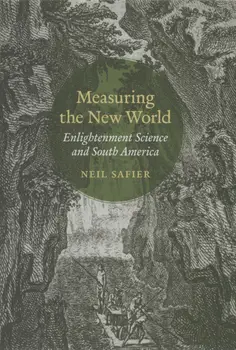
Measuring the New World : Enlightenment Science and South America

Prior to 1735, South America was terra incognita to many Europeans. But that year, the Paris Academy of Sciences sent a mission to the Spanish American province of Quito (in present-day Ecuador) to study the curvature of the earth at the Equator. Equipped with quadrants and telescopes, the mission's participants referred to the transfer of scientific knowledge from Europe to the Andes as a "sacred fire" passing mysteriously through European astronomical instruments to observers in South America.

By taking an innovative interdisciplinary look at the traces of this expedition, Measuring the New World examines the transatlantic flow of knowledge from West to East. Through ephemeral monuments and geographical maps, this book explores how the social and cultural worlds of South America contributed to the production of European scientific knowledge during the Enlightenment. Neil Safier uses the notebooks of traveling philosophers, as well as specimens from the expedition, to place this particular scientific endeavor in the larger context of early modern print culture and the emerging intellectual category of scientist as author.

Über dieses Buch

Prior to 1735, South America was terra incognita to many Europeans. But that year, the Paris Academy of Sciences sent a mission to the Spanish American province of Quito (in present-day Ecuador) to study the curvature of the earth at the Equator. Equipped with quadrants and telescopes, the mission's participants referred to the transfer of scientific knowledge from Europe to the Andes as a "sacred fire" passing mysteriously through European astronomical instruments to observers in South America.

By taking an innovative interdisciplinary look at the traces of this expedition, Measuring the New World examines the transatlantic flow of knowledge from West to East. Through ephemeral monuments and geographical maps, this book explores how the social and cultural worlds of South America contributed to the production of European scientific knowledge during the Enlightenment. Neil Safier uses the notebooks of traveling philosophers, as well as specimens from the expedition, to place this particular scientific endeavor in the larger context of early modern print culture and the emerging intellectual category of scientist as author.

Starte noch heute mit diesem Buch für € 0

  • Hole dir während der Testphase vollen Zugriff auf alle Bücher in der App
  • Keine Verpflichtungen, jederzeit kündbar
Jetzt kostenlos testen
Mehr als 52 000 Menschen haben Nextory im App Store und auf Google Play 5 Sterne gegeben.