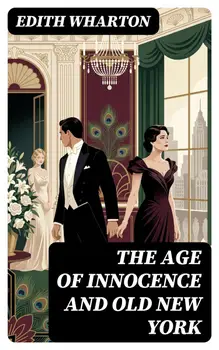
The Age of Innocence and Old New York : Enriched edition. Including False Dawn, The Old Maid, The Spark & New Year's Day

Edith Wharton's "The Age of Innocence" offers a meticulous exploration of the constraints of societal norms in Gilded Age New York, deftly illustrating the interplay between individual desires and the rigid expectations of upper-class society. Wharton employs a rich, descriptive prose style that captures the opulence and stagnation of the era, creating a vivid tableau of characters navigating their fates within an intricate web of tradition and propriety. The novel's exploration of themes such as love, hypocrisy, and the struggle for authenticity in a conformist society resonates deeply, situating it within the canon of American realism, while also reflecting the author's incisive observations of her own social milieu. Edith Wharton, a Pulitzer Prize-winning novelist, was born into the very society she critiques, providing her an intimate understanding of its mores and artistry. Her own experiences as a member of Old New York's elite, coupled with her desire to break free from such restrictive conventions, are the impetus behind this work. Wharton was profoundly interested in the moral conflicts arising from the human experience, which is why she so compellingly illustrates the dualities of aspiration and obligation. Readers seeking a profound and poignant examination of societal expectations and personal sacrifice will find "The Age of Innocence" to be an enlightening engagement with both the historical and the timeless. Wharton's masterful storytelling invites reflection on the complexities of love and duty, making it an essential read for anyone interested in the intersection of personal and social identity.

In this enriched edition, we have carefully created added value for your reading experience:

- A comprehensive Introduction outlines these selected works' unifying features, themes, or stylistic evolutions.

- The Author Biography highlights personal milestones and literary influences that shape the entire body of writing.

- A Historical Context section situates the works in their broader era—social currents, cultural trends, and key events that underpin their creation.

- A concise Synopsis (Selection) offers an accessible overview of the included texts, helping readers navigate plotlines and main ideas without revealing critical twists.

- A unified Analysis examines recurring motifs and stylistic hallmarks across the collection, tying the stories together while spotlighting the different work's strengths.

- Reflection questions inspire deeper contemplation of the author's overarching message, inviting readers to draw connections among different texts and relate them to modern contexts.

- Lastly, our hand‐picked Memorable Quotes distill pivotal lines and turning points, serving as touchstones for the collection's central themes.

Starten Sie noch heute mit diesem Buch für € 0

  • Hol dir während der Testphase vollen Zugriff auf alle Bücher in der App
  • Keine Verpflichtungen, jederzeit kündbar
Jetzt kostenlos testen
Mehr als 52 000 Menschen haben Nextory im App Store und auf Google Play 5 Sterne gegeben.

  1. Halloween Horrorfest – 100 Meisterwerke des Grauens

    Hugh Walpole, H.P. Lovecraft, Mary Shelley, Henry James, Edgar Allan Poe, Jeremias Gotthelf, Washington Irving, Nikolai Gogol, Joseph Sheridan Le Fanu, Bram Stoker, Algernon Blackwood, Fjodor M Dostojewski, Prosper Mérimée, Honoré de Balzac, Robert W. Chambers, Gaston Leroux, Charlotte Perkins Gilman, H.G. Wells, Franz Kafka, Arthur Conan Doyle, Oscar Wilde, Emily Brontë, Octave Mirbeau, Carolyn Wells, Edith Wharton, H. Rider Haggard

  2. #8

    El oficio de narrar

    Edith Wharton

  3. 5.0

    100 Klassiker des Horrors: Eine Halloween-Anthologie : Frankenstein, Carmilla, Dracula, Metzengerstein, Der Ruf des Cthulhu, Varney der Vampir, Die Hexe von Salem, Die Phantomkönige...

    Bram Stoker, H.P. Lovecraft, Mary Shelley, Edgar Allan Poe, Ann Radcliffe, Richard Marsh, Algernon Blackwood, Hugh Walpole, H.G. Wells, Emily Brontë, August Strindberg, Heinrich Seidel, Jodocus Temme, Stanislaw Przybyszewski, Felix Salten, H. Rider Haggard, Jane C. Loudon, Edith Wharton, Fjodor M Dostojewski, Wladyslaw Stanislaw Reymont, Marjorie Bowen, Robert W. Chambers, Gaston Leroux, Honoré de Balzac, Robert Louis Stevenson, Charlotte Perkins Gilman, Prosper Mérimée, Henry James

  4. 100 Meisterwerke des Horrors - Klassiker, die man kennen muss : Der Sandmann, Lebendig begraben, Der Vampyr, Frankenstein, Carmilla, Dracula, Die Katzen von Ulthar, Der Käfer, Die Drehung der Schraube

    H.P. Lovecraft, Richard Marsh, E T A Hoffmann, Bram Stoker, Edgar Allan Poe, Mary Shelley, Fjodor M Dostojewski, Hugh Walpole, Franz Kafka, Horace Walpole, Henry James, R. Ryan, James Malcolm Rymer, Prosper Mérimée, Wladyslaw Stanislaw Reymont, Algernon Blackwood, Ann Radcliffe, Marjorie Bowen, Robert W. Chambers, Gaston Leroux, Honoré de Balzac, Robert Louis Stevenson, Charlotte Perkins Gilman, H.G. Wells, Stanislaw Przybyszewski, Arthur Conan Doyle, Oscar Wilde, Octave Mirbeau, Emily Brontë, August Strindberg, Edith Wharton, H. Rider Haggard, Jodocus Temme

  5. The Complete Works of Edith Wharton

    Edith Wharton

  6. The Ghost Stories : Afterward, The Lady's Maid's Bell, All Souls', Kerfol, The Eyes, The Triumph of Night, Miss Mary Pask, The House of the Dead Hand, Bewitched, Pomegranate Seed...

    Edith Wharton

  7. The Age of Innocence

    Edith Wharton

  8. Dämmerschlaf

    Edith Wharton

  9. Gespenstergeschichten : Horror-Klassiker

    Edith Wharton

  10. Das Riff

    Edith Wharton

  11. 100 Amerikanische Klassiker - Meisterwerke, die man kennen muss

    Mark Twain, Louisa May Alcott, Jack London, Stephen Crane, L. Frank Baum, Walt Whitman, Herman Melville, Henry David Thoreau, Elbert Hubbard, Ralph Waldo Emerson, Ambrose Bierce, Frances Hodgson Burnett, Lew Wallace, Nathaniel Hawthorne, James Norman Hall, Edgar Allan Poe, O.Henry, H.P. Lovecraft, James Fenimore Cooper, Edward Bellamy, Bret Harte, Max Brand, Zane Grey, Willa Cather, F. Scott Fitzgerald, Kate Chopin, Charlotte Perkins Gilman, Edith Wharton, Margaret Mitchell, Henry James, Theodor Dreiser, Gertrude Stein, Sinclair Lewis, Warwick Deeping, Thomas Wolfe, Harriet Beecher Stowe

  12. Viejo Nueva York

    Edith Wharton