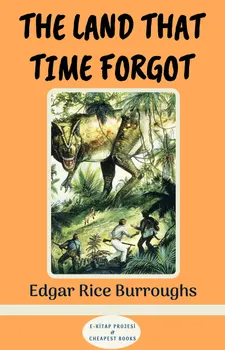
The Land That Time Forgot

The Land That Time Forgot is a fantasy novel by American writer Edgar Rice Burroughs, the first of his Caspak trilogy. His working title for the story was "The Lost U-Boat." The sequence was first published in Blue Book Magazine as a three-part serial in the issues for September, October and November 1918. The complete trilogy was later combined for publication in book form under the title of the first part by A. C. McClurg in June 1924. Beginning with the Ace Books editions of the 1960s, the three segments have usually been issued as separate short novels.

Starting out as a harrowing wartime sea adventure, Burroughs's story ultimately develops into a lost world story reminiscent of such novels as Sir Arthur Conan Doyle's The Lost World (1912) and Jules Verne's The Mysterious Island (1874) and Journey to the Center of the Earth (1864). Burroughs adds his own twist by postulating a unique biological system for his lost world, in which the slow progress of evolution in the world outside is recapitulated as a matter of individual metamorphosis. This system is only hinted at in The Land That Time Forgot; presented as a mystery whose explication is gradually worked out over the course of the next two novels, it forms a thematic element serving to unite three otherwise rather loosely linked stories.

After reading this far, my interest, which already had been stimulated by the finding of the manuscript, was approaching the boiling-point. I had come to Greenland for the summer, on the advice of my physician, and was slowly being bored to extinction, as I had thoughtlessly neglected to bring sufficient reading-matter. Being an indifferent fisherman, my enthusiasm for this form of sport soon waned; yet in the absence of other forms of recreation I was now risking my life in an entirely inadequate boat off Cape Farewell at the southernmost extremity of Greenland. Greenland! As a descriptive appellation, it is a sorry joke-but my story has nothing to do with Greenland, nothing to do with me; so I shall get through with the one and the other as rapidly as possible.
Über dieses Buch

The Land That Time Forgot is a fantasy novel by American writer Edgar Rice Burroughs, the first of his Caspak trilogy. His working title for the story was "The Lost U-Boat." The sequence was first published in Blue Book Magazine as a three-part serial in the issues for September, October and November 1918. The complete trilogy was later combined for publication in book form under the title of the first part by A. C. McClurg in June 1924. Beginning with the Ace Books editions of the 1960s, the three segments have usually been issued as separate short novels.

Starting out as a harrowing wartime sea adventure, Burroughs's story ultimately develops into a lost world story reminiscent of such novels as Sir Arthur Conan Doyle's The Lost World (1912) and Jules Verne's The Mysterious Island (1874) and Journey to the Center of the Earth (1864). Burroughs adds his own twist by postulating a unique biological system for his lost world, in which the slow progress of evolution in the world outside is recapitulated as a matter of individual metamorphosis. This system is only hinted at in The Land That Time Forgot; presented as a mystery whose explication is gradually worked out over the course of the next two novels, it forms a thematic element serving to unite three otherwise rather loosely linked stories.

After reading this far, my interest, which already had been stimulated by the finding of the manuscript, was approaching the boiling-point. I had come to Greenland for the summer, on the advice of my physician, and was slowly being bored to extinction, as I had thoughtlessly neglected to bring sufficient reading-matter. Being an indifferent fisherman, my enthusiasm for this form of sport soon waned; yet in the absence of other forms of recreation I was now risking my life in an entirely inadequate boat off Cape Farewell at the southernmost extremity of Greenland. Greenland! As a descriptive appellation, it is a sorry joke-but my story has nothing to do with Greenland, nothing to do with me; so I shall get through with the one and the other as rapidly as possible.
Starte noch heute mit diesem Buch für € 0

  • Hole dir während der Testphase vollen Zugriff auf alle Bücher in der App
  • Keine Verpflichtungen, jederzeit kündbar
Jetzt kostenlos testen
Mehr als 52 000 Menschen haben Nextory im App Store und auf Google Play 5 Sterne gegeben.

  1. Neu
    4.0
    #3

    The Beasts of Tarzan

    Edgar Rice Burroughs

  2. Neu

    100 obras maestras que debes leer antes de morir

    Francis Scott Fitzgerald, Mary Shelley, Lyman Frank Baum, Edith Nesbit, Dante Alighieri, Jane Austen, Ambrose Bierce, Emily Brontë, Edgar Rice Burroughs, Lewis Carroll, Wilkie Collins, René Descartes, Charles Dickens, Emily Dickinson, Alexandre Dumas, Gustave Flaubert, Benito Pérez Galdós, Johann Wolfgang Goethe, Thomas Hardy, E. T. Hoffmann, Washington Irving, Henry James, James Joyce, Franz Kafka, Gaston Leroux, Federico García Lorca, H.P. Lovecraft, Publio Virgilio Marón, Lucy Maud Montgomery, John William Polidori, Marco Polo, Antoine de Saint-Exupéry, Emilio Salgari, Walter Scott, Mark Twain, Jules Verne

  3. The Outlaw of Torn

    Edgar Rice Burroughs

  4. Neu
    2.0

    The Lost Continent

    Edgar Rice Burroughs

  5. Neu

    The Mad King

    Edgar Rice Burroughs

  6. Neu

    The Mucker

    Edgar Rice Burroughs

  7. Neu

    50 Masterpieces You Must Read Before You Die : Timeless Classics That Will Enrich Your Mind and Soul

    Louisa May Alcott, Jane Austen, Joseph Conrad, D. H. Lawrence, George Eliot, Leo Tolstoy, James Joyce, Charles Dickens, Bram Stoker, Oscar Wilde, Honoré de Balzac, Edgar Rice Burroughs, Anne Brontë, Charlotte Brontë, Emily Brontë, Lewis Carroll, Willa Cather, Miguel de Cervantes, E. E. Cummings, Fyodor Dostoyevsky, Daniel Defoe, Arthur Conan Doyle, Alexandre Dumas, Gustave Flaubert, Henry James, Victor Hugo

  8. Neu

    30 Suspense and Thriller Masterpieces

    Marcel Allain, Grant Allen, John Buchan, Edgar Rice Burroughs, Gilbert Keith Chesterton, Erskine Childers, Wilkie Collins, Arthur Griffiths, Henry Rider Haggard, Thomas Hardy, Anthony Hope, William Andrew Johnston, Frederic Arnold Kummer, William Le Queux, Frank Norris, Edward Phillips Oppenheim, Mary Roberts Rinehart, Allen Upward, Louis Joseph Vance, Edgar Wallace, Fred Merrick White

  9. Neu

    50 Masterpieces you have to read before you die vol 1

    Louisa May Alcott, Jane Austen, Joseph Conrad, Edwin Abbott Abbott, George Eliot, Leo Tolstoy, James Joyce, Charles Dickens, Bram Stoker, Oscar Wilde, Honoré de Balzac, Edgar Rice Burroughs, Anne Brontë, Charlotte Brontë, Emily Brontë, Lewis Carroll, Willa Cather, Miguel de Cervantes, E. E. Cummings, Fyodor Dostoyevsky, Daniel Defoe, Arthur Conan Doyle, Alexandre Dumas, Gustave Flaubert, Henry James, Victor Hugo

  10. Ikuinen rakastaja

    Edgar Rice Burroughs

  11. Effektivitetsexperten

    Edgar Rice Burroughs

  12. 100 Clásicos de la Literatura Universal

    Francis Scott Fitzgerald, Mary Shelley, Lyman Frank Baum, Louisa May Alcott, Dante Alighieri, Jane Austen, Ambrose Bierce, Emily Brontë, Edgar Rice Burroughs, Lewis Carroll, Wilkie Collins, René Descartes, Charles Dickens, Emily Dickinson, Alexandre Dumas, Gustave Flaubert, Benito Pérez Galdós, Johann Wolfgang von Goethe, Thomas Hardy, E T A Hoffmann, Washington Irving, Henry James, James Joyce, Franz Kafka, Gaston Leroux, Federico García Lorca, H.P. Lovecraft, Publio Virgilio Marón, Lucy Maud Montgomery, John William Polidori, Marco Polo, Antoine de Saint-Exupéry, Emilio Salgari, Walter Scott, Mark Twain, Jules Verne, Julio Verne, H.G. Wells, Edith Wharton, Mary Wollstonecraft, Stefan Zweig, Sun Tzu, Bram Stoker, - Aristoteles, George Bernard Shaw, Henryk Sienkiewicz, Concepción Arenal, Charlotte Brontë, Miguel de Cervantes, G.K. Chesterton, Daniel Defoe, Fyodor Mikhailovich Dostoyevsky, Arthur Conan Doyle, Sigmund Freud, H. Rider Haggard, Homero, Immanuel Kant, Rudyard Kipling, Molière, Friedrich Nietzsche, Fernando de Rojas, Sófocles, William Makepeace Thackeray, León Tolstói, Voltaire, Ramón María del Valle-Inclán, Oscar Wilde, Virginia Woolf