3.3(3)

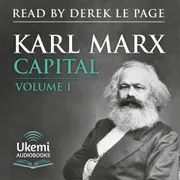
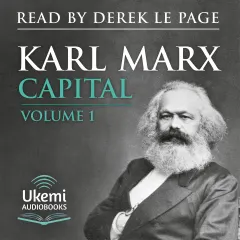
Capital : Volume 1: A Critique of Political Economy

It can be said of very few books that the world was changed as a result of its publication - but this is certainly the case of Capital: A Critique of Political Economy by Karl Marx (1818-1883). Volume 1 appeared (in German) in 1867, and the two subsequent volumes appeared at later dates after the author's death - completed from extensive notes left by Marx himself.

Marx, famously writing in the Reading Room of the British Museum, set out to draw on theories of labour, money and economics developed by many key figures in previous centuries and then present a vivid picture of the effect of (as he saw it) the vicious exploitation of labour and the power-play and greed of that class of unprincipled businessmen - the capitalists. He starts by considering commodity, value and exchange. In doing so he looks at the basic processes involved in labour productivity and how it turns into excessive surplus value at the expense of the labourer himself. But do not think that that this is a dry analysis of the nuts and bolts of economics. Soon Marx, from extensive research, begins to outline the horrifying effect of the industrial revolution (for all its benefits) on the working man, woman and child, the blighting of their lives and slow, oh so slow, march of correcting Acts of Parliaments through the 19th century. These two threads - exploitation economics and the personal plight of the worker - continue to be developed side by side and intertwine with conclusions to become a truly powerful and emotional polemic.

Sometimes it becomes clear that his observations are hugely relevant to our 24 hour life, our gig economy and our international economy, with a frightening percentage of world wealth being held in a few hands. This is not an easy book but, especially in the hands of Derek Le Page, who has incorporated all the relevant footnotes (and they are extensive), it is a compelling listen. Whatever the nightmare of 20th century communism, to ignore this book is misjudge it. Marx said, 'Philosophers have previously tried to explain the world; our task is to change it'. And he meant it.

Translation: Samuel Moore and Edward Aveling.

Starten Sie noch heute mit diesem Buch für 0 €

  • Hole dir während der Testphase vollen Zugriff auf alle Bücher in der App
  • Keine Verpflichtungen, jederzeit kündbar
Jetzt kostenlos testen
Mehr als 52 000 Menschen haben Nextory im App Store und auf Google Play 5 Sterne gegeben.

  1. 50 Meisterwerke der Philosophie : Metaphysik, Das Gastmahl, Bhagavadgita, Tractatus logico-philosophicus, Kritik der reinen Vernunft, Also sprach Zarathustra, Selbstbetrachtungen von Marcus Aurelius

    Ludwig Wittgenstein, Edmund Husserl, Karl Marx, Søren Kierkegaard, Friedrich Nietzsche, Ralph Waldo Emerson, John Stuart Mill, Georg Wilhelm Friedrich Hegel, Friedrich Schelling, Johann Gottlieb Fichte, Immanuel Kant, John Locke, Montesquieu, Jean-Jacques Rousseau, David Hume, Gottfried Wilhelm Leibniz, Baruch Spinoza, - Konfuzius, Lao Tse, Platon, Xenophon, - Aristoteles, Marcus Tullius Cicero, Seneca, Epiktet, Marc Aurel, Plotin, Thomas von Aquin, Nicolaus von Cues, - Erasmus von Rotterdam, Niccolò Machiavelli, Tommaso Campanella, Martin Luther, Giordano Bruno, Samuel von Pufendorf, Abbé Castel de Saint-Pierre, Michel de Montaigne, René Descartes, Francis Bacon, Blaise Pascal

  2. Klassiker des politischen Denkens: Die große Hörbuch Box : Ein Grundlagenwerk der Politik

    Karl Marx, Sun Tzu, Immanuel Kant, Max Weber, Benjamin Franklin, Platon, Niccolò Machiavelli, Georg Büchner

  3. The Communist Manifesto : Karl Marx & Friedrich Engels' Revolutionary Call

    Friedrich Engels, Karl Marx

  4. 5.0

    Wage Labour and Capital :

    Karl Marx

  5. Collected Works Of Marxism, Anarchism, Communism

    Karl Marx, Friedrich Engels, Rosa Luxemburg, Peter Kropotkin, Emma Goldman, Vladimir Lenin, Leon Trotsky

  6. Anarchistische Theorie: Ausgewählte philosophische Werke : Die Anarchisten; Anarchismus und revolutionäre Taktik; Memoiren eines Revolutionärs; Der Freiheitsucher

    Erich Mühsam, Michael Bakunin, Peter Kropotkin, John Henry Mackay, Wilhelm Liebknecht, Fritz Mauthner, Johann Most, Walther Rathenau, Karl Marx

  7. 5.0

    Das kommunistische Manifest : Mit Texten zu seiner Entstehung & historischen Kontextualisierung

    Karl Marx, Friedrich Engels

  8. Meisterwerke der Weltphilosophie : Das Gastmahl, Nikomachische Ethik, Also sprach Zarathustra, Utopia, Phänomenologie des Geistes, Neues Organon, Selbstbetrachtungen

    Immanuel Kant, Søren Kierkegaard, Edmund Husserl, Ludwig Wittgenstein, Friedrich Nietzsche, - Konfuzius, Platon, Xenophon, - Aristoteles, Lao Tse, Marcus Tullius Cicero, Marcus Aurelius, Plotin, Thomas von Aquin, Niccolò Machiavelli, Thomas Morus, Giordano Bruno, Michel de Montaigne, René Descartes, Francis Bacon, Blaise Pascal, Baruch Spinoza, Gottfried Wilhelm Leibniz, David Hume, Jean-Jacques Rousseau, Friedrich Schelling, John Locke, Georg Wilhelm Hegel, John Stuart Mill, Karl Marx

  9. 5.0

    Lohn, Preis und Profit

    Karl Marx

  10. 4.5

    Das kommunistische Manifest

    Karl Marx, Friedrich Engels

  11. Gekürzt
    4.0

    Das Kapital : Kritik der Politischen Ökonomie

    Karl Marx

  12. Zur Judenfrage : Politische Emanzipation der Juden in Preußen (Die Frage von dem Verhältnis der Religion zum Staat)

    Karl Marx