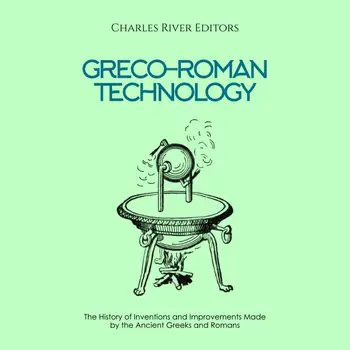
Greco-Roman Technology: The History of Inventions and Improvements Made by the Ancient Greeks and Romans

In virtually all fields of human endeavor Athens was so much at the forefront of dynamism and innovation that the products of its most brilliant minds remain not only influential but entirely relevant to this day. In the field of medicine, the great physician Hippocrates not only advanced the practical knowledge of human anatomy and care-giving but changed the entire face of the medical profession. The great philosophers of Athens, men like Aristotle, Socrates, and Plato, interrogated themselves with startling complexity about the nature of good and evil, questioned the existence of divinity, advocated intelligent design, and went so far as to argue that all life was composed of infinitesimal particles. Great architects and sculptors such as Phidias produced works of art of such breathtaking realism and startling dynamism that they later formed the driving force behind the resurgence of sculpture during the Renaissance and served as masters to artists such as Michelangelo, Bernini, and Donatello. And this does not take into account the host of equally brilliant mathematicians, natural philosophers, historians, astronomers and politicians that the city’s great schools nurtured and produced.

The modern world has the ancient Romans to thank for the origins of many modern technologies, conveniences, and ideas, from running water, baths, and republican style government to roads. Similarly, by the 3rd century BCE, the Romans were prodigious monument builders, so much so that the memory of the great Roman Republic and the Roman Empire continues to exist within a cityscape of stone. Rome’s public spaces were filled with statues, arches, temples, and many other varieties of monumental images, and each of these structures had its own civic or religious function. At the same time, most were embedded with stories, messages, and symbolism so that they also tended to function as propaganda.


Über dieses Buch

In virtually all fields of human endeavor Athens was so much at the forefront of dynamism and innovation that the products of its most brilliant minds remain not only influential but entirely relevant to this day. In the field of medicine, the great physician Hippocrates not only advanced the practical knowledge of human anatomy and care-giving but changed the entire face of the medical profession. The great philosophers of Athens, men like Aristotle, Socrates, and Plato, interrogated themselves with startling complexity about the nature of good and evil, questioned the existence of divinity, advocated intelligent design, and went so far as to argue that all life was composed of infinitesimal particles. Great architects and sculptors such as Phidias produced works of art of such breathtaking realism and startling dynamism that they later formed the driving force behind the resurgence of sculpture during the Renaissance and served as masters to artists such as Michelangelo, Bernini, and Donatello. And this does not take into account the host of equally brilliant mathematicians, natural philosophers, historians, astronomers and politicians that the city’s great schools nurtured and produced.

The modern world has the ancient Romans to thank for the origins of many modern technologies, conveniences, and ideas, from running water, baths, and republican style government to roads. Similarly, by the 3rd century BCE, the Romans were prodigious monument builders, so much so that the memory of the great Roman Republic and the Roman Empire continues to exist within a cityscape of stone. Rome’s public spaces were filled with statues, arches, temples, and many other varieties of monumental images, and each of these structures had its own civic or religious function. At the same time, most were embedded with stories, messages, and symbolism so that they also tended to function as propaganda.

Starte noch heute mit diesem Buch für 0 €

  • Hole dir während der Testphase vollen Zugriff auf alle Bücher in der App
  • Keine Verpflichtungen, jederzeit kündbar
Jetzt kostenlos testen
Mehr als 52 000 Menschen haben Nextory im App Store und auf Google Play 5 Sterne gegeben.

  1. 2.0

    Die Panzer: Die Geschichte und das Vermächtnis von Nazideutschlands berühmtesten Panzern des Zweiten Weltkriegs

    Charles River Editors

  2. 3.8

    Hans-Ulrich Rudel: The Life and Legacy of the Luftwaffe’s Deadliest Stuka Pilot

    Charles River Editors

  3. The Colonization of South Africa: The History and Legacy of the European Subjugation of South Africa

    Charles River Editors

  4. 4.5

    The Great Schism: The History and Legacy of the Split Between the Catholic and Eastern Orthodox Churches in 1054

    Charles River Editors

  5. The Biggest Tank Battles of the World Wars: Tank Warfare in History’s Deadliest Conflicts

    Charles River Editors

  6. Ada Lovelace: The Life and Legacy of the Math Prodigy Who Pioneered Computer Science

    Charles River Editors

  7. Imperial Germany’s Colonization in Africa: The History of the German Efforts and Conflicts to Colonize Parts of Africa

    Charles River Editors

  8. Eleanor of Aquitaine and Richard the Lionheart: The History of the Mother and Son Who Shaped Medieval Europe

    Charles River Editors

  9. The Texas Revolution and Mexican-American War: The History and Legacy of the Conflicts that Led to Mexico’s Cession of the American Southwest

    Charles River Editors

  10. Das mittelalterliche Russland: Die Geschichte und das Erbe der Gruppen, die den russischen Staat im Mittelalter entwickelten

    Charles River Editors

  11. The Colonies of British South Africa: The History and Legacy of British Imperialism in Modern South Africa and Zimbabwe

    Charles River Editors

  12. The Iranian Revolution and Iran Hostage Crisis: The History of the Events that Broke American Relations with Iran

    Charles River Editors