4.5(4)

The Decline and Rise of Democracy : A Global History from Antiquity to Today

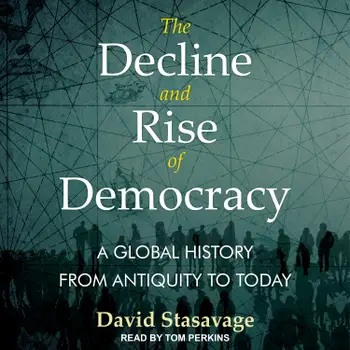
Historical accounts of democracy's rise tend to focus on ancient Greece and pre-Renaissance Europe. The Decline and Rise of Democracy draws from global evidence to show that the story is much richer—democratic practices were present in many places, at many other times. David Stasavage makes the case that understanding how and where these democracies flourished—and when and why they declined—can provide crucial information not just about the history of governance, but about the ways modern democracies work and where they could manifest in the future.

Drawing from examples spanning several millennia, Stasavage first considers why states developed either democratic or autocratic styles of governance and argues that early democracy tended to develop in small places with a weak state and, counterintuitively, simple technologies. When central state institutions (such as a tax bureaucracy) were absent—as in medieval Europe—rulers needed consent from their populace to govern. When central institutions were strong—as in China or the Middle East—consent was less necessary and autocracy more likely. He then explores the transition from early to modern democracy, which first took shape in England and then the United States, illustrating that modern democracy arose as an effort to combine popular control with a strong state over a large territory.

Sobre este libro

Historical accounts of democracy's rise tend to focus on ancient Greece and pre-Renaissance Europe. The Decline and Rise of Democracy draws from global evidence to show that the story is much richer—democratic practices were present in many places, at many other times. David Stasavage makes the case that understanding how and where these democracies flourished—and when and why they declined—can provide crucial information not just about the history of governance, but about the ways modern democracies work and where they could manifest in the future.

Drawing from examples spanning several millennia, Stasavage first considers why states developed either democratic or autocratic styles of governance and argues that early democracy tended to develop in small places with a weak state and, counterintuitively, simple technologies. When central state institutions (such as a tax bureaucracy) were absent—as in medieval Europe—rulers needed consent from their populace to govern. When central institutions were strong—as in China or the Middle East—consent was less necessary and autocracy more likely. He then explores the transition from early to modern democracy, which first took shape in England and then the United States, illustrating that modern democracy arose as an effort to combine popular control with a strong state over a large territory.

Empieza hoy con este libro por 0 €

  • Disfruta de acceso completo a todos los libros de la app durante el periodo de prueba
  • Sin compromiso, cancela cuando quieras
Pruébalo gratis ahora
Más de 52 000 clientes han dado a Nextory 5 estrellas en la App Store y Google Play.