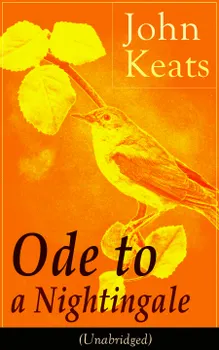
John Keats: Ode to a Nightingale (Unabridged)

This carefully crafted ebook: "John Keats: Ode to a Nightingale (Unabridged)" is formatted for your eReader with a functional and detailed table of contents.

"Ode to a Nightingale" is either the garden of the Spaniards Inn, Hampstead, London, or, according to Keats' friend Charles Armitage Brown, under a plum tree in the garden of Keats House, also in Hampstead. According to Brown, a nightingale had built its nest near his home in the spring of 1819. Inspired by the bird's song, Keats composed the poem in one day. It soon became one of his 1819 odes and was first published in Annals of the Fine Arts the following July. "Ode to a Nightingale" is a personal poem that describes Keats's journey into the state of Negative Capability. The tone of the poem rejects the optimistic pursuit of pleasure found within Keats's earlier poems and explores the themes of nature, transience and mortality, the latter being particularly personal to Keats. The nightingale described within the poem experiences a type of death but does not actually die. Instead, the songbird is capable of living through its song, which is a fate that humans cannot expect.

John Keats (1795-1821) was an English Romantic poet. The poetry of Keats is characterized by sensual imagery, most notably in the series of odes. Today his poems and letters are some of the most popular and most analyzed in English literature.
Über dieses Buch

This carefully crafted ebook: "John Keats: Ode to a Nightingale (Unabridged)" is formatted for your eReader with a functional and detailed table of contents.

"Ode to a Nightingale" is either the garden of the Spaniards Inn, Hampstead, London, or, according to Keats' friend Charles Armitage Brown, under a plum tree in the garden of Keats House, also in Hampstead. According to Brown, a nightingale had built its nest near his home in the spring of 1819. Inspired by the bird's song, Keats composed the poem in one day. It soon became one of his 1819 odes and was first published in Annals of the Fine Arts the following July. "Ode to a Nightingale" is a personal poem that describes Keats's journey into the state of Negative Capability. The tone of the poem rejects the optimistic pursuit of pleasure found within Keats's earlier poems and explores the themes of nature, transience and mortality, the latter being particularly personal to Keats. The nightingale described within the poem experiences a type of death but does not actually die. Instead, the songbird is capable of living through its song, which is a fate that humans cannot expect.

John Keats (1795-1821) was an English Romantic poet. The poetry of Keats is characterized by sensual imagery, most notably in the series of odes. Today his poems and letters are some of the most popular and most analyzed in English literature.
Starte noch heute mit diesem Buch für € 0

  • Hole dir während der Testphase vollen Zugriff auf alle Bücher in der App
  • Keine Verpflichtungen, jederzeit kündbar
Jetzt kostenlos testen
Mehr als 52 000 Menschen haben Nextory im App Store und auf Google Play 5 Sterne gegeben.

  1. Neu

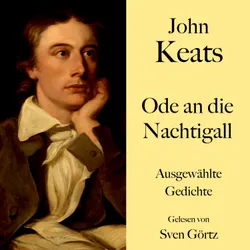
    John Keats: Ode an die Nachtigall : Ausgewählte Gedichte

    John Keats

  2. Lyrikalische Bibliothek

    Heinrich Heine, Annette von Droste-Hülshoff, Charles Baudelaire, John Keats, Rainer Maria Rilke, Georg Heym, Wilhelm Busch, Arno Holz, Johann Wolfgang von Goethe, Christian Morgenstern, Joachim Ringelnatz, Georg Trakl, Ludwig Tieck, Stefan Zweig, Hugo von Hoffmannsthal, Edgar Allan Poe, Frank Wedekind, Franz Werfel, Wolfgang Borchert, Karl Kraus, Kurt Tucholsky, Friedrich Nietzsche, Else Lasker-Schüler, Ludwig Kalisch, Jakob van Hoddis, Joseph von Eichendorff, Gotthold Ephraim Lessing

  3. Endimión

    John Keats

  4. Poesía [Antología bilingüe]

    John Keats

  5. Cartas. Antología

    John Keats

  6. Lyrikalische Lesung Episoden 91-95

    Arno Holz, John Keats, Annette von Droste-Hülshoff, Charles Baudelaire, Rainer Maria Rilke

  7. Lyrikalische Lesung Episoden 76-80

    Christian Morgenstern, Karl Kraus, Wolfgang Borchert, Kurt Tucholsky, Annette von Droste-Hülshoff, John Keats, Rainer Maria Rilke

  8. Lyrikalische Lesung Episoden 66-70

    John Keats, Wilhelm Busch, Ludwig Tieck, Rainer Maria Rilke, Johann Wolfgang von Goethe

  9. Lyrikalische Lesung Episoden 61-65

    Wilhelm Busch, Joachim Ringelnatz, Arno Holz, John Keats, Charles Baudelaire, Annette von Droste-Hülshoff, Else Lasker-Schüler, Georg Heym, Heinrich Heine

  10. Lyrikalische Lesung Episoden 56-60

    Johann Wolfgang von Goethe, John Keats, Annette von Droste-Hülshoff, Arno Holz, Wilhelm Busch, Georg Heym, Heinrich Heine, Franz Werfel, Charles Baudelaire, Rainer Maria Rilke, Friedrich Nietzsche, Hugo von Hofmannsthal, Edgar Allan Poe

  11. Lyrikalische Lesung Episoden 46-50

    Ludwig Kalisch, Else Lasker-Schüler, Annette von Droste-Hülshoff, Edgar Allan Poe, Charles Baudelaire, Hugo von Hoffmannsthal, Arno Holz, John Keats, Heinrich Heine, Karl Kraus, Georg Heym, Joachim Ringelnatz, Ludwig Tieck, Franz Werfel, Kurt Tucholsky, Johann Wolfgang von Goethe, Rainer Maria Rilke, Jakob van Hoddis, Wilhelm Busch

  12. 100 Meisterwerke der englischen Literatur - Klassiker, die man kennen muss

    George Orwell, Charles Dickens, Jane Austen, Katherine Mansfield, H.P. Lovecraft, William Wordsworth, John Keats, Percy Bysshe Shelley, Robert Burns, John Milton, William Shakespeare, Christopher Marlowe, Geoffrey Chaucer, Laurence Sterne, Henry Fielding, Mary Shelley, Emily Brontë, Charlotte Brontë, Anne Brontë, William Makepeace Thackeray, George Eliot, D. H. Lawrence, Herman Melville, Thomas Wolfe, Virginia Woolf, Joseph Conrad, Sinclair Lewis, Walt Whitman, Edgar Allan Poe, Oscar Wilde, Jerome K Jerome, Washington Irving, Bram Stoker, H.G. Wells, Daniel Defoe, Lew Wallace, James Fenimore Cooper, Jonathan Swift, Robert Louis Stevenson, Mark Twain, Lewis Carrol, Edward Bulwer-Lytton, F. Scott Fitzgerald, Arthur Conan Doyle, Jack London, Henry David Thoreau, G.K. Chesterton, Edith Wharton, Henry James, Thomas Hardy, Margaret Mitchell, Kate Chopin, Willa Cather, Charlotte Perkins Gilman, James Joyce, John Galsworthy, Francis Hodgson Burnett, Lucy Maud Montgomery, Louisa May Alcott, Rudyard Kipling