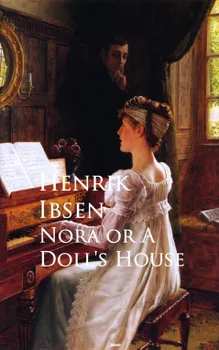
Nora or A Doll's House : Bestsellers and famous Books

The play is significant for its critical attitude toward 19th-century marriage norms. It aroused great controversy at the time,[2] as it concludes with the protagonist, Nora, leaving her husband and children because she wants to discover herself. Ibsen was inspired by the belief that "a woman cannot be herself in modern society," since it is "an exclusively male society, with laws made by men and with prosecutors and judges who assess feminine conduct from a masculine standpoint." Its ideas can also be seen as having a wider application: Michael Meyer argued that the play's theme is not women's rights, but rather "the need of every individual to find out the kind of person he or she really is and to strive to become that person." In a speech given to the Norwegian Association for Women's Rights in 1898, Ibsen insisted that he "must disclaim the honor of having consciously worked for the women's rights movement," since he wrote "without any conscious thought of making propaganda," his task having been "the description of humanity."

In 2006, the centennial of Ibsen's death, A Doll's House held the distinction of being the world's most performed play for that year. UNESCO has inscribed Ibsen's autographed manuscripts of A Doll's House on the Memory of the World Register in 2001, in recognition of their historical value.

Über dieses Buch

The play is significant for its critical attitude toward 19th-century marriage norms. It aroused great controversy at the time,[2] as it concludes with the protagonist, Nora, leaving her husband and children because she wants to discover herself. Ibsen was inspired by the belief that "a woman cannot be herself in modern society," since it is "an exclusively male society, with laws made by men and with prosecutors and judges who assess feminine conduct from a masculine standpoint." Its ideas can also be seen as having a wider application: Michael Meyer argued that the play's theme is not women's rights, but rather "the need of every individual to find out the kind of person he or she really is and to strive to become that person." In a speech given to the Norwegian Association for Women's Rights in 1898, Ibsen insisted that he "must disclaim the honor of having consciously worked for the women's rights movement," since he wrote "without any conscious thought of making propaganda," his task having been "the description of humanity."

In 2006, the centennial of Ibsen's death, A Doll's House held the distinction of being the world's most performed play for that year. UNESCO has inscribed Ibsen's autographed manuscripts of A Doll's House on the Memory of the World Register in 2001, in recognition of their historical value.

Starte noch heute mit diesem Buch für € 0

  • Hole dir während der Testphase vollen Zugriff auf alle Bücher in der App
  • Keine Verpflichtungen, jederzeit kündbar
Jetzt kostenlos testen
Mehr als 52 000 Menschen haben Nextory im App Store und auf Google Play 5 Sterne gegeben.

  1. Neu

    Il piccolo Eyolf : dramma in tre atti

    Henrik Ibsen

  2. Et dukkehjem. Et kanonværk

    Henrik Ibsen

  3. Teatro II

    Henrik Ibsen

  4. Nukkekoti

    Henrik Ibsen

  5. El pato salvaje

    Henrik Ibsen

  6. A Doll's House - Audiobook

    Henrik Ibsen, Classic Audiobooks

  7. 5.0

    Ghosts - Audiobook

    Henrik Ibsen, Classic Audiobooks

  8. Hedda Gabler - Audiobook

    Henrik Ibsen, Classic Audiobooks

  9. La donna del mare

    Henrik Ibsen

  10. 3.3

    Peer Gynt

    Henrik Ibsen

  11. 50 Klassiker des Feminismus - Bücher, die man kennen muss : Das Erwachen, Lelia, Jane Eyre, Neue Amazonia, Die gelbe Tapete, Mrs Dalloway, Kleine Frauen, Verteidigung der Rechte der Frau, Meine brillante Karriere

    Kate Chopin, Charlotte Perkins Gilman, Virginia Woolf, Charlotte Brontë, George Sand, Louisa May Alcott, Jane Austen, L.M. Montgomery, Victor Hugo, Daniel Defoe, Nathaniel Hawthorne, Wilhelmine von Hillern, Adalbert Stifter, Luise Ahlborn, George Eliot, Lou Andreas-Salomé, D. H. Lawrence, Henry James, Margaret Mitchell, Edith Wharton, Miles Franklin, Willa Cather, Leo Tolstoi, Henrik Ibsen, Elizabeth Gaskell, Nikolai Semjonowitsch Leskow, Theodore Dreiser, Elizabeth von Arnim, Colette, Emmeline Pankhurst, Louise Aston, Bertha von Suttner, Hedwig Dohm, Mary Wollstonecraft, Elizabeth Cady Stanton, Matilda Joslyn Gage, John Stuart Mill, Thomas Hardy, Sinclair Lewis, Elizabeth Burgoyne Corbett, Anne Brontë

  12. 20 Feministische Klassiker für junge Aktivistinnen : Verteidigung der Rechte der Frau, Ein Zimmer für sich allein, Die gelbe Tapete, Die Bibel der Frau, Das Erwachen, Neue Amazonia, Kleine Frauen

    Virginia Woolf, Rosa Luxemburg, Kate Chopin, Charlotte Perkins Gilman, Mary Wollstonecraft, Elizabeth Cady Stanton, Matilda Joslyn Gage, John Stuart Mill, Louise Otto, Clara Zetkin, Rosa Mayreder, Bertha Pappenheim, Charlotte Brontë, George Sand, Louisa May Alcott, Sinclair Lewis, Henrik Ibsen, Elizabeth Burgoyne Corbett, Miles Franklin