
In "The Essays of Arthur Schopenhauer: The Art of Controversy," Schopenhauer meticulously examines the nature of debate, rhetoric, and intellectual discourse, employing his characteristic wit and incisive prose. The work is a blend of philosophical inquiry and practical advice, exploring how arguments are constructed and deconstructed. Schopenhauer's literary style is marked by his penetrating insights and an often sardonic tone, reflecting the influence of German Romanticism and his profound skepticism. His exploration extends beyond mere logical argumentation, probing into the psychological aspects of human interaction and conflict, offering timeless strategies for persuasion that remain relevant across centuries. Arthur Schopenhauer, a pivotal figure in 19th-century philosophy, is often hailed as a precursor to existentialism and psychoanalysis. His life experiences—marked by tumultuous relationships and a penchant for solitude—shaped his philosophical outlook, emphasizing the often irrational nature of human desires and conflicts. Schopenhauer's background in metaphysics and aesthetics enriches his essays, providing a unique perspective on the art of contention, further enhancing the reader's understanding of his work. This compelling collection is an essential read for anyone interested in the dynamics of human interaction and the philosophical underpinnings of argumentation. Schopenhauer's insights are not only intellectually stimulating but also practically applicable, making it a valuable resource for scholars, students, and anyone seeking to navigate the complexities of discourse with greater acumen.
The Essays of Arthur Schopenhauer; the Art of Controversy
Starten Sie noch heute mit diesem Buch für € 0
- Hol dir während der Testphase vollen Zugriff auf alle Bücher in der App
- Keine Verpflichtungen, jederzeit kündbar
Autor*in:
Sprache:
Englisch
Format:

100 Meisterwerke der Weltliteratur - Klassiker die man kennen muss
Franz Kafka, Fjodor Michailowitsch Dostojewski, Rumi, Platon, Tacitus, Homer, Sigmund Freud, Friedrich Nietzsche, Oswald Spengler, Alfred Adler, Marcus Aurelius, Arthur Schopenhauer, Walt Whitman, Joseph Conrad, Robert Louis Stevenson, Karl May, Alexandre Dumas, James Fenimore Cooper, Arthur Conan Doyle, Edgar Allan Poe, Mary Shelley, O.Henry, Stefan Zweig, Charles Dickens, Jacob Grimm, Wilhelm Grimm, Hans Christian Andersen, Joseph von Eichendorff, Klaus Mann, Johann Wolfgang von Goethe, Jane Austen, Emily Brontë, Charlotte Brontë, Else Lasker-Schüler, Heinrich Heine, Herman Melville, Iwan Sergejewitsch Turgenew, Gustav Freytag, Thomas Wolfe, Jonathan Swift, Walter Scott, Nathaniel Hawthorne, Gustave Flaubert, Rainer Maria Rilke, John Galsworthy, Iwan Alexandrowitsch Gontscharow, Oscar Wilde, Lew Wallace, Voltaire, Lewis Carroll, Johanna Spyri, Mark Twain, Selma Lagerlöf, Rudyard Kipling, Jules Verne, Jack London, Miguel de Cervantes, Honoré de Balzac, Emile Zola, Guy De Maupassant, Moliere, Theodor Fontane, Nikolai Gogol, Leo Tolstoi, Anton Pawlowitsch Tschechow, Dante Alighieri, Joseph Roth, Robert Musil, E. T. Hoffmann, Heinrich Mann, Kurt Tucholsky, Heinrich von Kleist, Annette von Droste-Hülshoff, Gottfried Keller, Sophie von La Roche, Theodor Storm, William Shakespeare
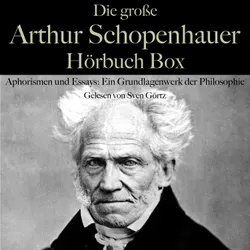
Die große Arthur Schopenhauer Hörbuch Box : Aphorismen und Essays: Ein Grundlagenwerk der Philosophie
Arthur Schopenhauer

Grundeinteilung
Arthur Schopenhauer

Vom Unterschiede der Lebensalter
Arthur Schopenhauer

Die Kunst, Recht zu behalten
Arthur Schopenhauer

Paränesen und Maximen
Arthur Schopenhauer

Über die Weiber
Arthur Schopenhauer

Über das Geistersehn (Ungekürzt)
Arthur Schopenhauer

Aphorismen zur Lebensweisheit. Ein philosophisches Meisterwerk. : Hörbuchzeit: Klassiker der Weltliteratur
Hörbuchzeit, Arthur Schopenhauer

Versuch über das Geistersehn und was damit zusammenhängt. Ein Grundlagenwerk der Philosophie. : Hörbuchzeit: Klassiker der Weltliteratur
Hörbuchzeit, Arthur Schopenhauer

Die Kunst Recht zu behalten. Ein Grundlagenwerk der Philosophie. : Hörbuchzeit: Klassiker der Weltliteratur
Hörbuchzeit, Arthur Schopenhauer

Ce que l’on est, ce que l’on a, et ce que l’on représente : Aphorismes sur la sagesse de la vie
Arthur Schopenhauer