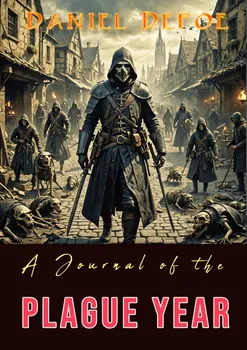
A Journal of the Plague Year : "Illustrated"

This is the Illustrated version of the "A Journal of the Plague Year", A work that is often read as if it were non-fiction is his account of the Great Plague of London in 1665: A Journal of the Plague Year, a complex historical novel published in 1722.

Bring out your dead! The ceaseless chant of doom echoed through a city of emptied streets and filled grave pits. For this was London in the year of 1665, the Year of the Great Plague....In 1721, when the Black Death again threatened the European Continent, Daniel Defoe wrote "A Journal of the Plague Year" to alert an indifferent populace to the horror that was almost upon them. Through the eyes of a saddler who had chosen to remain while multitudes fled, the master realist vividly depicted a plague-stricken city. He re-enacted the terror of a helpless people caught in a tragedy they could not comprehend: the weak preying on the dying, the strong administering to the sick, the sinful orgies of the cynical, the quiet faith of the pious. With dramatic insight he captured for all time the death throes of a great city.

In this Illustrated book, Noted all of Defoe's pamphlet writing was political. One pamphlet (originally published anonymously) entitled "A True Relation of the Apparition of One Mrs. Veal the Next Day after her Death to One Mrs. Bargrave at Canterbury the 8th of September, 1705," deals with interaction between the spiritual realm and the physical realm. It was most likely written in support of Charles Drelincourt's The Christian Defense against the Fears of Death (1651). It describes Mrs. Bargrave's encounter with an old friend Mrs. Veal, after she had died. It is clear from this piece and other writings, that while the political portion of

Defoe's life was fairly dominant, it was by no means the only aspect:

"Wherever God erects a house of prayer

the Devil always builds a chapel there;

And 't will be found, upon examination,

the latter has the largest congregation."

— Defoe's The True-Born Englishman, 1701

Copyright & Illustrated by e-Kitap Projesi

ABOUT AUTHOR:

Daniel Defoe ( 1660 – 1731), born Daniel Foe, was an English trader, writer, journalist, pamphleteer, and spy, now most famous for his novel Robinson Crusoe.
Om denne bog

This is the Illustrated version of the "A Journal of the Plague Year", A work that is often read as if it were non-fiction is his account of the Great Plague of London in 1665: A Journal of the Plague Year, a complex historical novel published in 1722.

Bring out your dead! The ceaseless chant of doom echoed through a city of emptied streets and filled grave pits. For this was London in the year of 1665, the Year of the Great Plague....In 1721, when the Black Death again threatened the European Continent, Daniel Defoe wrote "A Journal of the Plague Year" to alert an indifferent populace to the horror that was almost upon them. Through the eyes of a saddler who had chosen to remain while multitudes fled, the master realist vividly depicted a plague-stricken city. He re-enacted the terror of a helpless people caught in a tragedy they could not comprehend: the weak preying on the dying, the strong administering to the sick, the sinful orgies of the cynical, the quiet faith of the pious. With dramatic insight he captured for all time the death throes of a great city.

In this Illustrated book, Noted all of Defoe's pamphlet writing was political. One pamphlet (originally published anonymously) entitled "A True Relation of the Apparition of One Mrs. Veal the Next Day after her Death to One Mrs. Bargrave at Canterbury the 8th of September, 1705," deals with interaction between the spiritual realm and the physical realm. It was most likely written in support of Charles Drelincourt's The Christian Defense against the Fears of Death (1651). It describes Mrs. Bargrave's encounter with an old friend Mrs. Veal, after she had died. It is clear from this piece and other writings, that while the political portion of

Defoe's life was fairly dominant, it was by no means the only aspect:

"Wherever God erects a house of prayer

the Devil always builds a chapel there;

And 't will be found, upon examination,

the latter has the largest congregation."

— Defoe's The True-Born Englishman, 1701

Copyright & Illustrated by e-Kitap Projesi

ABOUT AUTHOR:

Daniel Defoe ( 1660 – 1731), born Daniel Foe, was an English trader, writer, journalist, pamphleteer, and spy, now most famous for his novel Robinson Crusoe.

Kom i gang med denne bog i dag for 0 kr.

  • Få fuld adgang til alle bøger i appen i prøveperioden
  • Ingen forpligtelser, opsiges når som helst
Prøv gratis nu
Mere end 52.000 mennesker har givet Nextory fem stjerner i App Store og Google Play.

  1. 4.1

    Robinson Crusoe

    Maj Bylock, Daniel Defoe

  2. 4.4

    Robinson Crusoe

    Daniel Defoe

  3. 5.0

    50 Masterpieces you have to read before you die vol: 2 : Timeless Classics to Enrich Your Mind and Soul

    Louisa, Jane Austen, Joseph Conrad, D. H. Lawrence, George Eliot, Leo Tolstoy, James Joyce, Charles Dickens, Bram Stoker, Oscar Wilde, Honoré de Balzac, Edgar Rice Burroughs, Anne Brontë, Charlotte Brontë, Emily Brontë, Lewis Carroll, Willa Cather, Miguel de Cervantes, E. E. Cummings, Fyodor Dostoyevsky, Daniel Defoe, Arthur Conan Doyle, Alexandre Dumas, Gustave Flaubert, Henry James, Victor Hugo, HB Classics

  4. #1

    The Life and Adventures of Robinson Crusoe

    Daniel Defoe

  5. The Jolly Roger Tales : Blackbeard, Captain Blood, Facing the Flag, Treasure Island, The Gold-Bug, Captain Singleton…

    Jules Verne, Charles Dickens, Robert Louis Stevenson, James Fenimore Cooper, Edgar Allan Poe, William Hope Hodgson, Howard Pyle, Jack London, Arthur Conan Doyle, Richard Le Gallienne, Daniel Defoe, Alexandre Dumas, Charles Ellms, Frederick Marryat, Harold MacGrath, Joseph Lewis French, Harry Collingwood, Stanley Lane-Poole, Charles Boardman Hawes, L. Frank Baum, J.M. Barrie, R.M Ballantyne, G. A Henty, J. D. Kelley, J. Allan Dunn, Robert E. Howard, F. Scott Fitzgerald, Sir Walter Scott, Ralph D. Paine, Captain Charles Johnson, W. H. Kingston, Currey E. Hamilton, John Esquemeling

  6. 5.0

    The Power of Darkness : The Legend of Sleepy Hollow, Sweeney Todd, Frankenstein, Dracula, The Haunted House, Dead Souls…

    Wilhelm Hauff, Charles Dickens, Mark Twain, Harriet Beecher Stowe, Adelbert von Chamisso, Oscar Wilde, Robert Louis Stevenson, Edgar Allan Poe, William Hope Hodgson, Joseph Sheridan Fanu, John Buchan, Louis Tracy, Bram Stoker, Anatole France, Charlotte Brontë, Emily Brontë, Jack London, Henry James, Théophile Gautier, Arthur Conan Doyle, Richard Le Gallienne, Jane Austen, Ralph Adams Cram, Thomas De Quincey, John Meade Falkner, Guy De Maupassant, Thomas Hardy, William Archer, Daniel Defoe, John Kendrick Bangs, Cleveland Moffett, Brander Matthews, Marie Belloc Lowndes, Horace Walpole, Rudyard Kipling, Lafcadio Hearn, Hugh Walpole, Ambrose Bierce, Frederick Marryat, Ellis Parker Butler, Washington Irving, Leonid Andreyev, David Lindsay, Nathaniel Hawthorne, Grant Allen, Arthur Machen, Wilkie Collins, William Makepeace Thackeray, Thomas Peckett Prest, James Malcolm Rymer, Fergus Hume, Edward Bellamy, Walter Hubbell, Charlotte Perkins Gilman, Leopold Kompert, Richard Marsh, Florence Marryat, Catherine Crowe, John William Polidori, Vincent O'Sullivan, H.G. Wells, Robert W. Chambers, W. W. Jacobs, M.P. Shiel, E F Benson, Jerome K Jerome, M. R. James, E. T. Hoffmann, Stanley G. Weinbaum, George W. Reynolds, H.P. Lovecraft, Robert E. Howard, Edith Nesbit, Sabine Baring-Gould, William Thomas Beckford, Francis Marion Crawford, Lucy Maud Montgomery, Mary Elizabeth Braddon, Mary Louisa Molesworth, Mary E. Freeman, Nikolai Gogol, Mary Shelley, Elizabeth Gaskell, Edward Bulwer-Lytton, Frank R. Stockton, A. T. Quiller-Couch, Ann Radcliffe, Louisa M. Alcott, Amelia B. Edwards, Leonard Kip, Matthew Gregory Lewis, Fitz-James O’Brien, Katherine Rickford, Bithia Mary Croker, Catherine L. Pirkis, Émile Erckmann, Alexandre Chatrian, Pedro De Alarçon, H. H. (Saki), Pliny the Younger, Helena Blavatsky, Villiers de Adam, William F. Harvey, Fiona Macleod, William T. Stead, Gambier Bolton, Andrew Jackson Davis, Nizida, Walter F. Prince, Chester Bailey Fernando

  7. 5.0

    12 Masterpieces of Erotic literature. Illustrated : Fanny Hill, The 120 Days of Sodom, Venus in Furs, Autobiography of a Flea, The Romance of Lust, The Nunnery Tales and others

    Miche Millot, John Cleland, Daniel Defoe, Marquis De Sade, D. H. Lawrence, Leopold von Sacher-Masoch, Anonymous, Jack Saul

  8. Racconti di fantasmi

    Daniel Defoe

  9. The Great Pirate Adventures

    Jules Verne, Charles Dickens, Robert Louis Stevenson, James Fenimore Cooper, Edgar Allan Poe, William Hope Hodgson, Howard Pyle, Jack London, Arthur Conan Doyle, Richard Le Gallienne, Walter Scott, Daniel Defoe, Alexandre Dumas, Charles Ellms, Frederick Marryat, Harold MacGrath, Joseph Lewis French, Harry Collingwood, Stanley Lane-Poole, Charles Boardman Hawes, L. Frank Baum, J.M. Barrie, R.M Ballantyne, G. A Henty, J. D. Kelley, J. Allan Dunn, Robert E. Howard, F. Scott Fitzgerald, Ralph D. Paine, Captain Charles Johnson, W. H. Kingston, Currey E. Hamilton, John Esquemeling

  10. 50 Masterpieces you have to read

    Louisa May Alcott, Jane Austen, Joseph Conrad, D. H. Lawrence, George Eliot, Leo Tolstoy, James Joyce, Charles Dickens, Bram Stoker, Oscar Wilde, Honoré de Balzac, Edgar Rice Burroughs, Anne Brontë, Charlotte Brontë, Emily Brontë, Lewis Carroll, Willa Cather, Miguel de Cervantes, E. Cummings, Fyodor Dostoyevsky, Daniel Defoe, Arthur Conan Doyle, Alexandre Dumas, Gustave Flaubert, Henry James, Victor Hugo

  11. 3.8

    GADS LETTE KLASSIKERE: Robinson Kruso

    Daniel Defoe

  12. 3.0

    Robinson Crusoe

    Daniel Defoe