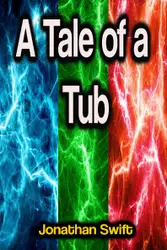
A Tale of a Tub

In "A Tale of a Tub," Jonathan Swift employs a satirical and allegorical narrative to critique religious and cultural dogmas of early 18th-century England. The book tells the stories of three brothers, representing various religious sects, who each inherit a tub that symbolizes their faiths. This richly layered work, employing a distinctive blend of linguistic clarity and complex metaphors, navigates themes of folly, corruption, and the inherent absurdity within organized religion. Swift's vivid imagery and biting irony serve not only to entertain but also to provoke thought about the philosophical vacuity underpinning his contemporary society. Jonathan Swift, an influential figure of the Enlightenment and a master of satire, was acutely aware of the social and political turmoil of his time. His experiences as a clergyman and a political pamphleteer shaped his perspective on the hypocrisy of religious institutions and their impact on human behavior. This background informs "A Tale of a Tub," as Swift deftly critiques not just the practices of religion but also the broader implications of unexamined beliefs and the nature of humanity. Readers seeking to delve into the intricacies of religious criticism and satire will find "A Tale of a Tub" an essential text. Swift invites us into a world where the absurdities of faith and doctrine are laid bare, offering wit and wisdom that resonate even in today's discourse on belief and identity. This work remains a cornerstone in the study of literary satire, encouraging readers to reflect on the nature of adherence and the folly that often accompanies it.

Om denne bog

In "A Tale of a Tub," Jonathan Swift employs a satirical and allegorical narrative to critique religious and cultural dogmas of early 18th-century England. The book tells the stories of three brothers, representing various religious sects, who each inherit a tub that symbolizes their faiths. This richly layered work, employing a distinctive blend of linguistic clarity and complex metaphors, navigates themes of folly, corruption, and the inherent absurdity within organized religion. Swift's vivid imagery and biting irony serve not only to entertain but also to provoke thought about the philosophical vacuity underpinning his contemporary society. Jonathan Swift, an influential figure of the Enlightenment and a master of satire, was acutely aware of the social and political turmoil of his time. His experiences as a clergyman and a political pamphleteer shaped his perspective on the hypocrisy of religious institutions and their impact on human behavior. This background informs "A Tale of a Tub," as Swift deftly critiques not just the practices of religion but also the broader implications of unexamined beliefs and the nature of humanity. Readers seeking to delve into the intricacies of religious criticism and satire will find "A Tale of a Tub" an essential text. Swift invites us into a world where the absurdities of faith and doctrine are laid bare, offering wit and wisdom that resonate even in today's discourse on belief and identity. This work remains a cornerstone in the study of literary satire, encouraging readers to reflect on the nature of adherence and the folly that often accompanies it.
Kom i gang med denne bog i dag for 0 kr.

  • Få fuld adgang til alle bøger i appen i prøveperioden
  • Ingen forpligtelser, opsiges når som helst
Prøv gratis nu
Mere end 52.000 mennesker har givet Nextory fem stjerner i App Store og Google Play.

  1. 4.4

    Gullivers rejser

    Maj Bylock, Jonathan Swift

  2. Gullivers rejser

    Jonathan Swift

  3. I viaggi di Gulliver

    Jonathan Swift

  4. Ny

    50 Clásicos que Debes Leer Antes de Morir : Un viaje literario por los tesoros de la literatura universal

    Dante Alighieri, Aristóteles, Jane Austen, Charles Baudelaire, Giovanni Boccaccio, Anne Brontë, C. Collodi, James Fenimore Cooper, Fedor Mikhaïlovitch Dostoïevski, Arthur Conan Doyle, Alexandre Dumas, José de Espronceda, Gustave Flaubert, Sigmund Freud, Benito Pérez Galdós, Kahlil Gibran, Johann Wolfgang Goethe, Johann Wolfgang von Goethe, Victor Hugo, Thomas Hardy, Nathaniel Hawthorne, Vicente Blasco Ibáñez, Washington Irving, James Joyce, Mariano José de Larra, Jack London, Federico García Lorca, H.P. Lovecraft, Antonio Machado, Gustav Meyrink, John Stuart Mill, Amado Nervo, Friedrich Nietzsche, Solomon Northup, Alexander Sergeyevich Pushkin, Francisco de Quevedo, Walter Scott, William Shakespeare, Robert Louis Stevenson, Harriet Beecher Stowe, Jonathan Swift, Mark Twain, Miguel De Unamuno, Ramón María del Valle-Inclán, Julio Verne, Virginia Woolf

  5. Ny
    4.0

    Los viajes de Gulliver

    Jonathan Swift

  6. Ny

    The Adventure Collection: Treasure Island, The Jungle Book, Gulliver's Travels

    Jonathan Swift, Jack London, Rudyard Kipling, Howard Pyle, Robert Louis Stevenson

  7. Ny

    10 MASTERPIECES OF COMEDY VOL1

    Charles Dickens, Edwin Abbott, Jane Austen, Jerome Klapka Jerome, Jonathan Swift, Mark Twain

  8. 3.9

    Gulliver's Travels

    Jonathan Swift

  9. 3.9

    Gulliver's Travels

    Jonathan Swift

  10. Gulliver’s Travels into several Remote Nations of The World

    Jonathan Swift

  11. #2

    Gulliver - I jättarnas land

    Jonathan Swift

  12. #1

    Gulliver - I småfolkets rike

    Jonathan Swift