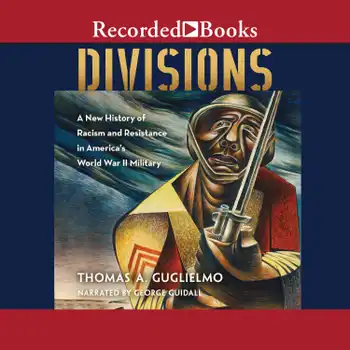
Divisions : A New History of Racism and Resistance in America's World War II Military

America's World War II military was a force of unalloyed good. While saving the world from Nazism, it also managed to unify a famously fractious American people. At least that’s the story many Americans have long told themselves.Divisions offers a decidedly different view. Prizewinning historian Thomas A. Guglielmo

draws together more than a decade of extensive research to tell sweeping yet personal stories of race and the military; of high command and ordinary GIs; and of African Americans, white Americans, Asian Americans,

Latinos, and Native Americans. Guglielmo argues that the military built not one color line, but a complex tangle of them. Taken together, they represented a sprawling structure of white supremacy. Freedom struggles arose in response, democratizing portions of the wartime military and setting the stage for postwar

desegregation and the subsequent civil rights movements. But the costs of the military’s color lines were devastating. They impeded America’s war effort, undermined the nation’s rhetoric of the Four Freedoms, further naturalized the concept of race, deepened many whites’ investments in white supremacy, and

further fractured the American people.

Offering a dramatic narrative of America’s World War II military and of the postwar world it helped to fashion, Guglielmo fundamentally reshapes our understanding of the war and of mid-twentieth-century America.

Om denne bog

America's World War II military was a force of unalloyed good. While saving the world from Nazism, it also managed to unify a famously fractious American people. At least that’s the story many Americans have long told themselves.Divisions offers a decidedly different view. Prizewinning historian Thomas A. Guglielmo

draws together more than a decade of extensive research to tell sweeping yet personal stories of race and the military; of high command and ordinary GIs; and of African Americans, white Americans, Asian Americans,

Latinos, and Native Americans. Guglielmo argues that the military built not one color line, but a complex tangle of them. Taken together, they represented a sprawling structure of white supremacy. Freedom struggles arose in response, democratizing portions of the wartime military and setting the stage for postwar

desegregation and the subsequent civil rights movements. But the costs of the military’s color lines were devastating. They impeded America’s war effort, undermined the nation’s rhetoric of the Four Freedoms, further naturalized the concept of race, deepened many whites’ investments in white supremacy, and

further fractured the American people.

Offering a dramatic narrative of America’s World War II military and of the postwar world it helped to fashion, Guglielmo fundamentally reshapes our understanding of the war and of mid-twentieth-century America.

Kom i gang med denne bog i dag for 0 kr.

  • Få fuld adgang til alle bøger i appen i prøveperioden
  • Ingen forpligtelser, opsiges når som helst
Prøv gratis nu
Mere end 52.000 mennesker har givet Nextory fem stjerner i App Store og Google Play.