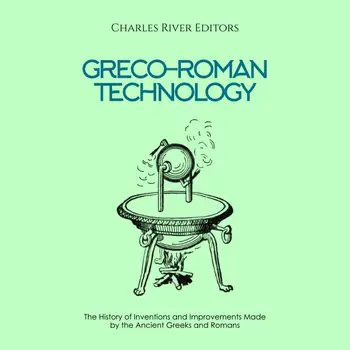
Greco-Roman Technology: The History of Inventions and Improvements Made by the Ancient Greeks and Romans

In virtually all fields of human endeavor Athens was so much at the forefront of dynamism and innovation that the products of its most brilliant minds remain not only influential but entirely relevant to this day. In the field of medicine, the great physician Hippocrates not only advanced the practical knowledge of human anatomy and care-giving but changed the entire face of the medical profession. The great philosophers of Athens, men like Aristotle, Socrates, and Plato, interrogated themselves with startling complexity about the nature of good and evil, questioned the existence of divinity, advocated intelligent design, and went so far as to argue that all life was composed of infinitesimal particles. Great architects and sculptors such as Phidias produced works of art of such breathtaking realism and startling dynamism that they later formed the driving force behind the resurgence of sculpture during the Renaissance and served as masters to artists such as Michelangelo, Bernini, and Donatello. And this does not take into account the host of equally brilliant mathematicians, natural philosophers, historians, astronomers and politicians that the city’s great schools nurtured and produced.

The modern world has the ancient Romans to thank for the origins of many modern technologies, conveniences, and ideas, from running water, baths, and republican style government to roads. Similarly, by the 3rd century BCE, the Romans were prodigious monument builders, so much so that the memory of the great Roman Republic and the Roman Empire continues to exist within a cityscape of stone. Rome’s public spaces were filled with statues, arches, temples, and many other varieties of monumental images, and each of these structures had its own civic or religious function. At the same time, most were embedded with stories, messages, and symbolism so that they also tended to function as propaganda.
Om denne bog

In virtually all fields of human endeavor Athens was so much at the forefront of dynamism and innovation that the products of its most brilliant minds remain not only influential but entirely relevant to this day. In the field of medicine, the great physician Hippocrates not only advanced the practical knowledge of human anatomy and care-giving but changed the entire face of the medical profession. The great philosophers of Athens, men like Aristotle, Socrates, and Plato, interrogated themselves with startling complexity about the nature of good and evil, questioned the existence of divinity, advocated intelligent design, and went so far as to argue that all life was composed of infinitesimal particles. Great architects and sculptors such as Phidias produced works of art of such breathtaking realism and startling dynamism that they later formed the driving force behind the resurgence of sculpture during the Renaissance and served as masters to artists such as Michelangelo, Bernini, and Donatello. And this does not take into account the host of equally brilliant mathematicians, natural philosophers, historians, astronomers and politicians that the city’s great schools nurtured and produced.

The modern world has the ancient Romans to thank for the origins of many modern technologies, conveniences, and ideas, from running water, baths, and republican style government to roads. Similarly, by the 3rd century BCE, the Romans were prodigious monument builders, so much so that the memory of the great Roman Republic and the Roman Empire continues to exist within a cityscape of stone. Rome’s public spaces were filled with statues, arches, temples, and many other varieties of monumental images, and each of these structures had its own civic or religious function. At the same time, most were embedded with stories, messages, and symbolism so that they also tended to function as propaganda.

Kom i gang med denne bog i dag for 0 kr.

  • Få fuld adgang til alle bøger i appen i prøveperioden
  • Ingen forpligtelser, opsiges når som helst
Prøv gratis nu
Mere end 52.000 mennesker har givet Nextory fem stjerner i App Store og Google Play.

  1. British Intelligence in the World Wars: The History and Legacy of Britain’s Covert Activities during Both Conflicts

    Charles River Editors

  2. Ancient Egyptian Conspiracy Theories: The History of the Most Popular Conspiracy Theories about Egypt in Antiquity

    Charles River Editors

  3. The Worst Nuclear Meltdowns of the Cold War: The History of the Biggest Nuclear Disasters in the United States and Soviet Union

    Charles River Editors

  4. Real Pirates of the Caribbean

    Charles River Editors

  5. Napoleon’s Great Escapes: The History of Napoleon’s Escapes from Egypt and Elba

    Charles River Editors

  6. The Special Operations Executive and the Office of Strategic Services: The History of the British and American Intelligence Agencies during World War II

    Charles River Editors

  7. French Senegal: The History of the French Colony and Senegal’s Transition to Independence

    Charles River Editors

  8. General Douglas MacArthur and Admiral Chester W. Nimitz: The Lives and Careers of America’s Commanders-in-Chief in the Pacific Theater during World War II

    Charles River Editors

  9. 1.0

    The Battle of Ia Drang: The History and Legacy of the Vietnam War’s First Major Battle

    Charles River Editors

  10. Nazi Germany’s Conquest of Western Europe: The Negotiations and Campaigns that Let Hitler Conquer the Continent Before and During World War II

    Charles River Editors

  11. Colonial Vietnam: The History of the Division Between North and South Vietnam

    Charles River Editors

  12. Germany and the World Wars: The History and Legacy of the Germans’ Participation in History’s Biggest Conflicts

    Charles River Editors