4.0(1)

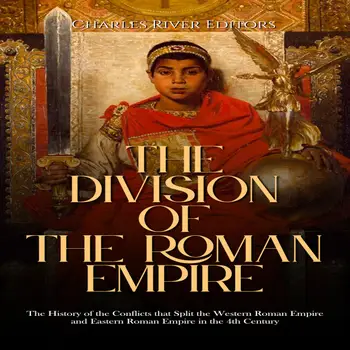
The Division of the Roman Empire: The History of the Conflicts that Split the Western Roman Empire and Eastern Roman Empire in the 4th Century

Rome’s Imperial Crisis has been difficult for historians to summarize, which is why, despite being one of the most intriguing periods in Roman history, it is often overlooked by people who have chosen to focus on the more cohesive periods before and after it. Even though he is best remembered for his religious reforms and what his (mostly Christian) admirers described as his spiritual enlightenment, Constantine was also an able and effective ruler in his own right. Rising to power in a period of decline and confusion for the Roman Empire, he gave it a new and unexpected lease on life by repelling the repeated invasions of the Germanic tribes on the Northern and Eastern borders of the Roman domains, even going so far as to re-expand the frontier into parts of Trajan’s old conquest of Dacia (modern Romania), which had been abandoned as strategically untenable.

However, it can be argued that despite his military successes – the most notable of which occurred fighting for supremacy against other Romans – Constantine may well have set the stage for the ultimate collapse of the Roman Empire as it had existed up until that point. It was Constantine who first decided that Rome, exposed and vulnerable near the gathering masses of barbarians moving into Germania and Gaul, was a strategically unsafe base for the empire, and thus he expanded the city of New Rome on the Dardanelles Straits, creating what eventually became Constantinople. By moving the political, administrative, and military capital of the empire from Rome to the East, as well as the imperial court with all its attendant followers, Constantine laid the groundwork for the eventual schism which saw the two parts of the Roman Empire become two entirely separate entities, go their own way, and eventually collapse piecemeal under repeated waves of invasion.

Om denne bog

Rome’s Imperial Crisis has been difficult for historians to summarize, which is why, despite being one of the most intriguing periods in Roman history, it is often overlooked by people who have chosen to focus on the more cohesive periods before and after it. Even though he is best remembered for his religious reforms and what his (mostly Christian) admirers described as his spiritual enlightenment, Constantine was also an able and effective ruler in his own right. Rising to power in a period of decline and confusion for the Roman Empire, he gave it a new and unexpected lease on life by repelling the repeated invasions of the Germanic tribes on the Northern and Eastern borders of the Roman domains, even going so far as to re-expand the frontier into parts of Trajan’s old conquest of Dacia (modern Romania), which had been abandoned as strategically untenable.

However, it can be argued that despite his military successes – the most notable of which occurred fighting for supremacy against other Romans – Constantine may well have set the stage for the ultimate collapse of the Roman Empire as it had existed up until that point. It was Constantine who first decided that Rome, exposed and vulnerable near the gathering masses of barbarians moving into Germania and Gaul, was a strategically unsafe base for the empire, and thus he expanded the city of New Rome on the Dardanelles Straits, creating what eventually became Constantinople. By moving the political, administrative, and military capital of the empire from Rome to the East, as well as the imperial court with all its attendant followers, Constantine laid the groundwork for the eventual schism which saw the two parts of the Roman Empire become two entirely separate entities, go their own way, and eventually collapse piecemeal under repeated waves of invasion.
Kom i gang med denne bog i dag for 0 kr.

  • Få fuld adgang til alle bøger i appen i prøveperioden
  • Ingen forpligtelser, opsiges når som helst
Prøv gratis nu
Mere end 52.000 mennesker har givet Nextory fem stjerner i App Store og Google Play.

  1. The Third Battle of Ypres : The History of the Largest Battle in Flanders during World War I

    Charles River Editors

  2. April 1865: The Tumultuous History of the Confederacy’s Last Month

    Charles River Editors

  3. 3.0

    Operation Speedy Express: The History and Legacy of One of the Vietnam War’s Most Controversial Campaigns

    Charles River Editors

  4. General Douglas MacArthur and Admiral Chester W. Nimitz: The Lives and Careers of America’s Commanders-in-Chief in the Pacific Theater during World War II

    Charles River Editors

  5. 1.0

    The Battle of Ia Drang: The History and Legacy of the Vietnam War’s First Major Battle

    Charles River Editors

  6. 4.0

    The Turkish War of Independence: The History of the Conflicts that Created the Modern State of Turkey

    Charles River Editors

  7. The First Guns: The History and Legacy of the Invention of Firearms

    Charles River Editors

  8. British Intelligence in the World Wars: The History and Legacy of Britain’s Covert Activities during Both Conflicts

    Charles River Editors

  9. Ancient Egyptian Conspiracy Theories: The History of the Most Popular Conspiracy Theories about Egypt in Antiquity

    Charles River Editors

  10. 3.0

    The Battle of Grunwald: The History and Legacy of the the Polish-Lithuanian-Teutonic War's Decisive Battle

    Charles River Editors

  11. Bosworth Field and Flodden Field: The History and Legacy of the Decisive Battles that Ended the Middle Ages in the British Isles

    Charles River Editors

  12. The My Lai Massacre and Operation Speedy Express: The History of the U.S. Army’s Most Controversial Operations during the Vietnam War

    Charles River Editors