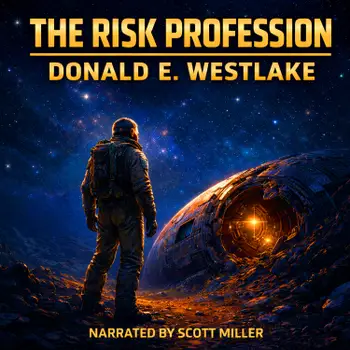
The Risk Profession : A Claim Worth Killing For

Ged Stanton makes his living chasing insurance claims that never quite add up, and this one smells wrong from the start. A retirement payout arrives after the client is already dead, signed in genuine handwriting, backed by a story that sounds reasonable—until you follow it off Earth. Stanton’s assignment takes him into the asteroid belt, where gravity is weak, witnesses are scarce, and a man’s past can disappear as easily as a body drifting into space. Every explanation fits, yet none of them feel true.

What unfolds is a tense, methodical unraveling built on observation rather than gunfire. Stanton isn’t hunting a criminal so much as testing a story, pushing it gently until it cracks. The setting amplifies the pressure: sealed domes, patched equipment, and a life where one mistake means suffocation. Each conversation tightens the problem instead of solving it, and the solution, when it comes, depends on noticing what should be there—but isn’t.

Donald E. Westlake was a master of precision plotting, equally at home in crime fiction, satire, and science fiction. Best known for the Parker novels written under the name Richard Stark, Westlake built his reputation on clean structure, sharp reversals, and endings that snap into place. “The Risk Profession” applies those same skills to a science-fiction setting, using insurance math, identity, and environment as the engines of suspense rather than gadgets or spectacle.
Om denne bog

Ged Stanton makes his living chasing insurance claims that never quite add up, and this one smells wrong from the start. A retirement payout arrives after the client is already dead, signed in genuine handwriting, backed by a story that sounds reasonable—until you follow it off Earth. Stanton’s assignment takes him into the asteroid belt, where gravity is weak, witnesses are scarce, and a man’s past can disappear as easily as a body drifting into space. Every explanation fits, yet none of them feel true.

What unfolds is a tense, methodical unraveling built on observation rather than gunfire. Stanton isn’t hunting a criminal so much as testing a story, pushing it gently until it cracks. The setting amplifies the pressure: sealed domes, patched equipment, and a life where one mistake means suffocation. Each conversation tightens the problem instead of solving it, and the solution, when it comes, depends on noticing what should be there—but isn’t.

Donald E. Westlake was a master of precision plotting, equally at home in crime fiction, satire, and science fiction. Best known for the Parker novels written under the name Richard Stark, Westlake built his reputation on clean structure, sharp reversals, and endings that snap into place. “The Risk Profession” applies those same skills to a science-fiction setting, using insurance math, identity, and environment as the engines of suspense rather than gadgets or spectacle.
Kom i gang med denne bog i dag for 0 kr.

  • Få fuld adgang til alle bøger i appen i prøveperioden
  • Ingen forpligtelser, opsiges når som helst
Prøv gratis nu
Mere end 52.000 mennesker har givet Nextory fem stjerner i App Store og Google Play.

  1. Lost Sci-Fi Books 201 thru 220 : Robots, Distant Worlds, Strange Experiments And The Wild Imagination Of Classic Sci-Fi

    Isaac Asimov, Arthur C. Clarke, Ray Bradbury, Andre Norton, John Wyndham, Robert Sheckley, Richard Matheson, Alfred Coppel, Fredric Brown, August Derleth, Gene L. Henderson, Donald E. Westlake, Robert Silverberg, I. M. Bukstein, Frank Belknap Long, H.P. Lovecraft, Kenneth Sterling, Theodore Sturgeon

  2. 4.5

    Jeg vil ha' mine penge!

    Donald E. Westlake

  3. En, to, mange

    Donald E. Westlake

  4. 3.5

    Nul puls

    Donald E. Westlake

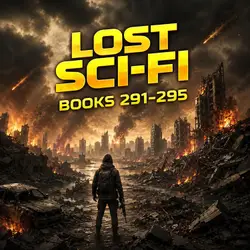
  5. Lost Sci-Fi Books 241 thru 260 : Twenty Forgotten Science Fiction Adventures from the Age of Rocketships and Strange Worlds

    Ray Bradbury, Clifford D. Simak, Robert Sheckley, Murray Leinster, Hugh B. Cave, Donald A. Wollheim, Donald E. Westlake, Clyde Beck, Mike Curry, J. F. Bone, Roger D. Aycock, Frederik Pohl, Charles E. Fritch, William Oberfield, George R. Hahn, Donald F. Daley, Miguel Hidalgo, Charles Einstein, Scott F. Grenville

  6. Lost Sci-Fi Books 251 thru 260 - Ten Vintage Sci-Fi Short Stories from the 1930s, 40s, 50s and 60s

    Clifford D. Simak, Donald E. Westlake, Frederik Pohl, Robert Sheckley, Roger D. Aycock, Charles E. Fritch, George R. Hahn, Donald F. Daley, William Oberfield

  7. Lost Sci-Fi Books 271 thru 275 - Five Vintage Sci-Fi Short Stories from the 1930s, 1940s, 1950s and 1960s

    Donald E. Westlake, Ray Bradbury, Alfred Coppel, Lynn Venable, Frank M. Robinson

  8. Lost Sci-Fi Books 251 thru 255 - Five Vintage Sci-Fi Short Stories from the 1930s, 40s, 50s and 60s

    Clifford D. Simak, Roger D. Aycock, Donald E. Westlake, Frederik Pohl, Donald F. Daley

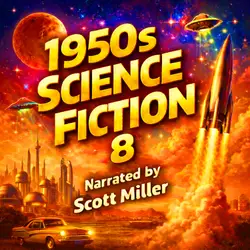
  9. 1950s Science Fiction 8 - 29 Classic Science Fiction Short Stories from the 1950s

    Robert Silverberg, Isaac Asimov, Ray Bradbury, Frank Herbert, lord Dunsany, Walter M. Miller, Bryce Walton, Mike Curry, Edward W. Ludwig, Charles Einstein, Miguel Hidalgo, Dean Evans, Robert Sheckley, Charles E. Fritch, William Oberfield, Frank M. Robinson, Evelyn E. Smith, C. M. Kornbluth, Lynn Venable, Fritz Leiber, Alfred Bester, Donald E. Westlake, J. F. Bone, Roger D. Aycock, Joseph Slotkin, David Mason

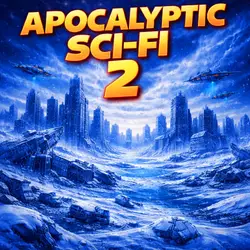
  10. Apocalyptic Sci-Fi 2 - 10 Science Fiction Short Stories by Philip K. Dick, H. G. Wells, Fritz Leiber and more : Ten Chilling Visions of the End—and What Comes After

    Lynn Venable, Donald E. Westlake, Edward W. Ludwig, Dean Evans, Miguel Hidalgo, H.G. Wells, Fritz Leiber, Robert Sheckley, William Oberfield, Philip K Dick

  11. Vintage Sci-Fi 17 - 17 Classic Science Fiction Short Stories from Arthur C. Clarke, Jack London, H. P. Lovecraft, Edgar Allan Poe, Harlan Ellison, H. G. Wells, Clifford D. Simak, and many more

    Arthur C. Clarke, H.P. Lovecraft, Harlan Ellison, H.G. Wells, Clifford D. Simak, Nelson S. Bond, Donald E. Westlake, Mack Reynolds, Katherine MacLean, Clyde Beck, Jack London, Edgar Allan Poe, Robert Silverberg, Frank R. Stockton, Alfred Coppel