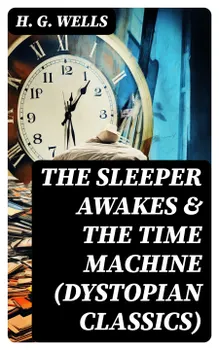
THE SLEEPER AWAKES & THE TIME MACHINE (Dystopian Classics)

In 'The Sleeper Awakes' and 'The Time Machine,' H. G. Wells masterfully intertwines the threads of science fiction and social commentary, crafting two seminal works that explore the implications of human progress and societal evolution. Both narratives employ a vivid literary style characterized by rich imagery and intricate plots that challenge the boundaries of time and existence. 'The Time Machine' introduces the concept of time travel as a mechanism to critique Victorian society, revealing a dystopian future where class disparities have starkly evolved. Meanwhile, 'The Sleeper Awakes' offers a chilling glimpse into a world transformed by technology, reflecting Wells' concerns about industrialization and its repercussions on humanity. H. G. Wells, often hailed as the father of science fiction, drew inspiration from the technological advancements and social upheavals of his time. Born in 1866, his upbringing amid the rapid changes of the Victorian era fueled his fascination with the future and the potential consequences of unchecked scientific progress. His keen intellect and progressive ideals influenced his writing, allowing him to pose profound questions about civilization's trajectory and human agency. These classics not only entertain but provoke thoughtful reflection on issues of power, identity, and the human condition. For readers eager to delve into the enigma of existence and the consequences of innovation, Wells' works are indispensable literary artifacts that resonate with contemporary anxieties about the future.
Om denne bog

In 'The Sleeper Awakes' and 'The Time Machine,' H. G. Wells masterfully intertwines the threads of science fiction and social commentary, crafting two seminal works that explore the implications of human progress and societal evolution. Both narratives employ a vivid literary style characterized by rich imagery and intricate plots that challenge the boundaries of time and existence. 'The Time Machine' introduces the concept of time travel as a mechanism to critique Victorian society, revealing a dystopian future where class disparities have starkly evolved. Meanwhile, 'The Sleeper Awakes' offers a chilling glimpse into a world transformed by technology, reflecting Wells' concerns about industrialization and its repercussions on humanity. H. G. Wells, often hailed as the father of science fiction, drew inspiration from the technological advancements and social upheavals of his time. Born in 1866, his upbringing amid the rapid changes of the Victorian era fueled his fascination with the future and the potential consequences of unchecked scientific progress. His keen intellect and progressive ideals influenced his writing, allowing him to pose profound questions about civilization's trajectory and human agency. These classics not only entertain but provoke thoughtful reflection on issues of power, identity, and the human condition. For readers eager to delve into the enigma of existence and the consequences of innovation, Wells' works are indispensable literary artifacts that resonate with contemporary anxieties about the future.
Kom i gang med denne bog i dag for 0 kr.

  • Få fuld adgang til alle bøger i appen i prøveperioden
  • Ingen forpligtelser, opsiges når som helst
Prøv gratis nu
Mere end 52.000 mennesker har givet Nextory fem stjerner i App Store og Google Play.

  1. The Red Room

    H.G. Wells

  2. Lost Sci-Fi Books 171 thru 180

    Voltaire, Andre Norton, Ray Bradbury, Henry Hasse, H.G. Wells, Arthur C. Clarke, Murray Leinster, Carl Jacobi, Fritz Leiber, Ambrose Bierce, Lawrence M. Jannifer

  3. 4.0

    La Guerra De Los Mundos

    H.G. Wells

  4. The Book of Shadows II

    Bram Stoker, Hugh Walpole, Robert W. Chambers, H.G. Wells, W. Jacobs, Arthur Machen, Mary Eleanor Wilkins Freeman, Mary Webb, John Buchan, Wilhelm Hauff

  5. The Time Machine :

    H.G. Wells

  6. The Essential Classics Collection : 1984; Great Expectations; The Brothers Karamazov; Pride and Prejudice; & The War of the Worlds

    George Orwell, Fyodor Dostoyevsky, Charles Dickens, Jane Austen, H.G. Wells

  7. 3.7

    The War of the Worlds :

    H.G. Wells

  8. Beware The Silence : Ultimate Collection of Horror Classics, Macabre Tales & Supernatural Mysteries

    Wilhelm Hauff, Charles Dickens, Mark Twain, Harriet Beecher Stowe, Adelbert von Chamisso, Oscar Wilde, Robert Louis Stevenson, Edgar Allan Poe, William Hope Hodgson, Joseph Sheridan Le Fanu, John Buchan, Louis Tracy, Bram Stoker, Anatole France, Charlotte Brontë, Emily Brontë, Jack London, Henry James, Théophile Gautier, Arthur Conan Doyle, Richard Le Gallienne, Jane Austen, Ralph Adams Cram, Thomas De Quincey, John Meade Falkner, Guy De Maupassant, Thomas Hardy, William Archer, Daniel Defoe, John Kendrick Bangs, Cleveland Moffett, Brander Matthews, Marie Belloc Lowndes, Horace Walpole, Rudyard Kipling, Lafcadio Hearn, Hugh Walpole, Ambrose Bierce, Frederick Marryat, Ellis Parker Butler, Washington Irving, Leonid Andreyev, David Lindsay, Nathaniel Hawthorne, Grant Allen, Arthur Machen, Wilkie Collins, William Makepeace Thackeray, Thomas Peckett Prest, James Malcolm Rymer, Fergus Hume, Edward Bellamy, Walter Hubbell, Charlotte Perkins Gilman, Leopold Kompert, Richard Marsh, Florence Marryat, Catherine Crowe, John William Polidori, Vincent O'Sullivan, H.G. Wells, Robert W. Chambers, W. Jacobs, M.P. Shiel, E F Benson, Jerome K Jerome, M. R. James, E T A Hoffmann, Stanley G. Weinbaum, George W. M. Reynolds, H.P. Lovecraft, Robert E. Howard, Edith Nesbit, Sabine Baring-Gould, William Thomas Beckford, Francis Marion Crawford, Lucy Maud Montgomery, Mary Elizabeth Braddon, Mary Louisa Molesworth, Mary E. Wilkins Freeman, Nikolai Gogol, Mary Shelley, Elizabeth Gaskell, Edward Bulwer-Lytton, Frank R. Stockton, A. T. Quiller-Couch, Ann Radcliffe, Louisa M. Alcott, Amelia B. Edwards, Leonard Kip, Matthew Gregory Lewis, Fitz-James O’Brien, Katherine Rickford, Bithia Mary Croker, Catherine L. Pirkis, Émile Erckmann, Alexandre Chatrian, Pedro De Alarçon, H. Munro (Saki), Pliny the Younger, Helena Blavatsky, Villiers de l'Isle-Adam, William F. Harvey, Fiona Macleod, William T. Stead, Gambier Bolton, Andrew Jackson Davis, Nizida, Walter F. Prince, Chester Bailey Fernando

  9. The New World Order

    H.G. Wells

  10. 30 Occult and Supernatural Masterpieces in One Book

    Washington Irving, Mary Shelley, Charles Dickens, Louisa May Alcott, Elizabeth Cleghorn Gaskell, Oscar Wilde, Rudyard Kipling, Edith Nesbit, John Meade Falkner, Henry James, H.G. Wells, Montague Rhodes James, Arnold Bennett, Henry Rider Haggard, William Hope Hodgson, Virginia Woolf

  11. 3.7

    War of the Worlds

    H.G. Wells

  12. Klodernes kamp

    H.G. Wells