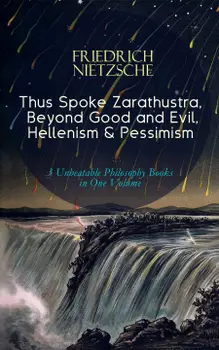
Thus Spoke Zarathustra, Beyond Good and Evil, Hellenism & Pessimism : 3 Unbeatable Philosophy Books in One Volume - The Birth of Tragedy

"Thus Spake Zarathustra: A Book for All and None" chronicles the fictitious travels and speeches of Zarathustra, the founder of Zoroastrianism. Zarathustra contains the famous dictum "God is dead" and the concept of the "Übermensch" (overman or superman).

In "Beyond Good and Evil" Nietzsche accuses past philosophers of lacking critical sense and blindly accepting dogmatic premises in their consideration of morality. The work moves into the realm "beyond good and evil" in the sense of leaving behind the traditional morality which Nietzsche subjects to a destructive critique in favour of what he regards as an affirmative approach.

"The Birth of Tragedy or, Hellenism and Pessimism" is a work of dramatic theory which discusses the history of the tragic form and introduces an intellectual dichotomy between the Dionysian and the Apollonian. Nietzsche believed that in classical Athenian tragedy an art form that transcended the pessimism and nihilism of a fundamentally meaningless world.

Friedrich Nietzsche (1844–1900) was a German philosopher, cultural critic, poet, philologist, and Latin and Greek scholar whose work has exerted a profound influence on Western philosophy and modern intellectual history. Because of Nietzsche's evocative style and provocative ideas, his philosophy generates passionate reactions. His works remain controversial, due to varying interpretations and misinterpretations of his work. In the Western philosophy tradition, Nietzsche's writings have been described as the unique case of free revolutionary thought, that is, revolutionary in its structure and problems, although not tied to any revolutionary project

Om denne bog

"Thus Spake Zarathustra: A Book for All and None" chronicles the fictitious travels and speeches of Zarathustra, the founder of Zoroastrianism. Zarathustra contains the famous dictum "God is dead" and the concept of the "Übermensch" (overman or superman).

In "Beyond Good and Evil" Nietzsche accuses past philosophers of lacking critical sense and blindly accepting dogmatic premises in their consideration of morality. The work moves into the realm "beyond good and evil" in the sense of leaving behind the traditional morality which Nietzsche subjects to a destructive critique in favour of what he regards as an affirmative approach.

"The Birth of Tragedy or, Hellenism and Pessimism" is a work of dramatic theory which discusses the history of the tragic form and introduces an intellectual dichotomy between the Dionysian and the Apollonian. Nietzsche believed that in classical Athenian tragedy an art form that transcended the pessimism and nihilism of a fundamentally meaningless world.

Friedrich Nietzsche (1844–1900) was a German philosopher, cultural critic, poet, philologist, and Latin and Greek scholar whose work has exerted a profound influence on Western philosophy and modern intellectual history. Because of Nietzsche's evocative style and provocative ideas, his philosophy generates passionate reactions. His works remain controversial, due to varying interpretations and misinterpretations of his work. In the Western philosophy tradition, Nietzsche's writings have been described as the unique case of free revolutionary thought, that is, revolutionary in its structure and problems, although not tied to any revolutionary project
Kom i gang med denne bog i dag for 0 kr.

  • Få fuld adgang til alle bøger i appen i prøveperioden
  • Ingen forpligtelser, opsiges når som helst
Prøv gratis nu
Mere end 52.000 mennesker har givet Nextory fem stjerner i App Store og Google Play.

  1. Thus Spoke Zarathustra : A Book for All and None

    Friedrich Nietzsche

  2. Beyond Good and Evil : Prelude to a Philosophy of the Future

    Friedrich Nietzsche

  3. 4.0

    Således talte Zarathustra

    Friedrich Nietzsche

  4. The Joyful Wisdom

    Friedrich Nietzsche

  5. 5.0

    Thus Spoke Zarathustra

    Friedrich Nietzsche

  6. Ny

    The Birth of Tragedy

    Friedrich Nietzsche

  7. Ny
    3.3

    Beyond Good and Evil

    Friedrich Nietzsche

  8. 50 Clásicos que Debes Leer Antes de Morir : Un viaje literario por los tesoros de la literatura universal

    Dante Alighieri, Aristóteles, Jane Austen, Charles Baudelaire, Giovanni Boccaccio, Anne Brontë, C. Collodi, James Fenimore Cooper, Fedor Mikhaïlovitch Dostoïevski, Arthur Conan Doyle, Alexandre Dumas, José de Espronceda, Gustave Flaubert, Sigmund Freud, Benito Pérez Galdós, Kahlil Gibran, Johann Wolfgang Goethe, Johann Wolfgang von Goethe, Victor Hugo, Thomas Hardy, Nathaniel Hawthorne, Vicente Blasco Ibáñez, Washington Irving, James Joyce, Mariano José de Larra, Jack London, Federico García Lorca, H.P. Lovecraft, Antonio Machado, Gustav Meyrink, John Stuart Mill, Amado Nervo, Friedrich Nietzsche, Solomon Northup, Alexander Sergeyevich Pushkin, Francisco de Quevedo, Walter Scott, William Shakespeare, Robert Louis Stevenson, Harriet Beecher Stowe, Jonathan Swift, Mark Twain, Miguel De Unamuno, Ramón María del Valle-Inclán, Julio Verne, Virginia Woolf

  9. 100 Clásicos de la Literatura Universal

    Francis Scott Fitzgerald, Mary Shelley, Lyman Frank Baum, Louisa May Alcott, Dante Alighieri, Jane Austen, Ambrose Bierce, Emily Brontë, Edgar Rice Burroughs, Lewis Carroll, Wilkie Collins, René Descartes, Charles Dickens, Emily Dickinson, Alexandre Dumas, Gustave Flaubert, Benito Pérez Galdós, Johann Wolfgang von Goethe, Thomas Hardy, E T A Hoffmann, Washington Irving, Henry James, James Joyce, Franz Kafka, Gaston Leroux, Federico García Lorca, H.P. Lovecraft, Publio Virgilio Marón, Lucy Maud Montgomery, John William Polidori, Marco Polo, Antoine de Saint-Exupéry, Emilio Salgari, Walter Scott, Mark Twain, Jules Verne, Julio Verne, H.G. Wells, Edith Wharton, Mary Wollstonecraft, Stefan Zweig, Sun Tzu, Bram Stoker, - Aristoteles, George Bernard Shaw, Henryk Sienkiewicz, Concepción Arenal, Charlotte Brontë, Miguel de Cervantes, G.K. Chesterton, Daniel Defoe, Fyodor Mikhailovich Dostoyevsky, Arthur Conan Doyle, Sigmund Freud, H. Rider Haggard, Homero, Immanuel Kant, Rudyard Kipling, Molière, Friedrich Nietzsche, Fernando de Rojas, Sófocles, William Makepeace Thackeray, León Tolstói, Voltaire, Ramón María del Valle-Inclán, Oscar Wilde, Virginia Woolf

  10. 4.0

    Thus Spoke Zarathustra :

    Friedrich Nietzsche

  11. El nacimiento de la tragedia : El origen de la rebeldía moderna: el diagnóstico profético de Nietzsche sobre la crisis de nuestra cultura

    Friedrich Nietzsche

  12. Beyond Good And Evil :

    Friedrich Nietzsche, Eden Garret