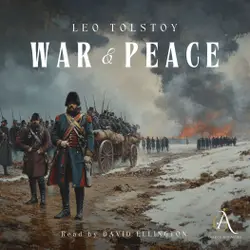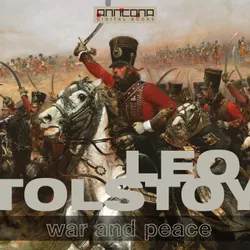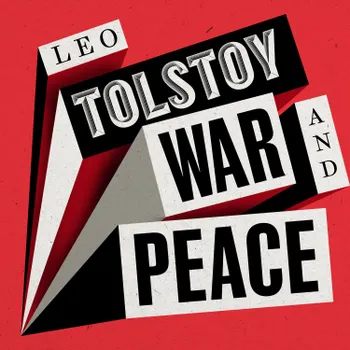
War and Peace

"The sole meaning of life is to serve humanity."

Tolstoy's War and Peace, written in serial format and published between 1865 and 1869, is widely regarded as a masterwork of Russian literature and one of the world's greatest novels.

This epic novel intricately weaves together the lives of several families against the backdrop of Napoleon's invasion of Russia in 1812, and follows Pierre Bezukhov, the illegitimate son of a count who is fighting for his inheritance and yearning for spiritual fulfilment; Prince Andrei Bolkonsky, who leaves his family behind to fight in the war against Napoleon; and Natasha Rostov, the beautiful young daughter of a nobleman, as they navigate love, loss, and their search for meaning in a tumultuous world.

As Napoleon's army invades, Tolstoy follows characters from diverse backgrounds—peasants and nobility, civilians and soldiers—as they struggle with the problems unique to their era, their history, and their culture; and through their experiences, explores the profound complexities of human nature and destiny.

Celebrated for its historical realism and rich character development, its examination of the social and political landscape of the time, and for its profound exploration of the human condition, War and Peace is an epic war chronicle, a philosophical study, and a celebration of the Russian spirit that continues to captivate audiences worldwide.

Leo Tolstoy (1828–1910) was a Russian novelist, philosopher, and social reformer, widely regarded as one of the greatest writers of all time. He is best known for his epic novels War and Peace and Anna Karenina, both celebrated for their intricate character development and profound exploration of moral dilemmas and human nature. In his later years, Tolstoy experienced a spiritual awakening which led him to reject materialism and embrace a life of simplicity, seeking to align his life with his beliefs about non-violence and compassion. Tolstoy's legacy endures not only through his literary masterpieces but also through his profound impact on literature and philosophy.
Om denne bog

"The sole meaning of life is to serve humanity."

Tolstoy's War and Peace, written in serial format and published between 1865 and 1869, is widely regarded as a masterwork of Russian literature and one of the world's greatest novels.

This epic novel intricately weaves together the lives of several families against the backdrop of Napoleon's invasion of Russia in 1812, and follows Pierre Bezukhov, the illegitimate son of a count who is fighting for his inheritance and yearning for spiritual fulfilment; Prince Andrei Bolkonsky, who leaves his family behind to fight in the war against Napoleon; and Natasha Rostov, the beautiful young daughter of a nobleman, as they navigate love, loss, and their search for meaning in a tumultuous world.

As Napoleon's army invades, Tolstoy follows characters from diverse backgrounds—peasants and nobility, civilians and soldiers—as they struggle with the problems unique to their era, their history, and their culture; and through their experiences, explores the profound complexities of human nature and destiny.

Celebrated for its historical realism and rich character development, its examination of the social and political landscape of the time, and for its profound exploration of the human condition, War and Peace is an epic war chronicle, a philosophical study, and a celebration of the Russian spirit that continues to captivate audiences worldwide.

Leo Tolstoy (1828–1910) was a Russian novelist, philosopher, and social reformer, widely regarded as one of the greatest writers of all time. He is best known for his epic novels War and Peace and Anna Karenina, both celebrated for their intricate character development and profound exploration of moral dilemmas and human nature. In his later years, Tolstoy experienced a spiritual awakening which led him to reject materialism and embrace a life of simplicity, seeking to align his life with his beliefs about non-violence and compassion. Tolstoy's legacy endures not only through his literary masterpieces but also through his profound impact on literature and philosophy.
Kom i gang med denne bog i dag for 0 kr.

  • Få fuld adgang til alle bøger i appen i prøveperioden
  • Ingen forpligtelser, opsiges når som helst
Prøv gratis nu
Mere end 52.000 mennesker har givet Nextory fem stjerner i App Store og Google Play.

  1. 3.7

    Anna Karenina

    Leo Tolstoy

  2. 4.0

    Anna Karenina

    Leo Tolstoy

  3. The Original Anna Karenina :

    Leo Tolstoy

  4. 5.0

    Anna Karenina - Audiobook

    Leo Tolstoy, Classic Audiobooks

  5. War And Peace

    Leo Tolstoy

  6. 4.0

    25+ The World's Greatest Short Stories. Vol. 1 : The Legend of Sleepy Hollow, The Gold Bug, Daisy Miller, The Yellow Wallpaper, The Call of Cthulhu and other

    Washington Irving, Edgar Allan Poe, Herman Melville, Bret Harte, Leo Tolstoy, Fyodor Dostoevsky, Rudyard Kipling, Charlotte Perkins Gilman, Anton Chekhov, David Herbert Lawrence, James Joyce, Ivan Turgenev, Nikolai Gogol, Mikhail Bulgakov, Ivan Bunin, Joseph Sheridan Le Fanu, O.Henry, Ambrose Gwinnett Bierce, Robert Louis Stevenson, Herbert George Wells, William Wymark Jacobs, Arthur Conan Doyle, Henry James, Howard Phillips Lovecraft, Alexander Pushkin, Gilbert Keith Chesterton

  7. #17

    War and Peace (Second Epilogue)

    Leo Tolstoy

  8. #16

    War and Peace (First Epilogue: 1813-20)

    Leo Tolstoy

  9. #15

    War and Peace (Book Fifteen: 1812-13)

    Leo Tolstoy

  10. #12

    War and Peace (Book Twelve: 1812)

    Leo Tolstoy

  11. 5.0

    50 Masterpieces you have to read before you die vol: 2 : Timeless Classics to Enrich Your Mind and Soul

    Louisa, Jane Austen, Joseph Conrad, D. H. Lawrence, George Eliot, Leo Tolstoy, James Joyce, Charles Dickens, Bram Stoker, Oscar Wilde, Honoré de Balzac, Edgar Rice Burroughs, Anne Brontë, Charlotte Brontë, Emily Brontë, Lewis Carroll, Willa Cather, Miguel de Cervantes, E. E. Cummings, Fyodor Dostoyevsky, Daniel Defoe, Arthur Conan Doyle, Alexandre Dumas, Gustave Flaubert, Henry James, Victor Hugo, HB Classics

  12. 100 Quotes by Leo Tolstoy

    Leo Tolstoy