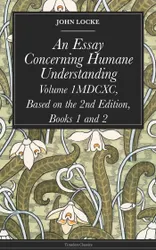
An Essay Concerning Humane Understanding (Vol. 1&2) (Annotated) : Enriched Edition. Complete Edition

John Locke's An Essay Concerning Humane Understanding (Vol. 1&2) is a foundational inquiry into the origin, limits, and reliability of human knowledge. Rejecting innate ideas, Locke argues that the mind begins as a blank slate, furnished by sensation and reflection. Its lucid, methodical prose belongs to the emerging empirical style of the Scientific Revolution, replacing scholastic abstraction with careful analysis of ideas, language, probability, and judgment. Locke, physician, political philosopher, and Fellow of the Royal Society, wrote from within the intellectual ferment of late seventeenth-century England. His association with experimental science, medicine, and political controversy shaped his suspicion of inherited dogma. The Essay reflects a mind trained to examine evidence, clarify terms, and ask how far reason may legitimately extend before it mistakes words for knowledge. This work is indispensable for readers interested in philosophy, intellectual history, theology, science, or literature of the Enlightenment. Though demanding, it rewards patience with extraordinary clarity about how humans think, believe, and err. Anyone seeking the roots of modern empiricism, liberal thought, or analytic philosophy will find Locke's Essay both historically decisive and still philosophically alive.

This enriched edition has been carefully crafted to add value to your reading experience.

- A succinct Introduction situates the work's timeless appeal and themes.

- The Synopsis outlines the central plot, highlighting key developments without spoiling critical twists.

- A detailed Historical Context immerses you in the era's events and influences that shaped the writing.

- An Author Biography reveals milestones in the author's life, illuminating the personal insights behind the text.

- A thorough Analysis dissects symbols, motifs, and character arcs to unearth underlying meanings.

- Reflection questions prompt you to engage personally with the work's messages, connecting them to modern life.

- Hand‐picked Memorable Quotes shine a spotlight on moments of literary brilliance.

- Interactive footnotes clarify unusual references, historical allusions, and archaic phrases for an effortless, more informed read.

Om den här boken

John Locke's An Essay Concerning Humane Understanding (Vol. 1&2) is a foundational inquiry into the origin, limits, and reliability of human knowledge. Rejecting innate ideas, Locke argues that the mind begins as a blank slate, furnished by sensation and reflection. Its lucid, methodical prose belongs to the emerging empirical style of the Scientific Revolution, replacing scholastic abstraction with careful analysis of ideas, language, probability, and judgment. Locke, physician, political philosopher, and Fellow of the Royal Society, wrote from within the intellectual ferment of late seventeenth-century England. His association with experimental science, medicine, and political controversy shaped his suspicion of inherited dogma. The Essay reflects a mind trained to examine evidence, clarify terms, and ask how far reason may legitimately extend before it mistakes words for knowledge. This work is indispensable for readers interested in philosophy, intellectual history, theology, science, or literature of the Enlightenment. Though demanding, it rewards patience with extraordinary clarity about how humans think, believe, and err. Anyone seeking the roots of modern empiricism, liberal thought, or analytic philosophy will find Locke's Essay both historically decisive and still philosophically alive.

This enriched edition has been carefully crafted to add value to your reading experience.

- A succinct Introduction situates the work's timeless appeal and themes.

- The Synopsis outlines the central plot, highlighting key developments without spoiling critical twists.

- A detailed Historical Context immerses you in the era's events and influences that shaped the writing.

- An Author Biography reveals milestones in the author's life, illuminating the personal insights behind the text.

- A thorough Analysis dissects symbols, motifs, and character arcs to unearth underlying meanings.

- Reflection questions prompt you to engage personally with the work's messages, connecting them to modern life.

- Hand‐picked Memorable Quotes shine a spotlight on moments of literary brilliance.

- Interactive footnotes clarify unusual references, historical allusions, and archaic phrases for an effortless, more informed read.
Kom igång med den här boken idag för 0 kr

  • Få full tillgång till alla böcker i appen under provperioden
  • Ingen bindningstid, avsluta när du vill
Prova gratis nu
Mer än 52 000 personer har gett Nextory 5 stjärnor i App Store och på Google Play.

  1. The Empiricists. Сlassic collection. Illustrated : Concerning Human Understanding, Principles of Human Knowledge, Dialogues Concerning Natural Religio and others

    Francis Bacon, Thomas Hobbes, John Locke, George Berkeley, David Hume, John Stuart Mill

  2. A Letter Concerning Toleration : Enriched edition.

    John Locke

  3. Two Treatises of Government and A Letter Concerning Toleration

    John Locke

  4. The Collected Works of John Locke : PergamonMedia

    John Locke

  5. Ensayo sobre la tolerancia : El Locke desconocido: la precuela de «Carta sobre la tolerancia» y 18 textos fundamentales.

    John Locke

  6. Second Treatise of Government :

    John Locke

  7. An Essay Concerning Humane Understanding : Volume 1MDCXC, Based on the 2nd Edition, Books 1 and 2

    John Locke

  8. 50 citations de John Locke

    John Locke

  9. 250 citations de philosophes anglais

    David Hume, John Locke, Francis Bacon, Thomas Hobbes, Thomas More

  10. 1800 Citations de philosophes

    Aristote, Épicure, Platon, Thalès de Milet, – Socrate, Protagoras, Anaximandre, Épictète, Héraclite, Marc Aurèle, René Descartes, Michel de Montaigne, Alexis de Tocqueville, Voltaire, Charles De Montesquieu, Jean-Jacques Rousseau, Emmanuel Kant, Hannah Arendt, Gottfried Wilhelm Leibniz, Georg Wilhelm Friedrich Hegel, Friedrich Nietzsche, Arthur Schopenhauer, David Hume, John Locke, Francis Bacon, Thomas Hobbes, Thomas More, Confucius, Érasme, Lao Tseu, Baruch Spinoza, Søren Kierkegaard, Nicolas Machiavel, Thomas d'Aquin, Henry David Thoreau

  11. Muutamia mietteitä kasvatuksesta

    John Locke

  12. Of the Conduct of the Understanding (Annotated) : Enriched Edition. A Classic Guide to Rational Inquiry, Clear Thinking, and Intellectual Self-Discipline

    John Locke