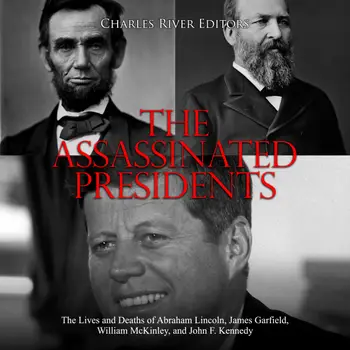
The Assassinated Presidents: The Lives and Deaths of Abraham Lincoln, James Garfield, William McKinley, and John F. Kennedy

Until April 14, 1865, John Wilkes Booth was one of the most famous actors of his time, and President Abraham Lincoln had even watched him perform. But his most significant performance at a theater did not take place on the stage. That night, Booth became one of history’s most infamous assassins when he assassinated President Lincoln at Ford's Theatre in Washington, D.C.

In 1880, Garfield ran as a Republican for president, and one of his supporters was a man named Charles Guiteau, who wrote and circulated a speech called “Garfield vs. Hancock” that aimed to rally support for the Republican candidate. Though few knew it, Guiteau’s family had already deemed him insane and attempted to keep him committed in an asylum, only to have him manage an escape from confinement. Garfield went on to narrowly edge Winfield Scott Hancock in the election, and Guiteau, harboring delusions of grandeur, believed he had helped tip the scales in Garfield’s favor.

President James Garfield had been assassinated just 20 years earlier, but McKinley didn’t worry about presidential security or his own safety, and that was the case in Buffalo. McKinley’s insistence on greeting the public and shaking hands allowed Czolgosz to walk up to him on September 6, 1901 at a public reception in the Temple of Music on the expo grounds and shoot him point blank, with one bullet grazing the president and another lodging in his abdomen.

In many ways, John Fitzgerald Kennedy and his young family were the perfect embodiment of the ‘60s. The decade began with a sense of idealism, personified by the attractive Kennedy, his beautiful and fashionable wife Jackie, and his young children. Months into his presidency, Kennedy exhorted the country to reach for the stars, calling upon the nation to send a man to the Moon and back by the end of the decade. But the idealism and optimism of the decade was quickly shattered, starting with Kennedy’s assassination in 1963.

Kom igång med den här boken idag för 0 kr

  • Få full tillgång till alla böcker i appen under provperioden
  • Ingen bindningstid, avsluta när du vill
Prova gratis nu
Mer än 52 000 personer har gett Nextory 5 stjärnor i App Store och på Google Play.

  1. Ny

    The Hellenization of the Near East: The History of the Spread of Greek Culture to the Region under Alexander the Great and His Successors

    Charles River Editors

  2. Ny

    The Early Persecution of Christians: The History of the Roman Empire’s Efforts to Stamp Out Christianity

    Charles River Editors

  3. Ny

    Dieppe and D-Day: The Controversial History of the Allies’ Amphibious Operations across the English Channel

    Charles River Editors

  4. 5.0

    The Top 5 Greatest Artists : Leonardo, Michelangelo, Raphael, Vincent Van Gogh, and Pablo Picasso

    Charles River Editors

  5. Ny

    Cryptography in World War I: The History of the Efforts to Make and Break Secret Codes during the Great War

    Charles River Editors

  6. Ny

    California: The History and Legacy of the Land Before and After It Joined the United States

    Charles River Editors

  7. Ny

    World War II in 1942: The History of the Year the Allies Turned the Tide Against the Axis

    Charles River Editors

  8. Ny

    The Clovis Culture: The History and Legacy of the Prehistoric Paleoamericans

    Charles River Editors

  9. Ny

    NASA Programs in the 1970s: The History and Legacy of the Space Agency’s Missions to Mars and Beyond

    Charles River Editors

  10. Ny

    Cryptography and the World Wars: The History of Codemaking and Codebreaking during Both Global Conflicts

    Charles River Editors

  11. Ny

    World War II in 1940: The History of the Fighting that Culminated with the German Conquest of Western Europe and the Battle of Britain

    Charles River Editors

  12. Ny

    Admiral David Farragut: The Life and Legacy of the American Civil War’s Most Famous Naval Officer

    Charles River Editors