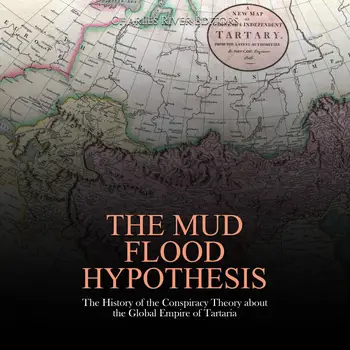
The Mud Flood Hypothesis: The History of the Conspiracy Theory about the Global Empire of Tartaria

From time to time, a new theory about world history still makes an appearance, particularly interesting when based on a geological reality. A popular notion at present is the existence of a great empire covering the bulk of Asia and Russia until only one hundred years ago that was destroyed and covered up to enable the rise of present nations. This was accomplished by worldwide deluges of mud, modern energy weapons, and the erasure of an advanced architectural and technological civilization that was far beyond its time. Over the past four years, the theory has developed branch extensions that go off in seemingly all directions.

The “mud flood” hypothesis is centered around the ancient empire of Tartaria, or Tartary, as it existed two hundred years ago, a continent-wide showcase of advanced architecture, transportation, free energy, and wireless technology. Tartary is generally described as occupying a large portion of Asia and Russia, bounded by the Caspian Sea and the Ural Mountains, the Pacific Ocean and Bulgaria, and the southern borders of China, India, and Persia. At one point, it took up the vast bulk of the Russian continent.

Tartaria is a story in present circulation as a country that once seemed known to the world but is now forgotten. Tartaria, Tartary, or Grand Tartaria troubles online researchers as they look over old maps dating back as far as the fifteenth century. The intrigue began with a declassified document from the CIA in 1957, mentioning the deletion of the country’s history at the hands of communist attackers. The Khanate of Khazan (Bulgaria) was named Tatarstan, a republic of the Russian Federation that purportedly flew the same flag as ancient Tartaria. In a map of 1824, Chinese-Tartaria and China appear to coexist. By 1850, Mongolia begins to appear where independent Tartaria was before, while China expands to become an empire and Tartaria disappears from view.

Kom igång med den här boken idag för 0 kr

  • Få full tillgång till alla böcker i appen under provperioden
  • Ingen bindningstid, avsluta när du vill
Prova gratis nu
Mer än 52 000 personer har gett Nextory 5 stjärnor i App Store och på Google Play.

  1. Ny

    Roman Arches: The History of the Famous Monuments in Rome and Throughout the Roman Empire

    Charles River Editors

  2. Ny

    The Ottoman Empire’s Most Important Battles: The History and Legacy of the Ottomans’ Biggest Victories and Defeats

    Charles River Editors

  3. Ny
    4.0

    The New Zealand Wars: The History and Legacy of the British Empire’s Conflicts with the Indigenous Māori

    Charles River Editors

  4. Ny
    3.6

    The Battle of Kosovo: The History and Legacy of the Battle Between the Serbs and Ottomans that Forged Serbia's National Identity

    Charles River Editors

  5. Ny
    3.0

    The Battle of Chosin Reservoir: The History of the Chinese Victory that Pushed UN Forces Out of North Korea during the Korean War

    Charles River Editors

  6. Ny

    The Oregon Trail and the Appalachian Trail: The History of America’s Two Most Famous Trails

    Charles River Editors

  7. Ny

    The Battle of Kadesh: The History of the Most Important Battle Between the Egyptians and Hittites

    Charles River Editors

  8. Ny
    4.0

    The Circassians: The Turbulent History of the Ethnic Group in the North Caucasus

    Charles River Editors

  9. Ny

    The Civil Wars of the Late Roman Republic: The History of the Conflicts that Made Sulla and Caesar the Dictators of Rome

    Charles River Editors

  10. Ny

    The Ottoman Sieges of Vienna: The History of the Ottoman Empire’s Unsuccessful Attempts to Conquer the Habsburg Capital

    Charles River Editors

  11. Ny

    The Battle of Myriokephalon: The History of the Byzantine Empire’s Last Campaign to Take Anatolia from the Seljuk Turks

    Charles River Editors

  12. Ny
    3.3

    The Unification of Italy: The History of the Risorgimento and the Conflicts that Unified the Italian Nation

    Charles River Editors