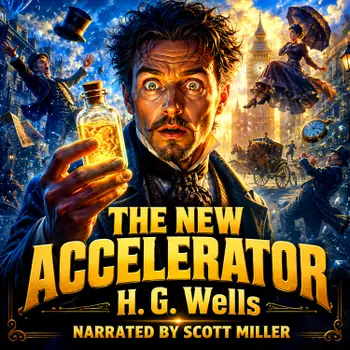
The New Accelerator : The Day The World Stood Still

What if a single drop of medicine could give you hours while everyone else experiences only seconds?

When Professor Gibberne unveils a revolutionary stimulant known as the New Accelerator, the promise seems irresistible. The drug does far more than sharpen the mind or energize the body. It speeds every process of human life to such an astonishing degree that the rest of the world appears almost motionless. For one extraordinary experiment, the professor and his skeptical friend step outside ordinary experience and into a reality where fluttering curtains hang frozen in midair, conversations become silent statues, and even a bee drifts through the sky with agonizing slowness.

At first, the experience feels exhilarating. Freed from the pace of everyday life, the pair explore a world that seems suspended for their private inspection. Yet the longer they remain in this accelerated state, the more unexpected complications arise. What begins as scientific triumph quickly raises practical questions, ethical concerns, and physical dangers that no laboratory test could fully predict. Wells combines humor, wonder, and scientific speculation to create one of the most imaginative thought experiments ever written.

Published in 1901, The New Accelerator remains remarkably fresh. Long before modern discussions about productivity, time management, and human enhancement, Wells imagined a discovery capable of transforming every profession and every aspect of daily life. The story showcases his gift for taking a single scientific idea and following it to surprising and entertaining conclusions.

H. G. Wells (1866–1946) was one of the most influential writers in the history of science fiction. His novels include The Time Machine, The War of the Worlds, The Invisible Man, and The First Men in the Moon, works that helped establish many of the foundations of modern speculative fiction.

Om den här boken

What if a single drop of medicine could give you hours while everyone else experiences only seconds?

When Professor Gibberne unveils a revolutionary stimulant known as the New Accelerator, the promise seems irresistible. The drug does far more than sharpen the mind or energize the body. It speeds every process of human life to such an astonishing degree that the rest of the world appears almost motionless. For one extraordinary experiment, the professor and his skeptical friend step outside ordinary experience and into a reality where fluttering curtains hang frozen in midair, conversations become silent statues, and even a bee drifts through the sky with agonizing slowness.

At first, the experience feels exhilarating. Freed from the pace of everyday life, the pair explore a world that seems suspended for their private inspection. Yet the longer they remain in this accelerated state, the more unexpected complications arise. What begins as scientific triumph quickly raises practical questions, ethical concerns, and physical dangers that no laboratory test could fully predict. Wells combines humor, wonder, and scientific speculation to create one of the most imaginative thought experiments ever written.

Published in 1901, The New Accelerator remains remarkably fresh. Long before modern discussions about productivity, time management, and human enhancement, Wells imagined a discovery capable of transforming every profession and every aspect of daily life. The story showcases his gift for taking a single scientific idea and following it to surprising and entertaining conclusions.

H. G. Wells (1866–1946) was one of the most influential writers in the history of science fiction. His novels include The Time Machine, The War of the Worlds, The Invisible Man, and The First Men in the Moon, works that helped establish many of the foundations of modern speculative fiction.
Kom igång med den här boken idag för 0 kr

  • Få full tillgång till alla böcker i appen under provperioden
  • Ingen bindningstid, avsluta när du vill
Prova gratis nu
Mer än 52 000 personer har gett Nextory 5 stjärnor i App Store och på Google Play.

  1. 4.6
    #6

    Stjärnan

  2. 5.0

    The War of the Worlds

    H.G. Wells

  3. 3.0

    50 Masterpieces you have to read before you die vol: 1 (2020 Edition) : Included: Little Women, The Richest Man in Babylon Emma, The Call Of The Wild ....

    Louisa May Alcott, Dante Alighieri, Marcus Aurelius, Jane Austen, L. Frank Baum, Charlotte Brontë, Emily Brontë, Anne Brontë, Miguel de Cervantes, Agatha Christie, George S. Clason, Arthur Conan Doyle, Joseph Conrad, Charles Dickens, Fyodor Dostoyevsky, Alexandre Dumas, George Eliot, G.K. Chesterton, G.K. Chesterton, Zane Grey, Nathaniel Hawthorne, Napoleon Hill, Homer, Victor Hugo, Frances Hodgson Burnett, Washington Irving, Henry James, Franz Kafka, Rudyard Kipling, Jack London, Leo Tolstoy, H.P. Lovecraft, Lucy Maud Montgomery, Joseph Murphy, Robert Louis Stevenson, Edgar Allan Poe, Marcel Proust, Publius, Mary Shelley, Bram Stoker, Mark Twain, Sun Tzu, Lew Wallace, Wallace D. Wattles, H.G. Wells

  4. 50 Vintage Sci-Fi Short Stories 10 : A Treasure Chest of Classic Science Fiction Short Stories

    Arthur C. Clarke, H.G. Wells, H.P. Lovecraft, Mary Shelley, Robert Silverberg, Robert Bloch, Harry Harrison, Fritz Leiber, Alfred Bester, A. E. van Vogt, Brian W. Aldiss, Robert E. Howard, Henry Kuttner, Clark Ashton Smith, Frank Belknap Long, Edward Page Mitchell, Jack Williamson, Tom Godwin, Robert Sheckley, Michael Shaara, Francis Stevens, A.H. Gibson, Gene L. Henderson, H. F. Arnold, Richard R. Smith, Frank M. Robinson, Manly Wade Wellman, William Bender, Thomas S. Gardiner, James Bell, Beta McGavin, Alfred Connable, Jack Sharkey, Ron Goulart, Victoria Lincoln, Nelson S. Bond, Ray Cummings, Morton Klass, Elisabeth R. Lewis, John W. Campbell, James Blish, Roger D. Aycock

  5. 3.6

    The Island of Doctor Moreau :

    H.G. Wells

  6. Mannen som sov i två sekler

    H.G. Wells

  7. 3.6
    #3

    Tidsmaskinen

    H.G. Wells

  8. The Essential Feminist Classics : Including Biographies & Memoirs of the Most Influential Women in History

    Henrik Ibsen, Charlotte Brontë, Marietta Holley, Henry James, Louisa May Alcott, John Stuart Mill, Zona Gale, Jane Austen, Thomas Hardy, Edith Wharton, Gene Stratton-Porter, Rebecca Harding Davis, Margaret Fuller, Elizabeth Cady Stanton, Elia Wilkinson Peattie, Virginia Woolf, Mary Wollstonecraft, Willa Cather, Nathaniel Hawthorne, Mary Johnston, Grant Allen, Theodore Dreiser, Kate Chopin, Sojourner Truth, Charlotte Perkins Gilman, Harriet Martineau, Fanny Burney, Mary Ware Dennett, Julia Ward Howe, Ada Cambridge, H.G. Wells, Sarah H. Bradford, D. H. Lawrence, Nikolai Leskov, Lucy Maud Montgomery, Leo Tolstoy, Margaret Deland, Elizabeth Gaskell, Margaret Oliphant, Margaret Mitchell, Elizabeth von Arnim, Elizabeth Burgoyne Corbett

  9. 3.4
    #1

    Världarnas krig

    H.G. Wells

  10. 50 Masterpieces you have to read before you die

    Frances Hodgson Burnett, Homer, Charles Dickens, Lyman Frank Baum, Nathaniel Hawthorne, Thomas Hardy, Robert Louis Stevenson, Henry Haggard, Wilkie Collins, H.G. Wells, Sir Walter Scott, Lucy Maud Montgomery, Louisa May Alcott, Henry Fielding, Mary Shelley, Arthur Conan Doyle, Leo Tolstoy, Euripides, Fyodor Dostoevsky, Alexander Pushkin, James Fenimore Cooper, Daniel Defoe, Joseph Conrad, Jonathan Swift, William Shakespeare, Oscar Wilde, John Bunyan, Charles Darwin, Alfred Tennyson, Bram Stoker, James Joyce, Dante Alighieri, Howard Pyle, Jane Austen, Emily Bronte, Giovanni Boccaccio, Rudyard Kipling

  11. 31 juli
    2.9

    The Time Machine

    H.G. Wells

  12. 3.2
    #6

    The Time Machine

    H.G. Wells