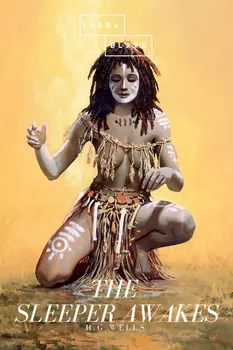
The Sleeper Awakes

The Sleeper Awakes is a dystopian science fiction novel by H. G. Wells about a man who sleeps for two hundred and three years, waking up in a completely transformed London, where, because of compound interest on his bank accounts, he has become the richest man in the world. The main character awakes to see his dreams realised, and the future revealed to him in all its horrors and malformities. The novel is a rewritten version of When the Sleeper Wakes, a story by Wells that was serialised between 1898 and 1899. Graham, an Englishman living in London in 1897 takes drugs to cure insomnia and falls into a coma. He wakes up in 2100. He later learns that he has inherited huge wealth and that his money has been put into a trust. Over the years, the trustees, the "White Council", have used his wealth to establish a vast political and economic world order. When he wakes Graham is disoriented. The people around him had not expected him to wake up, and are alarmed. Word spreads that the "Sleeper" has awakened. A mob gathers around the building and demands to see the fabled Sleeper. The people around Graham will not answer his questions. They place Graham under house arrest. Graham learns that he is the legal owner and master of most of the world. Rebels led by Ostrog help Graham to escape. They say that the people need Graham's leadership to rise against the White Council. Unconvinced, but unwilling to remain a prisoner, Graham goes with them. Graham arrives at a massive hall where the workers have gathered to prepare for the revolution. They march against the White Council but are soon attacked by the state police. In the confusion, Graham is separated from the revolutionaries. He meets an old man who tells him the story of the Sleeper - the White Council invested his wealth to buy the industries and political entities of half the world, establishing a plutocracy and sweeping away parliament and the monarchy. The Sleeper is just a figurehead.

Om den här boken

The Sleeper Awakes is a dystopian science fiction novel by H. G. Wells about a man who sleeps for two hundred and three years, waking up in a completely transformed London, where, because of compound interest on his bank accounts, he has become the richest man in the world. The main character awakes to see his dreams realised, and the future revealed to him in all its horrors and malformities. The novel is a rewritten version of When the Sleeper Wakes, a story by Wells that was serialised between 1898 and 1899. Graham, an Englishman living in London in 1897 takes drugs to cure insomnia and falls into a coma. He wakes up in 2100. He later learns that he has inherited huge wealth and that his money has been put into a trust. Over the years, the trustees, the "White Council", have used his wealth to establish a vast political and economic world order. When he wakes Graham is disoriented. The people around him had not expected him to wake up, and are alarmed. Word spreads that the "Sleeper" has awakened. A mob gathers around the building and demands to see the fabled Sleeper. The people around Graham will not answer his questions. They place Graham under house arrest. Graham learns that he is the legal owner and master of most of the world. Rebels led by Ostrog help Graham to escape. They say that the people need Graham's leadership to rise against the White Council. Unconvinced, but unwilling to remain a prisoner, Graham goes with them. Graham arrives at a massive hall where the workers have gathered to prepare for the revolution. They march against the White Council but are soon attacked by the state police. In the confusion, Graham is separated from the revolutionaries. He meets an old man who tells him the story of the Sleeper - the White Council invested his wealth to buy the industries and political entities of half the world, establishing a plutocracy and sweeping away parliament and the monarchy. The Sleeper is just a figurehead.

Kom igång med den här boken idag för 0 kr

  • Få full tillgång till alla böcker i appen under provperioden
  • Ingen bindningstid, avsluta när du vill
Prova gratis nu
Mer än 52 000 personer har gett Nextory 5 stjärnor i App Store och på Google Play.

  1. 50 Masterpieces you have to read before you die

    Frances Hodgson Burnett, Homer, Charles Dickens, Lyman Frank Baum, Nathaniel Hawthorne, Thomas Hardy, Robert Louis Stevenson, Henry Haggard, Wilkie Collins, H.G. Wells, Sir Walter Scott, Lucy Maud Montgomery, Louisa May Alcott, Henry Fielding, Mary Shelley, Arthur Conan Doyle, Leo Tolstoy, Euripides, Fyodor Dostoevsky, Alexander Pushkin, James Fenimore Cooper, Daniel Defoe, Joseph Conrad, Jonathan Swift, William Shakespeare, Oscar Wilde, John Bunyan, Charles Darwin, Alfred Tennyson, Bram Stoker, James Joyce, Dante Alighieri, Howard Pyle, Jane Austen, Emily Bronte, Giovanni Boccaccio, Rudyard Kipling

  2. 4.6
    #6

    Stjärnan

  3. 3.0

    50 Masterpieces you have to read before you die vol: 1 (2020 Edition) : Included: Little Women, The Richest Man in Babylon Emma, The Call Of The Wild ....

    Louisa May Alcott, Dante Alighieri, Marcus Aurelius, Jane Austen, L. Frank Baum, Charlotte Brontë, Emily Brontë, Anne Brontë, Miguel de Cervantes, Agatha Christie, George S. Clason, Arthur Conan Doyle, Joseph Conrad, Charles Dickens, Fyodor Dostoyevsky, Alexandre Dumas, George Eliot, G.K. Chesterton, G.K. Chesterton, Zane Grey, Nathaniel Hawthorne, Napoleon Hill, Homer, Victor Hugo, Frances Hodgson Burnett, Washington Irving, Henry James, Franz Kafka, Rudyard Kipling, Jack London, Leo Tolstoy, H.P. Lovecraft, Lucy Maud Montgomery, Joseph Murphy, Robert Louis Stevenson, Edgar Allan Poe, Marcel Proust, Publius, Mary Shelley, Bram Stoker, Mark Twain, Sun Tzu, Lew Wallace, Wallace D. Wattles, H.G. Wells

  4. 3.6
    #2

    Den osynlige mannen

    H.G. Wells

  5. 3.4
    #1

    Världarnas krig

    H.G. Wells

  6. 33 Masterpieces of Philosophy and Science to Read Before You Die (Illustrated) : Utopia, The Meditations, The Art of War, The Kama Sutra, Candide

    Thomas More, Marcus Aurelius Antoninus, Sun Tzu, Vatsyayana, Voltaire, Edwin A. Abbott, Aristotle, Dale Carnegie, Gilbert Keith Chesterton, René Descartes, Epictetus, Sigmund Freud, Hermann Hesse, David Hume, Lao Tzu, David Herbert Lawrence, Niccolò Machiavelli, John Mill, Prentice Mulford, Friedrich Nietzsche, Plato, Bertrand Russell, H.G. Wells, Frances Bacon

  7. 3.7

    War of the Worlds

    H.G. Wells

  8. 3.6
    #3

    Tidsmaskinen

    H.G. Wells

  9. 3.4
    #1

    Världarnas krig

    H.G. Wells

  10. 3.4

    Världarnas krig (lättläst)

    H.G. Wells

  11. 5.0

    The War of the Worlds

    H.G. Wells

  12. 3.6
    #3

    Tidsmaskinen

    H.G. Wells