

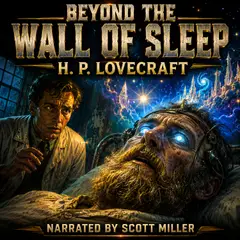
Some stories frighten with monsters. Others leave you wondering whether the impossible might actually be true. Beyond the Wall of Sleep does exactly that. H. P. Lovecraft blends psychological mystery with early speculative science fiction as a young physician becomes fascinated by a patient whose vivid dreams seem utterly beyond the limits of his education or imagination. Every strange outburst raises new questions, and each attempt to explain the man’s condition deepens the mystery. Refusing to dismiss what others call madness, the doctor risks his reputation on a remarkable experiment that may reveal whether dreams are merely illusions—or windows into something far greater.
Written years before science fiction embraced ideas such as consciousness beyond the body and telepathic communication, this story feels remarkably ahead of its time. Lovecraft balances eerie atmosphere with bold scientific speculation, carrying the listener from a lonely asylum to breathtaking visions of a universe unlike anything readers had encountered in the early twentieth century.
H. P. Lovecraft (1890–1937) transformed weird fiction through stories published in magazines including Weird Tales. His fiction introduced enduring creations such as Cthulhu, Yog-Sothoth, and the Necronomicon, while stories including The Call of Cthulhu, The Colour Out of Space, The Shadow Out of Time, The Dunwich Horror, and At the Mountains of Madness shaped generations of horror and science fiction writers.
First published in Pine Cones in 1919, Beyond the Wall of Sleep occupies a unique place in Lovecraft’s career. Long before his famous cosmic horror stories, it combined speculative science, astronomy, dreams, and the possibility of minds reaching far beyond Earth, making it one of his earliest and most fascinating science fiction tales.