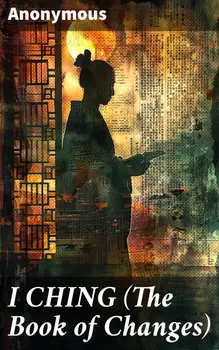
I CHING (The Book of Changes) : Unlocking Ancient Wisdom: Delving Into Chinese Culture and Life Dynamics

The I Ching, or The Book of Changes, is an ancient Chinese text that serves as both a divination guide and a philosophical treatise. Its complex system of hexagrams, formed by the interplay of yin and yang, reflects a profound understanding of duality and change in the universe. Through rich parables and commentaries, the text explores themes such as balance, moral integrity, and the cyclical nature of life. The stylistic elegance of the I Ching, characterized by terse yet evocative language, situates it within the broader literary tradition of classical Chinese philosophy, influencing both Eastern and Western thought over centuries. Though attributed to various sages within the Confucian and Taoist traditions, the true identity of its author remains anonymous, allowing the text to embody collective wisdom rather than individual ambition. The historical context of this work reflects ancient China's dynamic social fabric, with the text emerging from a synthesis of superstition, philosophy, and governance, which might have shaped its emphasis on harmony and ethical decision-making in an ever-changing world. I recommend the I Ching to readers seeking insights into the universal laws of change and balance. This timeless masterpiece not only offers guidance for personal reflection and decision-making but also serves as a philosophical anchor in tumultuous times, making it a vital read for scholars, practitioners of divination, and those interested in the intricate dance of fate and free will.
Über dieses Buch

The I Ching, or The Book of Changes, is an ancient Chinese text that serves as both a divination guide and a philosophical treatise. Its complex system of hexagrams, formed by the interplay of yin and yang, reflects a profound understanding of duality and change in the universe. Through rich parables and commentaries, the text explores themes such as balance, moral integrity, and the cyclical nature of life. The stylistic elegance of the I Ching, characterized by terse yet evocative language, situates it within the broader literary tradition of classical Chinese philosophy, influencing both Eastern and Western thought over centuries. Though attributed to various sages within the Confucian and Taoist traditions, the true identity of its author remains anonymous, allowing the text to embody collective wisdom rather than individual ambition. The historical context of this work reflects ancient China's dynamic social fabric, with the text emerging from a synthesis of superstition, philosophy, and governance, which might have shaped its emphasis on harmony and ethical decision-making in an ever-changing world. I recommend the I Ching to readers seeking insights into the universal laws of change and balance. This timeless masterpiece not only offers guidance for personal reflection and decision-making but also serves as a philosophical anchor in tumultuous times, making it a vital read for scholars, practitioners of divination, and those interested in the intricate dance of fate and free will.

Starte noch heute mit diesem Buch für € 0

  • Hole dir während der Testphase vollen Zugriff auf alle Bücher in der App
  • Keine Verpflichtungen, jederzeit kündbar
Jetzt kostenlos testen
Mehr als 52 000 Menschen haben Nextory im App Store und auf Google Play 5 Sterne gegeben.

  1. I CHING (The Book of Changes)

    Anonymous

  2. 5.0
    #40

    Harvard Classics Volume 40 : English Poetry 1: Chaucer To Gray

    Geoffrey Chaucer, Golden Deer Classics, Anonymous, Thomas Wyatt, Henry Howard, George Gascoigne, Edward Dyer, John Lyly, Thomas Lodge, George Peele, Robert Southwell, Samuel Daniel, Michael Drayton, Henry Constable, Edmund Spenser, William Habington, Christopher Marlowe, Richard Rowlands, Thomas Nashe, William Shakespeare, Robert Greene, Richard Barnfield, Thomas Campion, Robert Devereux, Henry Wotton, Edward de Vere, Ben Jonson, John Donne, Joshua Sylvester, William Alexander, Richard Corbet, Thomas Heywood, Thomas Dekker, Francis Beaumont, John Fletcher, John Webster, William Drummond, George Wither, William Browne, Robert Herrick, Francis Quarles, George Herbert, Henry Vaughan, Francis Bacon, James Shirley, Thomas Carew, John Suckling, William D'Avenant, Richard Lovelace, Edmund Waller, William Cartwright, James Graham, Richard Crashaw, Thomas Jordan, Abraham Cowley, Alexander Brome, Andrew Marvell, Earl of Rochester, Charles Sedley, John Dryden, Matthew Prior, Isaac Watts, Lady Grisel Baillie, Joseph Addison, Allan Ramsay, John Gay, Henry Carey, Alexander Pope, Ambrose Philips, Colley Cibber, James Thomson, Thomas Gray, George Bubb Dodington

  3. 2. Juni

    The Twelve Steps : A Modern Hero's Journey

    Anonymous

  4. The Song of Mio Cid

    Anonymous

  5. Signs of Agni Yoga

    Anonymous

  6. Fiery World : (Agni Yoga)

    Anonymous

  7. 3.2

    Beowulf

    Anonymous

  8. The Ancient Book of Jashar

    Anonymous

  9. #93

    Teig O' Kane and the Corpse

    Anonymous

  10. The Holy Bible — Volume I: The Old Testament - Audiobook

    Anonymous, Classic Audiobooks

  11. The Gospel according to John - King James Version :

    Anonymous

  12. Beowulf : An Anglo-Saxon Epic Poem

    Anonymous