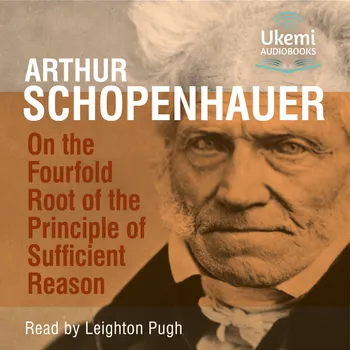
On the Fourfold Root of the Principle of Sufficient Reason

There is a cause, or a reason, behind everything that happens. This is the fundamental view behind the classical proposition the Principle of Sufficient Reason, which, in 1813, Schopenhauer chose as his subject for further examination in his doctoral dissertation On the Fourfold Root of the Principle of Sufficient Reason. He was 25.

In later years Schopenhauer revised this dissertation and republished it in 1847. The original ideas expressed here formed the basis of much of his later works, and therefore it remains an important core text for Schopenhauer studies. He discusses commentaries on the principle by earlier philosophers including Descartes, Spinoza, Wolff and Kant before going on to propose his four ‘classes of objects’ which he feels offer greater clarity and depth of meaning. The four classes of objects are each governed by their own form of the Principle: the Principle of Sufficient Reason of Becoming, the Principle of Sufficient Reason of Knowing, the Principle of Sufficient Reason of Being and the Principle of Sufficient Reason of Willing.

This recording of On the Fourfold Root of the Principle of Sufficient Reason uses the clear, classic translation by Madame Karl Hillebrand (1903).

Leighton Pugh presents it with the same clarity and commitment he has brought to his recording of all three volumes of The World as Will and Idea (Ukemi Audiobooks).

Starten Sie noch heute mit diesem Buch für € 0

  • Hol dir während der Testphase vollen Zugriff auf alle Bücher in der App
  • Keine Verpflichtungen, jederzeit kündbar
Jetzt kostenlos testen
Mehr als 52 000 Menschen haben Nextory im App Store und auf Google Play 5 Sterne gegeben.

  1. 100 Meisterwerke der Weltliteratur - Klassiker die man kennen muss

    Franz Kafka, Fjodor Michailowitsch Dostojewski, Rumi, Platon, Tacitus, Homer, Sigmund Freud, Friedrich Nietzsche, Oswald Spengler, Alfred Adler, Marcus Aurelius, Arthur Schopenhauer, Walt Whitman, Joseph Conrad, Robert Louis Stevenson, Karl May, Alexandre Dumas, James Fenimore Cooper, Arthur Conan Doyle, Edgar Allan Poe, Mary Shelley, O.Henry, Stefan Zweig, Charles Dickens, Jacob Grimm, Wilhelm Grimm, Hans Christian Andersen, Joseph von Eichendorff, Klaus Mann, Johann Wolfgang von Goethe, Jane Austen, Emily Brontë, Charlotte Brontë, Else Lasker-Schüler, Heinrich Heine, Herman Melville, Iwan Sergejewitsch Turgenew, Gustav Freytag, Thomas Wolfe, Jonathan Swift, Walter Scott, Nathaniel Hawthorne, Gustave Flaubert, Rainer Maria Rilke, John Galsworthy, Iwan Alexandrowitsch Gontscharow, Oscar Wilde, Lew Wallace, Voltaire, Lewis Carroll, Johanna Spyri, Mark Twain, Selma Lagerlöf, Rudyard Kipling, Jules Verne, Jack London, Miguel de Cervantes, Honoré de Balzac, Emile Zola, Guy De Maupassant, Moliere, Theodor Fontane, Nikolai Gogol, Leo Tolstoi, Anton Pawlowitsch Tschechow, Dante Alighieri, Joseph Roth, Robert Musil, E. T. Hoffmann, Heinrich Mann, Kurt Tucholsky, Heinrich von Kleist, Annette von Droste-Hülshoff, Gottfried Keller, Sophie von La Roche, Theodor Storm, William Shakespeare

  2. Neu

    Aforismos Sobre el Arte de Saber Vivir : Reflexiones introspectivas para la sabiduría cotidiana y el bienestar

    Arthur Schopenhauer

  3. Neu

    Notre conduite envers nous-mêmes et envers les autres : Pensées de Schopenhauer

    Arthur Schopenhauer

  4. Neu

    Aphorismen zur Lebensweisheit. Ein philosophisches Meisterwerk. : Hörbuchzeit: Klassiker der Weltliteratur

    Hörbuchzeit, Arthur Schopenhauer

  5. Versuch über das Geistersehn und was damit zusammenhängt. Ein Grundlagenwerk der Philosophie. : Hörbuchzeit: Klassiker der Weltliteratur

    Hörbuchzeit, Arthur Schopenhauer

  6. Die Kunst Recht zu behalten. Ein Grundlagenwerk der Philosophie. : Hörbuchzeit: Klassiker der Weltliteratur

    Hörbuchzeit, Arthur Schopenhauer

  7. Ce que l’on est, ce que l’on a, et ce que l’on représente : Aphorismes sur la sagesse de la vie

    Arthur Schopenhauer

  8. La Métaphysique de l’Amour : Pensées de Schopenhauer

    Arthur Schopenhauer

  9. Sobre el dolor del mundo, el suicidio y la voluntad de vivir

    Arthur Schopenhauer

  10. Sobre la cuádruple raíz del principio de razón suficiente

    Arthur Schopenhauer

  11. Parábolas y aforismos

    Arthur Schopenhauer

  12. Die große Arthur Schopenhauer Hörbuch Box : Aphorismen und Essays: Ein Grundlagenwerk der Philosophie

    Arthur Schopenhauer