Often appearing as ?gveda, the oldest of the four sacred books linked to Hinduism, it was composed in an ancient form of Sanskrit about 1500 BCE. The Rig Veda (Sanskrit: The Knowledge of Verses) was preserved in secrecy by ancient clans, initially orally, before it was written down about 300 BCE.
These 1028 poems, grouped as 10 ‘Circles’ (mandalas), have variously been called hymns, poems or songs by Sanskrit scholars. The Rik (so pronounced by the ancient Angirases clans, or Seer-Priest families) was an experiment with sound. The emphasis is always on sounding the words perfectly. The focus tends to be on the ideas rather than on the authors in Vedic literature, they are largely religious in nature, reflecting the world view and spiritual preoccupations of ancient India.
Like the Homeric epics, portions were composed during different periods in the north-western region of present-day India and Pakistan. That any of these verses have entered modern day usage is in itself extraordinary. No Hindu wedding is performed without reference to the Suryasukta, the model marriage of the Sun to the daughter of the Moon (Book 10, hymn 85). In India today certain surnames denote whether a family has a Vedic link, Dwivedi (knowledge of two vedas) Trivedi (three), Chaturvedi (four) among other Vedic linked ancestral roots. Very, very few had open access to this the Secret most Magical Veda.
The writers or composers of the Vedic verses were essentially storytellers. Once they had told their stories enough times they began to believe in the mythology they had woven to explain the vagaries of the universe. The sudden flood, the torrential downpour, the landslides that killed life-giving cattle and the forest fires that consumed all it touched, the quaking earth or sudden drought, all of which disarrayed an agrarian community. In comparison with other ancient belief systems the magical practice contained herein link with the Judaic tradition. A social order is seen evolving its supremacy with ritual practice. A strong priestly bias exists as the Seer-Priests monopolised transmitting them.
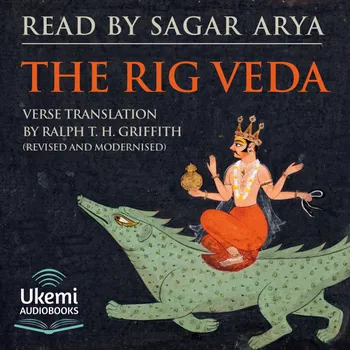
This present translation is based on the first poetic version in the English language by Ralph T. Griffith (1896) and revised and modernised for this Ukemi recording. The more explicitly worded verses (avoided by Griffith!) have been newly translated by Anwesha Arya to make this Rig Veda complete, as it was meant to be chanted and heard. Translator Anwesha Arya comes from within the tradition of Rgvedic priests. Sagar Arya reads expertly, responding to the varying character of the verses and observing, in spirit, the ritual background of The Rig Veda.