Über dieses Buch

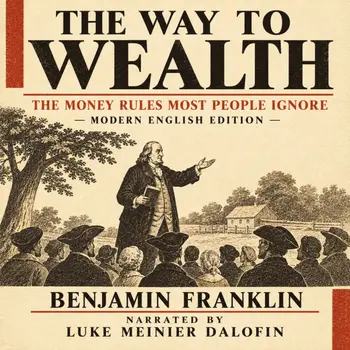
Most people want more money. Benjamin Franklin starts with what they do with the money they already have.

First published in 1758, *The Way to Wealth* brings together Franklin's memorable advice on earning, saving, spending, work, and debt. Through the voice of Father Abraham, Franklin challenges familiar excuses and exposes the habits that keep people from building lasting prosperity.

His message is direct: time is valuable, idleness is expensive, wasteful spending has consequences, and earning money means little if you cannot manage what you keep. Long before modern personal finance became an industry, Franklin was examining the everyday decisions behind financial security and wealth.

This Modern English Edition updates dated language for clearer, more natural listening while preserving the original work's central lessons and arguments.

Human-narrated by Luke Meinier Dalofin—not synthetic AI voice narration—this edition also includes a substantial companion at the end, extending Franklin's ideas through further explanation and reflection for contemporary listeners.

For listeners interested in personal finance, wealth-building, saving money, frugality, debt, financial discipline, and practical wisdom about making better use of what they earn.
Starte noch heute mit diesem Buch für € 0

  • Hole dir während der Testphase vollen Zugriff auf alle Bücher in der App
  • Keine Verpflichtungen, jederzeit kündbar
Jetzt kostenlos testen
Mehr als 52 000 Menschen haben Nextory im App Store und auf Google Play 5 Sterne gegeben.

Mehr von Benjamin Franklin

  1. 13. Jän.

    The Autobiography of Benjamin Franklin

    Benjamin Franklin

  2. Neu

    Autobiography of Benjamin Franklin

    Benjamin Franklin

  3. Neu

    Narratives of Humanity: The Autobiography of Benjamin Franklin & the Diary of a Young Girl in One Book

    Benjamin Franklin, Anne Frank

  4. Autobiography of Benjamin Franklin

    Benjamin Franklin

  5. Declaration of Independence & U.S. Constitution : Avec la Declaration des droits et tous les amendements

    Thomas Jefferson, James Madison, Benjamin Franklin, John Adams, Alexander Hamilton, George Washington

  6. Harvard Classics : The Five-Foot Shelf of Books

    Aesop, Dante Alighieri, Hans Christian Andersen, Augustine of Hippo, Marcus Aurelius, Jane Austen, Francis Bacon, Honoré de Balzac, Francis Beaumont, Bjørnstjerne Bjørnson, Thomas Browne, Robert Browning, John Bunyan, EDMUND BURKE, Robert Burns, Lord Byron, Thomas Carlyle, Benvenuto Cellini, Miguel de Cervantes, Marcus Tullius Cicero, Richard Henry Jr., Charles Darwin, Alphonse Daudet, Thomas Dekker, Charles Dickens, Fyodor Dostoevsky, John Dryden, Charles W. Eliot, George Eliot, Ralph Waldo Emerson, Epictetus, John Fletcher, Theodor Fontane, Benjamin Franklin, Johann Wolfgang Goethe, Oliver Goldsmith, Jacob Grimm, Edward Everett Hale, Bret Harte, Nathaniel Hawthorne, Homer, Victor Hugo, Washington Irving, Henry James, Ben Jonson, Gottfried Keller, Thomas à Kempis, Alexander L. Kielland, Martin Luther, Niccolò Machiavelli, Alessandro Manzoni, Christopher Marlowe, Philip Massinger, Guy De Maupassant, John Stuart Mill, John Milton, Thomas More, William Morris, Alfred de Musset, William Allan Neilson, William Penn, Plato, Pliny the Younger, Plutarch, George Sand, Percy Bysshe Shelley, Richard Brinsley Sheridan, Adam Smith, Laurence Sterne, Theodor Storm, William Makepeace Thackeray, Leo Tolstoy, Ivan Turgenev, Mark Twain, Juan Valera, Virgil, Izaak Walton, John Webster, John Woolman

  7. Autobiography of Benjamin Franklin

    Benjamin Franklin

  8. Autobiography of Benjamin Franklin

    Benjamin Franklin

  9. 3.7

    The Autobiography of Benjamin Franklin

    Benjamin Franklin

  10. 2.0

    The Way to Wealth

    Benjamin Franklin

  11. 3.7

    The Autobiography of Benjamin Franklin

    Benjamin Franklin