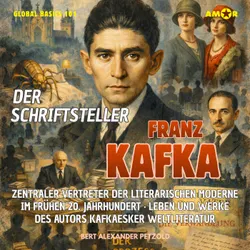

Anyone who reads Franz Kafka steps into a world in which doors close, rules shift, and a single sentence triggers the feeling of being watched and judged. How could a quiet clerk from Prague become the inventor of the Kafkaesque and write world literature that still acts like a mirror of literary modernism today?
This non-fiction book invites you on a fact rich cultural journey and conveys essential knowledge about Kafka's life and work in a way that is accessible, entertaining and clearly structured. You discover how everyday life, bureaucracy and inner restlessness gave rise to a prose that produces fear, comedy and insight all at once. You do not only get to know the content, you also gain tools for interpreting motifs, narrative stance and symbolism with confidence. Anyone who has ever tried to explain Kafka's scenes knows the problem. You sense the truth immediately, yet the right words are missing. This is exactly where the book begins and makes Kafka's logic visible without destroying the magic.
Franz Kafka was born in 1883 in Prague and grew up in a German speaking Jewish family, in a city full of tensions between languages, social worlds and traditions. The book shows how formative his relationship with his father was, along with his need for self assertion and his experiences at school and university. After studying law, Kafka worked at the Workers' Accident Insurance Institute and wrote mostly at night. This very double role, duty and files by day, imagination and truth by night, becomes tangible as the core of his literary energy. At the same time it becomes clear how strongly Kafka longed for closeness and feared it, in engagements, correspondence and friendships that drove him forward and exhausted him.
In his lifetime Kafka published little, yet one story became the key work, 'The Metamorphosis'. The study explains why this seemingly simple event, a person wakes up as an insect, became one of the most powerful metaphors of modernity. You see how Kafka does not explain alienation, guilt and the coldness of social roles, but turns them into scenes you do not forget. His larger prose projects often remained unfinished. It is precisely these fragments that feel like labyrinths in which the goal recedes ever further, as if avoiding completion were part of the truth. The book makes it understandable how Kafka, with a sober tone, precise observation and apparently matter of fact phrasing, creates a reality that is both everyday and uncanny.
As his health deteriorated and tuberculosis narrowed his life, Kafka kept writing, often in spite of his own exhaustion. Only after his early death in 1924 did his friend Max Brod publish the manuscripts, and so a body of work that might almost have been lost found its way into the canon of world literature. Even now it is difficult to assign Kafka's style to a single movement. This openness is precisely what makes him so modern. The book shows how Kafkaesque became a label for a reality in which power remains anonymous and the individual loses themselves in procedures, regulations and expectations. Alongside the literary texts, Kafka's letters, diaries and notebooks, as well as eyewitness accounts, open a view onto an unusual life, marked by inner conflict, humour and an unsparing self observation. The book is ideally suited to preparation for examinations leading to the higher education entrance qualification and for study at university.
Secure this book and discover Franz Kafka as an author who transformed the unsayable into clear language. If you want not only to know 'The Metamorphosis', but to truly understand it, you will find here the depth that lasts.