Om denne bog

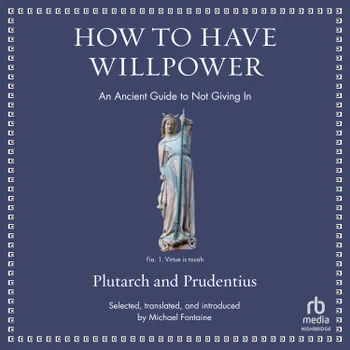
How to Have Willpower brings together two profound ancient meditations on how to overcome pressures that encourage us to act against our own best interests—Plutarch's essay On Dysopia or How to Resist Pressure and Prudentius's poetic allegory Psychomachia or How to Slay Your Demons. Challenging the idea that humans are helpless victims of vice, these works—introduced and presented in vivid, accessible new prose translations by Michael Fontaine—emphasize the power of personal choice and the possibility of personal growth, as they offer insights and practical advice about resisting temptation.

In the spirit of the best ancient self-help writing, Plutarch, a pagan Greek philosopher and historian, offers a set of practical recommendations and steps we can take to resist pressure and to stop saying "yes" against our better judgment. And in a delightfully different work, Prudentius, a Latin Christian poet, dramatizes the necessity to actively fight temptation through the story of an epic battle within the human soul between fierce warrior women representing our virtues and vices.

Plutarch and Prudentius insist that we allow pressure or temptations to get the best of us. But they also agree that we can do something about it. And their wisdom can help.

Kom i gang med denne bog i dag for 0 kr.

  • Få fuld adgang til alle bøger i appen i prøveperioden
  • Ingen forpligtelser, opsiges når som helst
Prøv gratis nu
Mere end 52.000 mennesker har givet Nextory fem stjerner i App Store og Google Play.

Mere af Plutarch

  1. Harvard Classics : The Five-Foot Shelf of Books

    Aesop, Dante Alighieri, Hans Christian Andersen, Augustine of Hippo, Marcus Aurelius, Jane Austen, Francis Bacon, Honoré de Balzac, Francis Beaumont, Bjørnstjerne Bjørnson, Thomas Browne, Robert Browning, John Bunyan, EDMUND BURKE, Robert Burns, Lord Byron, Thomas Carlyle, Benvenuto Cellini, Miguel de Cervantes, Marcus Tullius Cicero, Richard Henry Jr., Charles Darwin, Alphonse Daudet, Thomas Dekker, Charles Dickens, Fyodor Dostoevsky, John Dryden, Charles W. Eliot, George Eliot, Ralph Waldo Emerson, Epictetus, John Fletcher, Theodor Fontane, Benjamin Franklin, Johann Wolfgang Goethe, Oliver Goldsmith, Jacob Grimm, Edward Everett Hale, Bret Harte, Nathaniel Hawthorne, Homer, Victor Hugo, Washington Irving, Henry James, Ben Jonson, Gottfried Keller, Thomas à Kempis, Alexander L. Kielland, Martin Luther, Niccolò Machiavelli, Alessandro Manzoni, Christopher Marlowe, Philip Massinger, Guy De Maupassant, John Stuart Mill, John Milton, Thomas More, William Morris, Alfred de Musset, William Allan Neilson, William Penn, Plato, Pliny the Younger, Plutarch, George Sand, Percy Bysshe Shelley, Richard Brinsley Sheridan, Adam Smith, Laurence Sterne, Theodor Storm, William Makepeace Thackeray, Leo Tolstoy, Ivan Turgenev, Mark Twain, Juan Valera, Virgil, Izaak Walton, John Webster, John Woolman

  2. Ny

    The Boys' and Girls' Plutarch : Being Parts of the "Lives" of Plutarch, Edited for Boys and Girls

    Plutarch

  3. Plutarch's On Peace of Mind

    Plutarch

  4. Die größten Geschichtsbücher der Antike : Römische Kaiserbiographien, Der Alexanderzug, Der Bürgerkrieg, Der Peloponnesische Krieg, Ab urbe condita, Historien, Die Kriegsgeschichte, Kirchengeschichte

    Tacitus, Ammianus Marcellinus, Gaius Iulius Caesar, Plutarch, Herodot, Thukydides, Arrian, Titus Livius, Sueton, Polybios, Diogenes Laërtios, Prokop von Cäsarea, Eusebius, Xenophon

  5. The Face In The Moon (De Facie Quae in Orbe Lunae Apparet) : A Founding work of scientific analysis & Science Fiction

    Plutarch

  6. The Life of Pompey

    Plutarch, Bernadotte Perrin

  7. 3.3

    The Life of Cicero

    Plutarch, Bernadotte Perrin

  8. The Life of Agesilaus

    Plutarch, Bernadotte Perrin

  9. The Life of Demosthenes

    Plutarch, Bernadotte Perrin

  10. 4.0

    The Life of Pyrrhus

    Plutarch, Bernadotte Perrin

  11. The Life of Camillus

    Plutarch, Bernadotte Perrin

  12. The Life of Fabius Maximus

    Plutarch, Bernadotte Perrin