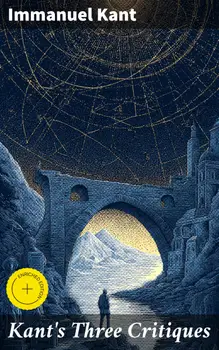
Kant's Three Critiques : Enriched edition. The Critique of Pure Reason, The Critique of Practical Reason & The Critique of Judgment

In "Kant's Three Critiques," Immanuel Kant presents a groundbreaking exploration of the nature of human experience and understanding through his seminal works: "Critique of Pure Reason," "Critique of Practical Reason," and "Critique of Judgment." Each critique delves into the structures and limits of human cognition, ethical behavior, and aesthetic appreciation, effectively shaping modern philosophy and epistemology. Kant employs a rigorous analytical style, intertwining detailed argumentation with profound insights, and situates his work within the Enlightenment context, challenging both rationalist and empiricist traditions. This trilogy not only seeks to elucidate the conditions under which knowledge is possible but also addresses moral imperatives and the experience of beauty, forming a comprehensive framework for understanding the interplay between the empirical world and metaphysical inquiries. Kant, a key figure in Western philosophy, was deeply influenced by the philosophical inquiries of his time, including the works of Hume and Rousseau. His intellectual journey led him to grapple with the limitations of reason and the capacities of human thought. His background as a scholar of mathematics and the natural sciences also informed his systematic approach to philosophy, fostering a desire to harmonize rational thought with ethical imperatives and aesthetic values. This collection is essential reading for anyone seeking a deeper understanding of modern philosophical thought. Kant's critiques challenge readers to reevaluate their assumptions about knowledge, morality, and beauty, making it a profound contribution to both philosophical discourse and practical ethical considerations. Engage with these foundational texts to appreciate the complexity of human cognition and the philosophical foundations that continue to influence contemporary debates.

In this enriched edition, we have carefully created added value for your reading experience:

- A succinct Introduction situates the work's timeless appeal and themes.

- The Synopsis outlines the central plot, highlighting key developments without spoiling critical twists.

- A detailed Historical Context immerses you in the era's events and influences that shaped the writing.

- An Author Biography reveals milestones in the author's life, illuminating the personal insights behind the text.

- A thorough Analysis dissects symbols, motifs, and character arcs to unearth underlying meanings.

- Reflection questions prompt you to engage personally with the work's messages, connecting them to modern life.

- Hand‐picked Memorable Quotes shine a spotlight on moments of literary brilliance.

- Interactive footnotes clarify unusual references, historical allusions, and archaic phrases for an effortless, more informed read.

Om denne bog

In "Kant's Three Critiques," Immanuel Kant presents a groundbreaking exploration of the nature of human experience and understanding through his seminal works: "Critique of Pure Reason," "Critique of Practical Reason," and "Critique of Judgment." Each critique delves into the structures and limits of human cognition, ethical behavior, and aesthetic appreciation, effectively shaping modern philosophy and epistemology. Kant employs a rigorous analytical style, intertwining detailed argumentation with profound insights, and situates his work within the Enlightenment context, challenging both rationalist and empiricist traditions. This trilogy not only seeks to elucidate the conditions under which knowledge is possible but also addresses moral imperatives and the experience of beauty, forming a comprehensive framework for understanding the interplay between the empirical world and metaphysical inquiries. Kant, a key figure in Western philosophy, was deeply influenced by the philosophical inquiries of his time, including the works of Hume and Rousseau. His intellectual journey led him to grapple with the limitations of reason and the capacities of human thought. His background as a scholar of mathematics and the natural sciences also informed his systematic approach to philosophy, fostering a desire to harmonize rational thought with ethical imperatives and aesthetic values. This collection is essential reading for anyone seeking a deeper understanding of modern philosophical thought. Kant's critiques challenge readers to reevaluate their assumptions about knowledge, morality, and beauty, making it a profound contribution to both philosophical discourse and practical ethical considerations. Engage with these foundational texts to appreciate the complexity of human cognition and the philosophical foundations that continue to influence contemporary debates.

In this enriched edition, we have carefully created added value for your reading experience:

- A succinct Introduction situates the work's timeless appeal and themes.

- The Synopsis outlines the central plot, highlighting key developments without spoiling critical twists.

- A detailed Historical Context immerses you in the era's events and influences that shaped the writing.

- An Author Biography reveals milestones in the author's life, illuminating the personal insights behind the text.

- A thorough Analysis dissects symbols, motifs, and character arcs to unearth underlying meanings.

- Reflection questions prompt you to engage personally with the work's messages, connecting them to modern life.

- Hand‐picked Memorable Quotes shine a spotlight on moments of literary brilliance.

- Interactive footnotes clarify unusual references, historical allusions, and archaic phrases for an effortless, more informed read.
Kom i gang med denne bog i dag for 0 kr.

  • Få fuld adgang til alle bøger i appen i prøveperioden
  • Ingen forpligtelser, opsiges når som helst
Prøv gratis nu
Mere end 52.000 mennesker har givet Nextory fem stjerner i App Store og Google Play.

  1. 4.0

    Om pædagogik

    Immanuel Kant

  2. Ny

    100 Clásicos de la Literatura Universal

    Francis Scott Fitzgerald, Mary Shelley, Lyman Frank Baum, Louisa May Alcott, Dante Alighieri, Jane Austen, Ambrose Bierce, Emily Brontë, Edgar Rice Burroughs, Lewis Carroll, Wilkie Collins, René Descartes, Charles Dickens, Emily Dickinson, Alexandre Dumas, Gustave Flaubert, Benito Pérez Galdós, Johann Wolfgang von Goethe, Thomas Hardy, E T A Hoffmann, Washington Irving, Henry James, James Joyce, Franz Kafka, Gaston Leroux, Federico García Lorca, H.P. Lovecraft, Publio Virgilio Marón, Lucy Maud Montgomery, John William Polidori, Marco Polo, Antoine de Saint-Exupéry, Emilio Salgari, Walter Scott, Mark Twain, Jules Verne, Julio Verne, H.G. Wells, Edith Wharton, Mary Wollstonecraft, Stefan Zweig, Sun Tzu, Bram Stoker, - Aristoteles, George Bernard Shaw, Henryk Sienkiewicz, Concepción Arenal, Charlotte Brontë, Miguel de Cervantes, G.K. Chesterton, Daniel Defoe, Fyodor Mikhailovich Dostoyevsky, Arthur Conan Doyle, Sigmund Freud, H. Rider Haggard, Homero, Immanuel Kant, Rudyard Kipling, Molière, Friedrich Nietzsche, Fernando de Rojas, Sófocles, William Makepeace Thackeray, León Tolstói, Voltaire, Ramón María del Valle-Inclán, Oscar Wilde, Virginia Woolf

  3. Hacia la paz perpetua

    Immanuel Kant

  4. Teoría y praxis : Estudio preliminar: Eduardo García Belsunce

    Immanuel Kant

  5. La paz perpetua : Octava edición

    Immanuel Kant

  6. Yaşam Felsefesi

    Immanuel Kant

  7. La Paz Perpetua :

    Immanuel Kant

  8. 12 Masterpieces You Have to Read Before You Die. Philosophy

    Niccolo Machiavelli, Tommaso Campanella, Francis Bacon, Thomas More, John Stuart Mill, Immanuel Kant, Kahlil Gibran, Leo Tolstoy, G.K. Chesterton, Henry David Thoreau

  9. Crítica de la Razón Pura

    Immanuel Kant

  10. 2.5

    An Answer to the Question: What is Enlightenment?

    Immanuel Kant

  11. 3.6

    Ikuiseen rauhaan

    Immanuel Kant

  12. Dreams of a Spirit-Seer

    Immanuel Kant