Living Space : Infinite Earths, Infinite Possibilities—And One Fatal Flaw

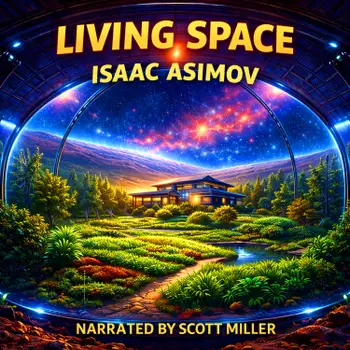
Humanity has solved overpopulation at last. Instead of crowding together, families now live in perfect isolation, each on their own version of Earth—vast, silent, and seemingly lifeless. In Living Space, that elegant solution is taken for granted, until a single disturbance raises an impossible question: what if the system isn’t as flawless as everyone believes?

Isaac Asimov builds a calm, orderly future and then quietly introduces doubt. The story unfolds with methodical precision, blending domestic normalcy with mounting unease. Beneath the comfort of advanced technology lies a deeper tension—about ownership, entitlement, and the dangers of assuming humanity is always alone. What begins as a bureaucratic inconvenience grows into something far more unsettling, forcing characters to confront the limits of logic in an infinite universe.

This is classic Asimov: clear-eyed, idea-driven, and relentlessly thoughtful. Living Space doesn’t rely on spectacle or action, but on the slow realization that even perfect systems carry hidden risks. It’s a story about unintended consequences, cultural blind spots, and how small anomalies can expose vast truths.

Isaac Asimov was one of the most influential science fiction writers of the twentieth century, known for combining scientific rigor with sharp social insight. Across hundreds of stories and essays, he explored how human institutions respond to technology, power, and change. Living Space reflects his talent for turning abstract concepts into intimate, unsettling human drama—proof that the biggest dangers often arrive quietly.
Om denne bog

Humanity has solved overpopulation at last. Instead of crowding together, families now live in perfect isolation, each on their own version of Earth—vast, silent, and seemingly lifeless. In Living Space, that elegant solution is taken for granted, until a single disturbance raises an impossible question: what if the system isn’t as flawless as everyone believes?

Isaac Asimov builds a calm, orderly future and then quietly introduces doubt. The story unfolds with methodical precision, blending domestic normalcy with mounting unease. Beneath the comfort of advanced technology lies a deeper tension—about ownership, entitlement, and the dangers of assuming humanity is always alone. What begins as a bureaucratic inconvenience grows into something far more unsettling, forcing characters to confront the limits of logic in an infinite universe.

This is classic Asimov: clear-eyed, idea-driven, and relentlessly thoughtful. Living Space doesn’t rely on spectacle or action, but on the slow realization that even perfect systems carry hidden risks. It’s a story about unintended consequences, cultural blind spots, and how small anomalies can expose vast truths.

Isaac Asimov was one of the most influential science fiction writers of the twentieth century, known for combining scientific rigor with sharp social insight. Across hundreds of stories and essays, he explored how human institutions respond to technology, power, and change. Living Space reflects his talent for turning abstract concepts into intimate, unsettling human drama—proof that the biggest dangers often arrive quietly.
Kom i gang med denne bog i dag for 0 kr.

  • Få fuld adgang til alle bøger i appen i prøveperioden
  • Ingen forpligtelser, opsiges når som helst
Prøv gratis nu
Mere end 52.000 mennesker har givet Nextory fem stjerner i App Store og Google Play.

  1. 4.1
    #1

    Foundation

    Isaac Asimov

  2. Lost Sci-Fi Books 301 thru 320 : Robots, Time Travel, Alien Worlds and Visions of Tomorrow

    Poul Anderson, Mack Reynolds, John Victor Peterson, Mary Carlson, David Mason, John W. Campbell, Ray Bradbury, Henry Kuttner, Alfred Bester, Lester del Rey, Alan E. Nourse, Robert Silverberg, Arthur C. Clarke, Miriam Allen deFord, Donald A. Wollheim, R. J. Rice, Isaac Asimov, Roger D. Aycock

  3. Lost Sci-Fi Books 281 thru 300 : Lovecraft, Asimov, Clarke, Bradbury and More

    H.P. Lovecraft, lord Dunsany, Isaac Asimov, Robert Sheckley, Evelyn E. Smith, Frederik Pohl, Arthur C. Clarke, Ray Bradbury, Donald A. Wollheim, Robert E. Howard, James Blish, J. F. Bone, Donald E. Westlake, William Brittain, Jack London, Frank Belknap Long, Kenneth Harmon, Richard R. Smith

  4. The Frank Herbert and Isaac Asimov Collection : 8 Science Fiction Short Stories

    Frank Herbert, Isaac Asimov

  5. Science Fiction Grand Masters : From Asimov to Ellison—Timeless Sci-Fi by the Genre’s Greatest Minds

    Arthur C. Clarke, Isaac Asimov, Robert Silverberg, Damon Knight, Fritz Leiber, Clifford D. Simak, Harry Harrison, Poul Anderson, Frederik Pohl, Harlan Ellison, Ray Bradbury, Lester del Rey

  6. 5.0
    #133

    Christmas on Ganymede

    Isaac Asimov

  7. 4.0
    #159

    Someday : The Day The Computer Listened

    Isaac Asimov

  8. Vintage Sci-Fi 18 - 21 Classic Science Fiction Short Stories from Isaac Asimov, Jack London, H. G. Wells, H. P. Lovecraft, Harry Harrison and many more : Classic Sci-Fi Legends Brought to Life

    Jack London, H.G. Wells, H.P. Lovecraft, Michael Shaara, Clark Ashton Smith, Isaac Asimov, Harry Harrison, William Tenn, Randall Garrett, Donald A. Wollheim, Henry Kuttner, Zenna Henderson, Alfred Bester, Charles Dye, Noel Loomis, Fritz Leiber, Robert Sheckley, Miriam Allen deFord, Francis Stevens, Lynn Venable, Robert Moore Williams

  9. Topbedømt
    4.6

    Robots and Empire

    Isaac Asimov

  10. 4.4

    The Robots of Dawn

    Isaac Asimov

  11. 4.4
    #2

    Forward the Foundation

    Isaac Asimov

  12. 3.5

    The Stars, Like Dust

    Isaac Asimov