Om denne bog

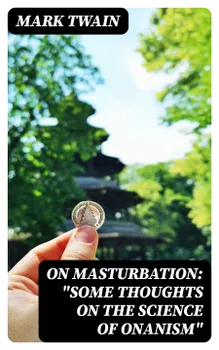
In "Some Thoughts on the Science of Onanism," Mark Twain tackles a taboo subject with his characteristic wit and keen societal observation. This provocative essay, written in Twain's signature conversational style, presents a critical examination of the societal attitudes toward masturbation in the late 19th century. Twain engages with the prevailing moral and medical discourses of his time, combining humor with earnest inquiry, ultimately challenging the stigma surrounding the act and urging a more enlightened understanding of human sexuality. The work reflects both the literary depth and the cultural anxieties of the era, making it a compelling read for those interested in historical perspectives on sexual health. Mark Twain, a stalwart figure of American literature, often infused his writing with elements of personal experience and social commentary. His upbringing in a puritanical society, coupled with his extensive travels and exposure to diverse cultural norms, shaped his views on propriety and personal freedom. Twain's exploration of complex subjects, such as sexuality, was driven by his commitment to truth and his disdain for hypocrisy, lending his works a distinct authenticity and relatability. This book is recommended for readers seeking a nuanced exploration of a sensitive topic, framed within the context of Twain's sharp intellect and humor. Twain's insights encourage readers to confront societal taboos with curiosity and open-mindedness, making this essay a vital addition to the canon of American literature and a surprising yet enlightening investigation into human nature.

In this enriched edition, we have carefully created added value for your reading experience:

- A succinct Introduction situates the work's timeless appeal and themes.

- The Synopsis outlines the central plot, highlighting key developments without spoiling critical twists.

- A detailed Historical Context immerses you in the era's events and influences that shaped the writing.

- An Author Biography reveals milestones in the author's life, illuminating the personal insights behind the text.

- A thorough Analysis dissects symbols, motifs, and character arcs to unearth underlying meanings.

- Reflection questions prompt you to engage personally with the work's messages, connecting them to modern life.

- Hand‐picked Memorable Quotes shine a spotlight on moments of literary brilliance.

- Interactive footnotes clarify unusual references, historical allusions, and archaic phrases for an effortless, more informed read.

Kom i gang med denne bog i dag for 0 kr.

  • Få fuld adgang til alle bøger i appen i prøveperioden
  • Ingen forpligtelser, opsiges når som helst
Prøv gratis nu
Mere end 52.000 mennesker har givet Nextory fem stjerner i App Store og Google Play.

Mere af Mark Twain

  1. 50 Masterpieces You Have to Read : Volume Two - A Second Library of World Literature

    Joseph Sheridan Fanu, Madame de Fayette, Jerome K Jerome, James Joyce, Charles Kingsley, Rudyard Kipling, Pierre Choderlos Laclos, D. H. Lawrence, Matthew Gregory Lewis, Sinclair Lewis, Jack London, H.P. Lovecraft, Thomas Mann, W. Somerset Maugham, Guy De Maupassant, Herman Melville, Edgar Allan Poe, Marcel Proust, Ann Radcliffe, Samuel Richardson, George Sand, Walter Scott, Mary Shelley, Henryk Sienkiewicz, May Sinclair, Upton Sinclair, Stendhal, Laurence Sterne, Robert Louis Stevenson, Bram Stoker, Harriet Beecher Stowe, Jonathan Swift, Rabindranath Tagore, William Makepeace Thackeray, Leo Tolstoy, Anthony Trollope, Ivan Turgenev, Mark Twain, Jules Verne, Lew Wallace, H.G. Wells, Rebecca West, Edith Wharton, Oscar Wilde, Cao Xueqin, Émile Zola

  2. Harvard Classics : The Five-Foot Shelf of Books

    Aesop, Dante Alighieri, Hans Christian Andersen, Augustine of Hippo, Marcus Aurelius, Jane Austen, Francis Bacon, Honoré de Balzac, Francis Beaumont, Bjørnstjerne Bjørnson, Thomas Browne, Robert Browning, John Bunyan, EDMUND BURKE, Robert Burns, Lord Byron, Thomas Carlyle, Benvenuto Cellini, Miguel de Cervantes, Marcus Tullius Cicero, Richard Henry Jr., Charles Darwin, Alphonse Daudet, Thomas Dekker, Charles Dickens, Fyodor Dostoevsky, John Dryden, Charles W. Eliot, George Eliot, Ralph Waldo Emerson, Epictetus, John Fletcher, Theodor Fontane, Benjamin Franklin, Johann Wolfgang Goethe, Oliver Goldsmith, Jacob Grimm, Edward Everett Hale, Bret Harte, Nathaniel Hawthorne, Homer, Victor Hugo, Washington Irving, Henry James, Ben Jonson, Gottfried Keller, Thomas à Kempis, Alexander L. Kielland, Martin Luther, Niccolò Machiavelli, Alessandro Manzoni, Christopher Marlowe, Philip Massinger, Guy De Maupassant, John Stuart Mill, John Milton, Thomas More, William Morris, Alfred de Musset, William Allan Neilson, William Penn, Plato, Pliny the Younger, Plutarch, George Sand, Percy Bysshe Shelley, Richard Brinsley Sheridan, Adam Smith, Laurence Sterne, Theodor Storm, William Makepeace Thackeray, Leo Tolstoy, Ivan Turgenev, Mark Twain, Juan Valera, Virgil, Izaak Walton, John Webster, John Woolman

  3. 5.0

    What Stumped the Blue Jays

    Mark Twain

  4. 4.0

    The Adventures of Huckleberry Finn

    Mark Twain

  5. 50 Masterpieces you have to read before you die vol : A Monumental Collection of Fiction That Continues the Legacy of World Literature's Greatest Voices

    Lewis Carroll, Mark Twain, Jules Verne, Arthur Conan Doyle, Louisa May Alcott, Jane Austen, G.K. Chesterton, Wilkie Collins, Charles Dickens, Fyodor Dostoyevsky, Alexandre Dumas, F. Scott Fitzgerald, E. M. Forster, Thomas Hardy, Hermann Hesse

  6. 3.6

    The Adventures of Huckleberry Finn

    Mark Twain

  7. 12 Classic Books You Need to Read Before You Grow up

    Antoine de Saint Exupery, Lewis Carroll, Robert Louis Stevenson, Frances Hodgson Burnett, Mark Twain, Eleanor H. Porter, Jules Verne, Charles Dickens, Jack London, Lyman Frank Baum, Margery Williams, J.M. Barrie

  8. 4.8

    Huckleberry Finn

    Mark Twain

  9. 3.7

    The Adventures Of Huckleberry Finn

    Mark Twain

  10. Something Wicked : The Call of Cthulhu, Frankenstein, Dracula, The Murders in the Rue Morgue, Dr Jekyll & Mr Hyde…

    Wilhelm Hauff, Charles Dickens, Mark Twain, Harriet Beecher Stowe, Adelbert von Chamisso, Oscar Wilde, Robert Louis Stevenson, Edgar Allan Poe, William Hope Hodgson, Joseph Sheridan Fanu, John Buchan, Louis Tracy, Bram Stoker, Anatole France, Charlotte Brontë, Emily Brontë, Jack London, Henry James, Théophile Gautier, Arthur Conan Doyle, Richard Le Gallienne, Jane Austen, Ralph Adams Cram, Thomas De Quincey, John Meade Falkner, Guy De Maupassant, Thomas Hardy, William Archer, Daniel Defoe, John Kendrick Bangs, Cleveland Moffett, Brander Matthews, Marie Belloc Lowndes, Horace Walpole, Rudyard Kipling, Lafcadio Hearn, Hugh Walpole, Ambrose Bierce, Frederick Marryat, Ellis Parker Butler, Washington Irving, Leonid Andreyev, David Lindsay, Nathaniel Hawthorne, Grant Allen, Arthur Machen, Wilkie Collins, Saki, William Makepeace Thackeray, Thomas Peckett Prest, James Malcolm Rymer, Fergus Hume, Edward Bellamy, Walter Hubbell, Charlotte Perkins Gilman, Leopold Kompert, Richard Marsh, Florence Marryat, Catherine Crowe, Vincent O'Sullivan, H.G. Wells, Robert W. Chambers, W. W. Jacobs, M.P. Shiel, E F Benson, Jerome K Jerome, M. R. James, E. T. Hoffmann, Stanley G. Weinbaum, George W. Reynolds, H.P. Lovecraft, Robert E. Howard, Edith Nesbit, Sabine Baring-Gould, William Thomas Beckford, Francis Marion Crawford, Lucy Maud Montgomery, Mary Elizabeth Braddon, Mary Louisa Molesworth, Mary E. Freeman, Nikolai Gogol, Mary Shelley, Elizabeth Gaskell, Edward Bulwer-Lytton, Frank R. Stockton, A. T. Quiller-Couch, Ann Radcliffe, Louisa M. Alcott, Amelia B. Edwards, Leonard Kip, Matthew Gregory Lewis, Fitz-James O’Brien, Katherine Rickford, Bithia Mary Croker, Catherine L. Pirkis, Émile Erckmann, Alexandre Chatrian, Pedro De Alarçon, Pliny the Younger, Helena Blavatsky, Villiers de Adam, William F. Harvey, Fiona Macleod, William T. Stead, Gambier Bolton, Andrew Jackson Davis, Nizida, Walter F. Prince, Chester Bailey Fernando, William Polidori, H. H. Munro

  11. Mark Twain Essays

    Mark Twain

  12. 1.0

    The Adventures of Huckleberry Finn

    Mark Twain