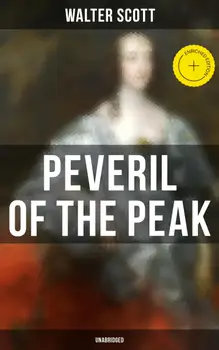
Peveril of the Peak (Unabridged) : Enriched edition. Historical Novel

In 'Peveril of the Peak' by Walter Scott, the reader is transported back to the tumultuous times of 17th century England, where political intrigue and personal vendettas threaten to tear the country apart. Scott's lyrical prose and intricate plot weave a tale of love, betrayal, and redemption against the backdrop of the historical events of the Popish Plot. With its detailed descriptions of landscapes and characters, the book exemplifies the romantic style of writing that Scott is known for, immersing the reader in a world of chivalry and adventure. This classic novel is a must-read for those interested in historical fiction and the literature of the Romantic period. Walter Scott, a Scottish author and poet, drew inspiration from the history and legends of his native land to create his vast body of literary work. His deep knowledge of Scottish history and his passion for storytelling shine through in 'Peveril of the Peak', as he masterfully blends fact and fiction to craft a compelling narrative. Scott's unique voice and storytelling abilities have cemented his reputation as a literary giant of the 19th century. I highly recommend 'Peveril of the Peak' to readers who enjoy historical fiction with a touch of romance and adventure. Walter Scott's vivid imagery and captivating storytelling make this novel a timeless classic that will transport you to another era.

In this enriched edition, we have carefully created added value for your reading experience:

- A succinct Introduction situates the work's timeless appeal and themes.

- The Synopsis outlines the central plot, highlighting key developments without spoiling critical twists.

- A detailed Historical Context immerses you in the era's events and influences that shaped the writing.

- An Author Biography reveals milestones in the author's life, illuminating the personal insights behind the text.

- A thorough Analysis dissects symbols, motifs, and character arcs to unearth underlying meanings.

- Reflection questions prompt you to engage personally with the work's messages, connecting them to modern life.

- Hand‐picked Memorable Quotes shine a spotlight on moments of literary brilliance.

- Interactive footnotes clarify unusual references, historical allusions, and archaic phrases for an effortless, more informed read.

Om denne bog

In 'Peveril of the Peak' by Walter Scott, the reader is transported back to the tumultuous times of 17th century England, where political intrigue and personal vendettas threaten to tear the country apart. Scott's lyrical prose and intricate plot weave a tale of love, betrayal, and redemption against the backdrop of the historical events of the Popish Plot. With its detailed descriptions of landscapes and characters, the book exemplifies the romantic style of writing that Scott is known for, immersing the reader in a world of chivalry and adventure. This classic novel is a must-read for those interested in historical fiction and the literature of the Romantic period. Walter Scott, a Scottish author and poet, drew inspiration from the history and legends of his native land to create his vast body of literary work. His deep knowledge of Scottish history and his passion for storytelling shine through in 'Peveril of the Peak', as he masterfully blends fact and fiction to craft a compelling narrative. Scott's unique voice and storytelling abilities have cemented his reputation as a literary giant of the 19th century. I highly recommend 'Peveril of the Peak' to readers who enjoy historical fiction with a touch of romance and adventure. Walter Scott's vivid imagery and captivating storytelling make this novel a timeless classic that will transport you to another era.

In this enriched edition, we have carefully created added value for your reading experience:

- A succinct Introduction situates the work's timeless appeal and themes.

- The Synopsis outlines the central plot, highlighting key developments without spoiling critical twists.

- A detailed Historical Context immerses you in the era's events and influences that shaped the writing.

- An Author Biography reveals milestones in the author's life, illuminating the personal insights behind the text.

- A thorough Analysis dissects symbols, motifs, and character arcs to unearth underlying meanings.

- Reflection questions prompt you to engage personally with the work's messages, connecting them to modern life.

- Hand‐picked Memorable Quotes shine a spotlight on moments of literary brilliance.

- Interactive footnotes clarify unusual references, historical allusions, and archaic phrases for an effortless, more informed read.
Kom i gang med denne bog i dag for 0 kr.

  • Få fuld adgang til alle bøger i appen i prøveperioden
  • Ingen forpligtelser, opsiges når som helst
Prøv gratis nu
Mere end 52.000 mennesker har givet Nextory fem stjerner i App Store og Google Play.

  1. Believe in Love & Joy : A Treasury of Christmas Love, Joy & Legends

    Selma Lagerlöf, Charles Dickens, Mark Twain, Harriet Beecher Stowe, Martin Luther, Robert Louis Stevenson, William Shakespeare, Henry Wadsworth Longfellow, William Wordsworth, Carolyn Wells, Sophie May, Louisa May Alcott, Henry van Dyke, Walter Scott, Anthony Trollope, Rudyard Kipling, Beatrix Potter, Emily Dickinson, Lucas Malet, Thomas Nelson Page, O.Henry, Maud Lindsay, Alice Hale Burnett, Walter Crane, Amy Ella Blanchard, Amanda M. Douglas), Booker T. Washington, Ernest Ingersoll, L. Frank Baum, J.M. Barrie, Eleanor H. Porter, Annie F. Johnston, Jacob A. Riis, Florence L. Barclay, E. T. Hoffmann, Marjorie L. Pickthall, Hans Christian Andersen, William Butler Yeats, Lucy Maud Montgomery, Leo Tolstoy, Fyodor Dostoevsky, Alfred Lord Tennyson, George MacDonald, A. S. Boyd, Juliana Horatia Ewing, Brothers Grimm, Clement Moore, Susan Anne Livingston, Ridley Sedgwick, Lucy Wheelock, Aunt Hede, Frederick E. Dewhurst

  2. The Mythology and History of Witchcraft

    Bram Stoker, Charles Mackay, William Godwin, Walter Scott, Charles Wentworth Upham, Jules Michelet, John Ashton, Howard Williams, Increase Mather, Cotton Mather, Allen Putnam, George Moir, Frederick George Lee, James Thacher, M. V. B. Perley, Wilhelm Meinhold, John M. Taylor, E. Lynn Linton, William P. Upham, W. H. Davenport Adams, M. Schele de Vere, John G. Campbell, John Maxwell Wood, Samuel Roberts Wells

  3. Deadly Sails - Complete Collection : History of Pirates, Trues Stories about the Most Notorious Pirates & Most Famous Pirate Novels

    Charles Johnson, Robert Louis Stevenson, Walter Scott, Howard Pyle, Edgar Allan Poe, Jack London, Jules Verne, Charles Boardman Hawes, J.M. Barrie, Arthur Conan Doyle, Frederick Marryat, R.M Ballantyne, Charles Dickens, L. Frank Baum, J. Allan Dunn, Robert E. Howard, James Fenimore Cooper, Alexandre Dumas, William Hope Hodgson, F. Scott Fitzgerald, Harold MacGrath, Harry Collingwood, W. H. G. Kingston, G. A Henty, Joseph Lewis French, Maturin Murray Ballou, Charles Kingsley, Washington Irving, William Clark Russell, Max Pemberton

  4. 4.0

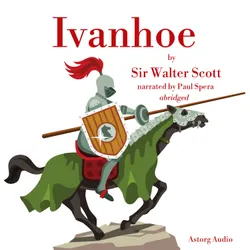
    Ivanhoe

    Walter Scott

  5. 4.3

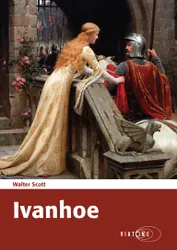
    Ivanhoe

    Walter Scott

  6. 5.0

    Talismanen

    Walter Scott

  7. Ivanhoe: A Romance

    Walter Scott

  8. 4.0
    #5

    Ivanhoe

    Walter Scott

  9. 100 Obras Maestras Que Debes Leer Antes De Morir

    Francis Scott Fitzgerald, Mary Shelley, Lyman Frank Baum, Edith Nesbit, Dante Alighieri, Jane Austen, Ambrose Bierce, Emily Brontë, Edgar Rice Burroughs, Lewis Carroll, Wilkie Collins, René Descartes, Charles Dickens, Emily Dickinson, Alexandre Dumas, Gustave Flaubert, Benito Pérez Galdós, Johann Wolfgang von Goethe, Thomas Hardy, E T A Hoffmann, Washington Irving, Henry James, James Joyce, Franz Kafka, Gaston Leroux, Federico García Lorca, H.P. Lovecraft, Publio Virgilio Marón, Lucy Maud Montgomery, John William Polidori, Marco Polo, Antoine de Saint-Exupéry, Emilio Salgari, Walter Scott, Mark Twain, Jules Verne, H.G. Wells, Edith Wharton, Mary Wollstonecraft, Fernando de Rojas

  10. 100 Clásicos de la Literatura Universal

    Francis Scott Fitzgerald, Mary Shelley, Lyman Frank Baum, Louisa May Alcott, Dante Alighieri, Jane Austen, Ambrose Bierce, Emily Brontë, Edgar Rice Burroughs, Lewis Carroll, Wilkie Collins, René Descartes, Charles Dickens, Emily Dickinson, Alexandre Dumas, Gustave Flaubert, Benito Pérez Galdós, Johann Wolfgang von Goethe, Thomas Hardy, E T A Hoffmann, Washington Irving, Henry James, James Joyce, Franz Kafka, Gaston Leroux, Federico García Lorca, H.P. Lovecraft, Publio Virgilio Marón, Lucy Maud Montgomery, John William Polidori, Marco Polo, Antoine de Saint-Exupéry, Emilio Salgari, Walter Scott, Mark Twain, Jules Verne, Julio Verne, H.G. Wells, Edith Wharton, Mary Wollstonecraft, Stefan Zweig, Sun Tzu, Bram Stoker, - Aristoteles, George Bernard Shaw, Henryk Sienkiewicz, Concepción Arenal, Charlotte Brontë, Miguel de Cervantes, G.K. Chesterton, Daniel Defoe, Fyodor Mikhailovich Dostoyevsky, Arthur Conan Doyle, Sigmund Freud, H. Rider Haggard, Homero, Immanuel Kant, Rudyard Kipling, Molière, Friedrich Nietzsche, Fernando de Rojas, Sófocles, William Makepeace Thackeray, León Tolstói, Voltaire, Ramón María del Valle-Inclán, Oscar Wilde, Virginia Woolf

  11. 50 Clásicos que Debes Leer Antes de Morir : Un viaje literario por los tesoros de la literatura universal

    Dante Alighieri, Aristóteles, Jane Austen, Charles Baudelaire, Giovanni Boccaccio, Anne Brontë, C. Collodi, James Fenimore Cooper, Fedor Mikhaïlovitch Dostoïevski, Arthur Conan Doyle, Alexandre Dumas, José de Espronceda, Gustave Flaubert, Sigmund Freud, Benito Pérez Galdós, Kahlil Gibran, Johann Wolfgang Goethe, Johann Wolfgang von Goethe, Victor Hugo, Thomas Hardy, Nathaniel Hawthorne, Vicente Blasco Ibáñez, Washington Irving, James Joyce, Mariano José de Larra, Jack London, Federico García Lorca, H.P. Lovecraft, Antonio Machado, Gustav Meyrink, John Stuart Mill, Amado Nervo, Friedrich Nietzsche, Solomon Northup, Alexander Sergeyevich Pushkin, Francisco de Quevedo, Walter Scott, William Shakespeare, Robert Louis Stevenson, Harriet Beecher Stowe, Jonathan Swift, Mark Twain, Miguel De Unamuno, Ramón María del Valle-Inclán, Julio Verne, Virginia Woolf

  12. 4.0
    #5

    Ivanhoe

    Walter Scott