In the primitive ages there was a Gospel extant bearing this name, attributed to St. Matthew, and received as genuine and authentic by several of the ancient Christian sects. It is to be found in the works of Jerome, a Father of the Church, who flourished in the fourth century, from whence the present translation is made. His contemporaries, Epiphanius, Bishop of Salamis, and Austin, also mention a gospel under this title. The ancient copies differed from Jerome’s, for from one of them the learned Faustus, a native of Britain, who became Bishop of Riez, in Provence, endeavoured to prove that Christ was not the Son of God till after his baptism; and that he was not of the house of David and tribe of Judah, because, according to the Gospel he cited, the Virgin herself was not of this tribe, but of the tribe of Levi; her father being a priest of the name of Joachim. It was likewise from this Gospel that the sect of the Collyridians established the worship and offering of manchet bread and cracknels, or fine wafers, as sacrifices to Mary, whom they imagined to have been born of a Virgin, as Christ is related in the Canonical Gospels to have been born of her. Epiphanius likewise cites a passage concerning the death of Zacharias, which is not in Jerome’s copy, viz.: “That it was the occasion of the death of Zacharias in the temple, that when he had seen a vision, he, through surprise, was willing to disclose it, and his mouth was stopped. That which he saw was at the time of his offering incense, and it was a man standing in the form of an ass. When he was gone out, and had a mind to speak thus to the people, Woe unto you, whom do you worship? he who had appeared to him in the temple took away the use of his speech. Afterwards when he recovered it, and was able to speak, he declared this to the Jews, and they slew him. They add (viz. the Gnostics in this book), that on this very account the high-priest was appointed by their lawgiver (by God to Moses) to carry little bells, that whensoever he Went into the temple to sacrifice he, whom they worshipped, hearing the noise of the bells, might have time enough to hide himself, and not be caught in that ugly shape and figure.”—The principal part of this Gospel is contained in the Protevangelion of James which follows next in order.
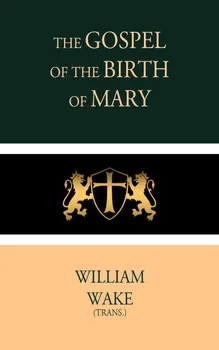
The Gospel of the Birth of Mary
Om denne bog
In the primitive ages there was a Gospel extant bearing this name, attributed to St. Matthew, and received as genuine and authentic by several of the ancient Christian sects. It is to be found in the works of Jerome, a Father of the Church, who flourished in the fourth century, from whence the present translation is made. His contemporaries, Epiphanius, Bishop of Salamis, and Austin, also mention a gospel under this title. The ancient copies differed from Jerome’s, for from one of them the learned Faustus, a native of Britain, who became Bishop of Riez, in Provence, endeavoured to prove that Christ was not the Son of God till after his baptism; and that he was not of the house of David and tribe of Judah, because, according to the Gospel he cited, the Virgin herself was not of this tribe, but of the tribe of Levi; her father being a priest of the name of Joachim. It was likewise from this Gospel that the sect of the Collyridians established the worship and offering of manchet bread and cracknels, or fine wafers, as sacrifices to Mary, whom they imagined to have been born of a Virgin, as Christ is related in the Canonical Gospels to have been born of her. Epiphanius likewise cites a passage concerning the death of Zacharias, which is not in Jerome’s copy, viz.: “That it was the occasion of the death of Zacharias in the temple, that when he had seen a vision, he, through surprise, was willing to disclose it, and his mouth was stopped. That which he saw was at the time of his offering incense, and it was a man standing in the form of an ass. When he was gone out, and had a mind to speak thus to the people, Woe unto you, whom do you worship? he who had appeared to him in the temple took away the use of his speech. Afterwards when he recovered it, and was able to speak, he declared this to the Jews, and they slew him. They add (viz. the Gnostics in this book), that on this very account the high-priest was appointed by their lawgiver (by God to Moses) to carry little bells, that whensoever he Went into the temple to sacrifice he, whom they worshipped, hearing the noise of the bells, might have time enough to hide himself, and not be caught in that ugly shape and figure.”—The principal part of this Gospel is contained in the Protevangelion of James which follows next in order.

Kom i gang med denne bog i dag for 0 kr.
- Få fuld adgang til alle bøger i appen i prøveperioden
- Ingen forpligtelser, opsiges når som helst

Unveiling The Gospel of Thomas : Secret Teachings of Jesus Explored

The Surprising Genius of Jesus : What the Gospels Reveal about the Greatest Teacher

the gospel of Saint Thomas

English Greek Bible №3

Forbidden Gospels And Epistles

The Causes of the Corruption of the Traditional Text of the Holy Gospels

Three Gospels

Retrograde Hebrew and Aramaic Dictionary

The Everything Women of the Bible Book: From Eve to Mary Magdalene--a history of saints, queens, and matriarchs

Expository Thoughts on the Gospel of John : An Aneko Press Christian Classic

English Dutch Turkish Bible - The Gospels II - Matthew, Mark, Luke & John

Light and Truth or Gospel Thoughts and Themes: Volume II: Gospels

Beowulf

The Bhagavad Gita - The Song Celestial :

The Ramayana : The Lost Manuscript

12 Days Of Christmas : The Night Before Christmas

The Yoga Of Egyptian Book Of The Dead :

The Mysticism Of The Egyptian Book Of The Dead :

The Egyptian Book Of The Dead : The Complete Text

The Diamond Sutra : The Lost Knowledge Of The Buddha

Brama Samhita : The Eternal Veda

The Book Of Enoch :

Secrets Of The Buddha

Beowulf : The Original Manuscript