Om denne bog

In "Thus Spoke Zarathustra," Friedrich Nietzsche presents a philosophical allegory that journeys through the life and teachings of the prophet Zarathustra as he redefines morality, spirituality, and the essence of humanity. Written in a poetic and lyrical style reminiscent of biblical scripture, the text combines aphoristic narratives with profound philosophical insights, breaking free from traditional structures to explore themes such as the √úbermensch, eternal recurrence, and the will to power. As a pivotal work in existentialism and modern philosophy, it challenges the prevailing moral paradigms of the 19th century, propelling readers into a contemplative space where individuality, creation, and transcendence are paramount. Friedrich Nietzsche, a German philosopher and cultural critic, embodied the spirit of his time, grappling with the disillusionment of traditional values following the Enlightenment and the rise of nihilism. His experiences with mental health, personal trauma, and a tumultuous academic career fueled his quest for meaning and truth. Nietzsche's encounters with various philosophical traditions, coupled with his passion for language, are vividly manifested in this magnum opus, revealing his profound understanding of the human condition and existential inquiry. I highly recommend "Thus Spoke Zarathustra" to any reader seeking to navigate the complexities of existence, ethics, and individuality. Nietzsche's thought-provoking prose offers a rich tapestry of ideas that invite deep reflection and discussion. This unabridged edition presents the work in its entirety, ensuring that readers fully appreciate its nuanced arguments and the poetically charged style that solidifies Nietzsche's legacy as one of the most influential thinkers in Western philosophy.

Kom i gang med denne bog i dag for 0 kr.

  • Få fuld adgang til alle bøger i appen i prøveperioden
  • Ingen forpligtelser, opsiges når som helst
Prøv gratis nu
Mere end 52.000 mennesker har givet Nextory fem stjerner i App Store og Google Play.

  1. 4.0

    Således talte Zarathustra

    Friedrich Nietzsche

  2. Ny

    The Essential Ancient Wisdom Library : 10 Timeless Classics of Stoicism, Philosophy, Strategy and Self-Mastery

    Marcus Aurelius, Seneca, Epictetus, Laozi, Plato, Sun Tzu, Miyamoto Musashi, Niccolò Machiavelli, Friedrich Nietzsche, James Allen

  3. Ny

    The Essential Ancient Wisdom Library : 10 Timeless Classics of Stoicism, Philosophy, Strategy and Self-Mastery

    Marcus Aurelius, Seneca, Epictetus, Laozi, Plato, Sun Tzu, Miyamoto Musashi, Niccolò Machiavelli, Friedrich Nietzsche, James Allen

  4. Ny

    The Essential Ancient Wisdom Library : 10 Classics of Philosophy, Strategy and Self-Mastery

    Marcus Aurelius, Seneca, Epictetus, Laozi, Plato, Sun Tzu, Miyamoto Musashi, Niccolò Machiavelli, Friedrich Nietzsche, James Allen

  5. 4.0

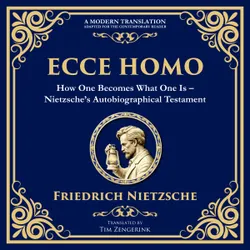
    Ecce Homo : How to Become Who You Are

    Friedrich Nietzsche, Tim Zengerink

  6. 3.0

    2000 Final Quotations

    Marcus Aurelius, Jane Austen, Buddha, Anton Chekhov, Cicero, Emil Cioran, Confucius, Albert Einstein, Anne Frank, Mahatma Gandhi, Johann Wolfgang Goethe, Carl Jung, Immanuel Kant, Friedrich Nietzsche, Marcel Proust, Arthur Schopenhauer, William Shakespeare, Baruch Spinoza, Leonardo da Vinci, Laozi

  7. 3.0

    Classic Philosophical Works (Thus Spoke Zarathustra, The Apology of Socrates, Tao Te Ching...)

    Plato, Friedrich Nietzsche, Herman Hesse, Leo Tolstoy, Immanuel Kant, Sun Tzu

  8. The Portable Nietzsche (Portable Library)

    Friedrich Nietzsche

  9. Ny

    Ecce Homo

    Friedrich Nietzsche

  10. Ny

    Ecce homo

    Friedrich Nietzsche

  11. Ny
    3.5

    Beyond Good and Evil

    Friedrich Nietzsche

  12. 50 Clásicos que Debes Leer Antes de Morir : Un viaje literario por los tesoros de la literatura universal

    Dante Alighieri, Aristóteles, Jane Austen, Charles Baudelaire, Giovanni Boccaccio, Anne Brontë, C. Collodi, James Fenimore Cooper, Fedor Mikhaïlovitch Dostoïevski, Arthur Conan Doyle, Alexandre Dumas, José de Espronceda, Gustave Flaubert, Sigmund Freud, Benito Pérez Galdós, Kahlil Gibran, Johann Wolfgang Goethe, Victor Hugo, Thomas Hardy, Nathaniel Hawthorne, Vicente Blasco Ibáñez, Washington Irving, James Joyce, Mariano José Larra, Jack London, Federico García Lorca, H.P. Lovecraft, Antonio Machado, Gustav Meyrink, John Stuart Mill, Amado Nervo, Friedrich Nietzsche, Solomon Northup, Alexander Sergeyevich Pushkin, Francisco de Quevedo, Walter Scott, William Shakespeare, Robert Louis Stevenson, Harriet Beecher Stowe, Jonathan Swift, Mark Twain, Miguel De Unamuno, Ramón María Valle-Inclán, Julio Verne, Virginia Woolf